


We’re not naturally bug-phobic, but when they eat our food, clothes or boat, something needs to be done. Since we don’t like heavy doses of pesticides in a space as small as a boat, let’s first look at low-impact approaches that focus on specific pests. After that, we’ll look at the more potent approaches.
Of course, prevention is the best medicine here. Washing produce before it comes aboard will keep tropical critters like the biting molokau centipedes on land rather than aboard. Get rid of cardboard containers as well—they can harbor cockroach eggs. But if bugs are already present, read on.
Specific Pests
Grain Weevils
We described in detail the treatments for grain weevils here, so we won’t repeat those tips.
Spiders
Fundamentally, we’re both on the same side. They eat insects. However, at some point they become annoying. The best way to remove them from the cabin is to eliminate their natural food source by eliminating insect pests. Because they are at the top of the food chain, they are more susceptible to pesticides than most insects, so any pesticides applied for insects will probably kill the spiders.
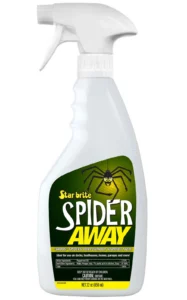
At certain times of year and in certain areas, spiders can descend on the wind, each predator dangling from a single thread of silk. The lifelines create a natural framework, and the breeze delivers a steady supply of mosquitoes and small flying insects. The dark corners of the cockpit are naturally attractive to no-web spinning spiders.
There seems little point in trying to poison them on deck; fresh ranks arrive daily. But repellents have proven reasonably effective, at least in the cockpit and around the companionway. We’ve used Star brite Spider Away with considerable success, focusing on dark corners and the edge of the companionway. They are less effective on the lifelines, but if you go sailing, the wind and spray will generally take care of that.

Ants
Because they need a fresh water source, these are typically only an issue on the hard or when there is fresh water in the bilge. Eliminate the water source.
If they persist, we found Terro Liquid Ant Bait trays to be quite efficient. Some of the ants will die in the tray or in the immediate vicinity, but others will carry the poison back to the nest, eliminating the nest. They should be placed as close to the nest as practical and where the ants run. If there are small children or pets on the boat, locate them so that they are inaccessible.
Fruit Flies
The simplest cure is prevention. Keep fruit either in a basket draped with netting or in a net laundry bag. Monitor your store rigorously for signs that something is getting overripe and eat it first.
In a house, vinegar traps and sticky paper work. But a brisk sail with the hatches open usually blows them out, if there is no overripe fruit to hold them. At night, a vacuum cleaner is quite effective at collecting the flies and mosquitoes that gather around cabin lights (after you put the netting up).
Bees and Wasps
Prevention is best. Seal up holes, particularly in spars. Try to remove the nest at the very beginning, when they are relatively harmless.
The best answer for a bee’s nest is a beekeeper. Most of the bees in the Caribbean and Mexico are Africanized; they get mad, swarm and don’t stop stinging. The keeper will move the queen to a box, along with some comb, wait for the workers to return in the evening, and remove the box after dark. Try moving the boat mid-day; the workers that are out will be unable to find the boat-repeat as needed.

Roaches
We’re a fan of boric acid and borate-based cleaners such as Formula B (“Homemade Mildew Preventers That Really Work“), in part because they are effective biocides, but also because bugs hate them. Thus, a little boric acid in the pantry makes sense to us. The roaches do not eat it directly, but it does get on their legs, and when they clean themselves, they die.
When borax-based cleaners have not worked, we’ve found that either Terro Liquid Ant and Roach Bait trays are effective, sometimes using both.
Termites
Cabinet damage is bad, but if they get into the glassed-in wood, the boat may become a total loss in short order. Bug bombs don’t work—the galleries are too deep. DIY injections are sometimes effective against minor infestations, but often as not, they fail to reach the whole colony.
Our advice is to act immediately; while you fiddle around with do-it-yourself solutions, the bugs are chewing wood and devaluing your investment. Better to admit that it’s time to call in the professionals.

Eco-Friendly Insect Weapons
Freezing
In northern climates, freezing the boat at temperatures below 10 F (-12 C) for a week or more is fatal to nearly all bugs and their eggs. Yes, native insect populations survive the winter, but they do this by burrowing deep in the ground or into trees, avoiding the most severe cold.
The effectiveness varies with the year, but if you live in snow country, hauling out for the winter is a proven solution. This is less effective if the boat stays in the water, since the water moderates the cabin temperature, preventing it from going far below freezing.
Cook Them
If you seal the boat and turn on a space heater, that alone should move the temperature well over 100 F (38 C). Adding more electric space heaters—make to monitor them frequently for safety)—and you can easily drive the temperature to 130 F (54 C) for the afternoon.
An infrared thermometer should help you monitor the process. In extreme cases, tenting the boat may be required. Unfortunately, the boat will need to be hauled, since the water cools the hull. Remove all electronics.
Dehumidifier
Few bugs can thrive in truly dry air. Get the boat really dry. There must be zero water in the bilge, not a single drop. This is also good to do before heating the boat, as described above.
Carbon Dioxide
To be effective, the CO2 level must be maintained above 40 percent over 7 to 15 days in order to kill every type of insect. That means a 35-ft. boat would require 150 lb. of dry ice (the simplest means of delivery). Even then, it won’t always reach termites that have burrowed deep into the wood.
Extreme caution must be taken when reentering a space fumigated with CO2. Fans should be used aggressively to ventilate each space in stages, before progressing. The main cabin should be cleared by a fan in the companionway for at least 30 minutes, followed by ventilating each of the cabins and lockers in progressive order.
Do not remain in the boat for more than a few minutes until it is well ventilated. Don’t forget the bilge. CO2 levels above 4 percent will cause headaches and loss of balance; above 8 percent can result in loss of consciousness in a few minutes
Pesticide Methods

Bug Bombs
These contain cypermethrin or N-octyl bicycloheptene dicarboximide. These are generally effective against everything, although bugs have been known to develop resistance after repeated use. They are not effective against termites because they burrow too deeply.
Because they contain flammable solvents, disconnect the battery and shore power, and do NOT exceed the recommended application rate. Ventilate before reentering.
Gas Fumigation
Whole-boat fumigation is the only reliable method to eliminate termites, and there is only one anti-termite fumigant in common use: Vikane gas (sulfuryl fluoride). Because it is a gas, Vikane does not leave toxic surface residues, so dishes, clothes, cooking utensils, equipment and other items do not need to be washed following fumigation with Vikane. Vikane is odorless, so chloropicrin is added (tear gas-like) to provide warning of exposure. (Remove or double-bag food, because it will get nasty.)
It’s not cheap. Expect to pay $1,500 to $8,000 depending on the size of the boat and the complexity of the problem. The contractor will fully tent and seal the boat. After waiting two to three days, they will extract all of the gas with suction fans reaching into the bilge and all enclosed spaces. Workers typically wear full protective equipment, including supplied air respirators. For the process to be both safe and effective, it must be executed meticulously.
Conclusions
To prevent infestation, you need to think like an insect. What attracts me? What do I need to live? Does it change throughout my life cycle? What is deadly to me? Remember, that includes environmental conditions, not just poison. We’ve been invaded a few times by pretty much everything, but most of the time low-impact solutions work.
Let us know in the comments: What methods work best to keep your boat bug-free?
This article was originally published on July 15, 2019, and has been updated.










I use a heavy duty ant/roach spray along all floor to whatever joints. Crawling insects crawl thru the residue and they die. I don’t have crawling bugs.
Flying ones another issue. A fly swatter takes care of them
What about simple but awful Bed Bugs ? Sh-t happens, what is best way to prevent and treat it ? Also maybe some tips on dealing with wasps and biting black flies so common in the Aegean and elsewhere ? thank you
In South Florida we have a roach mantra: No cardboard comes aboard! They lay their eggs in it and love to eat the glue…even on labels…peel them and wash off the glue. So we unbox EVERYTHING…cereal, beer cartons…EVERYTHING! Best rule EVER.
Then we use borax in hard to reach places – kills all the crawlers dead!
So best defense is to NOT bring them aboard. Not been a problem in the 25 years since we adopted this. Rats…well…another issue as those buggers can fit through small openings and eat through screens. ICK.
I use an ionizer occasionally. It also helps with orders. Rich in Lorain, Ohio