

Sail America’s mission is to “promote the health and growth of sailing.” Thus, you’d think alarm bells would be going off there given that the trade group’s most recent annual “Economic Outlook Report” included some rather grim data.
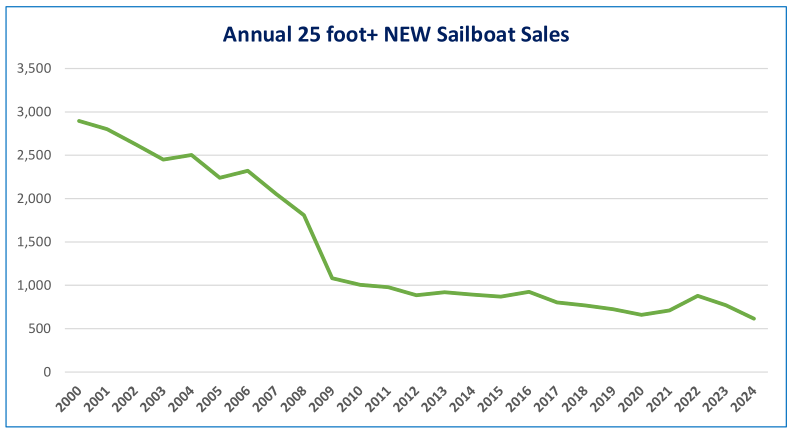
Most concerning, sales of new sailboats in the U.S. decreased by 20 percent from 2023 to 2024 to just 616 boats 25 feet and larger. What’s more, this 2025 report, released at last year’s Annapolis Sailboat Show, noted that this sales decline continued a steady downward trend reported by the group since 2011.
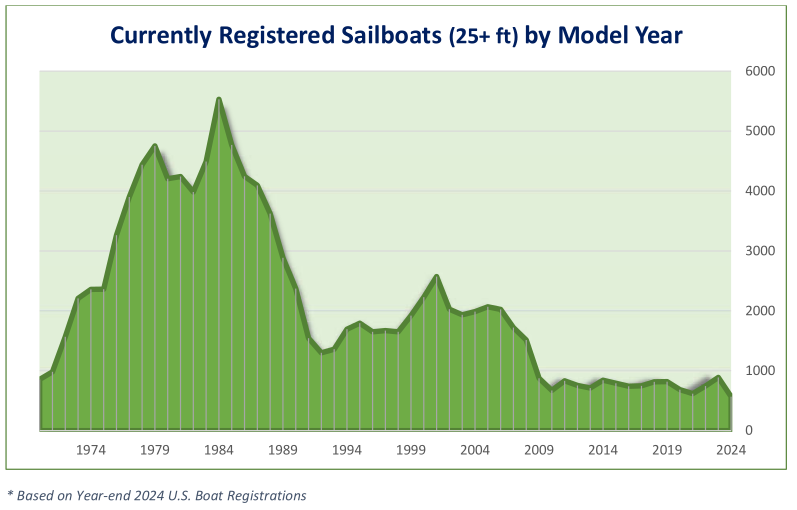
Encouragingly, 11,100 used sailboats of 25 feet and up sold in 2024, but even that figure was down by 12.6 percent. The fleet of 25-foot-plus sailboats now registered across the U.S. totals 121,876 boats. As shown below, a look at the model years of those boats serves as a reminder that the glory days of sailboat building, whether by U.S. or non-U.S. manufacturers, seem to be behind us.
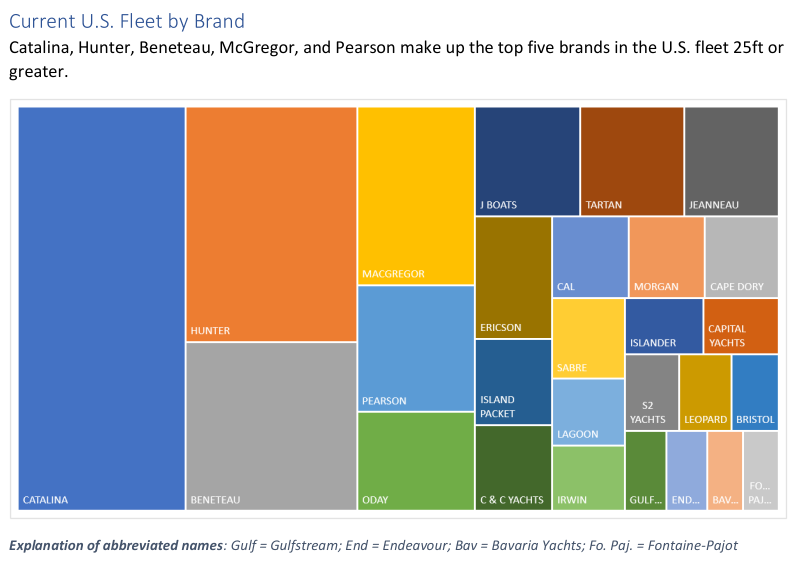
The decline of U.S.-based sailboat manufacturing became all the more apparent in 2025 with the permanent closure of Com Pac Yachts and a halt in production at one-time industry leader Catalina Yachts after a failed acquisition (see “Is U.S. Sailboat Manufacturing Facing Extinction?”). As shown below, a look at the current fleet of registered boats by brand is studded with the names of North American manufacturers that have long since gone out of business, including, in order of production numbers, Hunter, Pearson, O’Day, Ericson, Cape Dory, and C&C Yachts.
So is there concern within Sail America and, if so, what can a trade association with a modest budget and led by member volunteers do to change the course of the industry? We interviewed Adam Cove, now serving in his second year as president of the group, to ask about the data and what Sail America is doing to promote sailing.
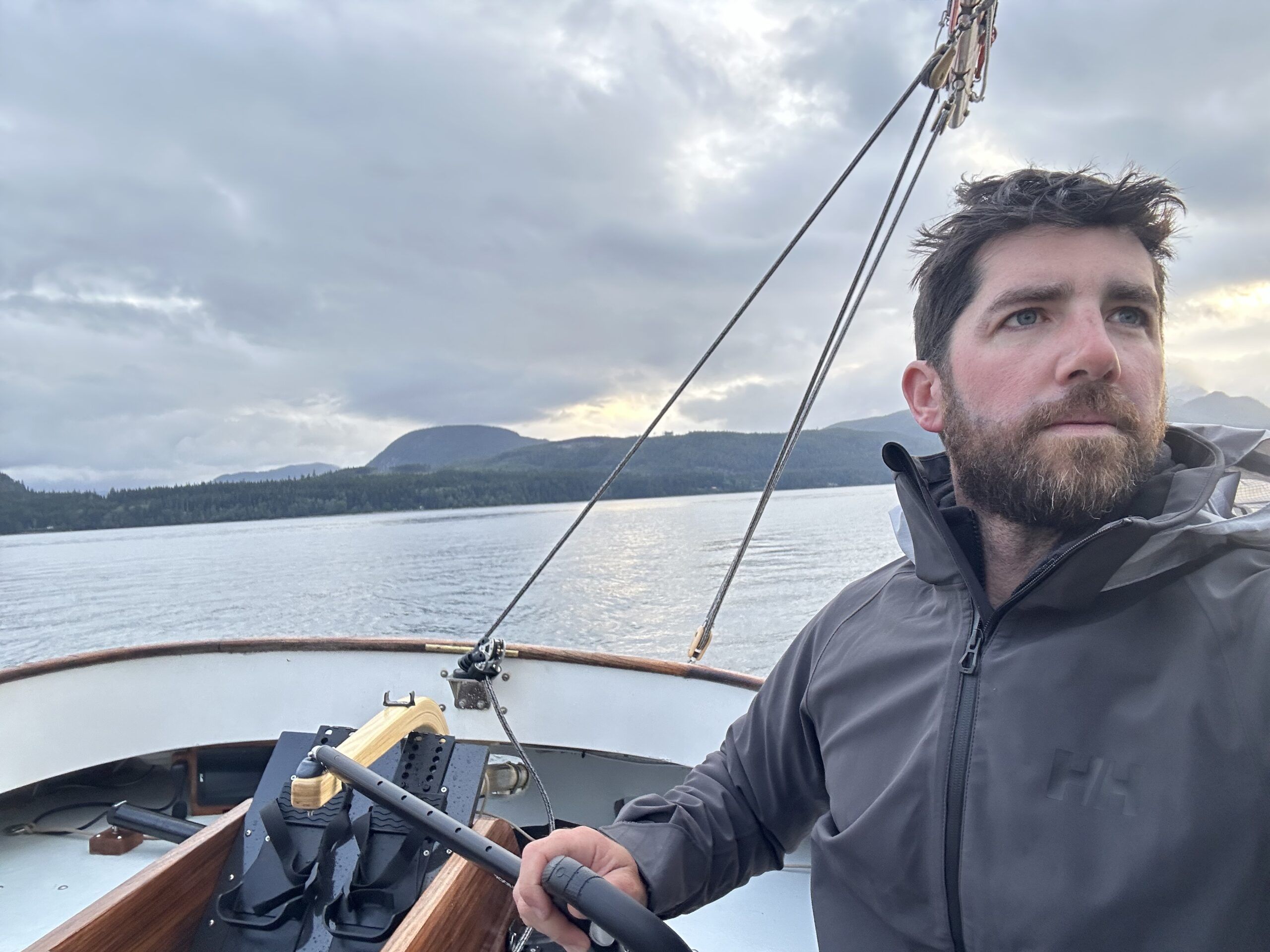
Hailing from New Bedford, MA, Cove, pictured above during his 2024 participation in the R2AK (Race to Alaska), recently led a group that acquired sailboat steering system and pump manufacturer Edson, where Cove previously served in a variety of executive roles including CEO from 2016 to 2021. Cove has a background as a yacht designer, boat builder, rigger, and sailing instructor, and he’s also a contributor to Sail Magazine.
Practical Sailor (PS): Can you summarize Sail America’s mandate and who, exactly, it represents?
Adam Cove (AC): Sail America represents anyone within the sailing industry. We have brokers as a part of our group, sales reps, equipment manufacturers, boat manufacturers, publications, sail makers… It’s really pretty widespread and it goes from one-man bands all the way up to the largest companies in the industry.
PS: Do they have to be U.S.-based?
AC: No. We have some international companies, like, Barton Marine, for example, that are members, but it’s typically businesses that are either based in the U.S. or doing business here.
PS: Is it about promoting the U.S. sailing industry or sailing in general?
AC: We are focused on promoting and helping the sailing industry in the U.S. They go hand in hand. If we were not to support sailing itself, everything would kind of all fall apart. In order for the industry to be successful, sailing has to be successful, but we are not a consumer-facing organization.
A Question of Industry Health
PS: According to Sail America’s Economic Outlook Report 2025, new boat sales have steadily declined since 2011 – down to just 616 new, 25-foot-plus boats sold in the U.S. in 2024. About 11,000 used sailboats in that size range were also purchased, according to the report, but those sales were down more than 12 percent. What’s your view of the health of the sailing industry?
AC: I’ve been a boat builder, I’ve been a sail maker, I was a rigger and I was even a yacht designer for a while. I pretty much have worked in just about every part of the industry. I don’t think it’s fair to judge the health of the industry just in one area, like new boat sales, because there is so much more depth to it. If you look at the most successful boat builders and boat yards, they have great service programs. That is what has continued to sustain those businesses through the highs and the lows. They’ve done very well by having that ability to diversify.
PS: Are there any examples you would cite?
AC: I would call Marshall Marine, in South Dartmouth, MA, an example. They’ve done a great job with their service side. Their customers absolutely love them. They have a dedicated following. Before I sailed in the R2AK (Race to Alaska) in an 18-foot Marshall catboat, I had no idea what the catboat following was all about. It is such a cool little niche. I mean, there are thousands and thousands of people in this country that absolutely love catboats.
It’s amazing the niches that you can build, and that happens with small boats, too, whether it’s Vipers or N-10 Turnabouts, or Thistles. These classes are pretty old, but I have seen some of them coming back and revived. When you start to see those things happening, you know there’s a future for the sport. I go to some of these meetings and there’s a fair number of young people there.
PS: Trade organizations such as the National Marine Manufacturers Association, which focuses on power boats, are quite concerned about the big baby boomer generation aging out of boating, so they’ve launched a Discover Boating program to promote the boating lifestyle rather than focusing on just selling more boats. What’s your take on the demographic trends?
AC: So the baby boomer generation retires and, you know, passes on some inheritance to the next generation. I see [the next generation] investing in boats again, but it might not be new boats. Maybe we’re doing more with the used boats that are out there. Maybe we’re just being a little smarter about when new boats might fit and when they don’t, and when a refit might make more sense.
The Case for Small Boats
PS: Some say too many builders have followed existing customers up into bigger boats and have given up on smaller, more affordable boats. Has affordability been discussed within Sail America?
AC: We certainly have. Used boats can certainly help to solve that, depending on the amount of work people are willing to put in themselves. It allows people to be a little more incremental with the investment, even if they are having a yard do the work. But the other thought within the [Sail America] board is that if we get more adults—young adults—into small boats, that also solves the affordability issue.
I spent some time living in Southampton, England, and there’s a huge small boat following in that country. It’s so cool, and I think we need more of that in the U.S. I can’t speak for everyone on the board. Not everyone loves small boats, but we are all very passionate about sailing. Some people prefer their bigger boats, but I think everyone has a love for sailing and growing the sport, and I think it comes down to kind of whatever it takes to make that happen.
So it’s not just new boat sales or used boats. Maybe it’s small used boats, like Thistles, or something like that, that can be put in a garage and fixed up over the winter. Maybe someone’s buying a boat for a couple thousand dollars, maybe less than a thousand. But they are stimulating the industry because maybe they need new blocks and cordage and rigging and sails, so those areas start to benefit. All the more reason that our organizations need to be a little more diversified in what we offer.
The Data Gap Below 25 Feet
PS: Speaking of small boats, why does Sail America’s industry data start at 25 feet and higher?
AC: The reason is that if you look at states like Massachusetts, for example, you’ll find that the smaller boats, if they don’t have engines and they’re purely sail, they’re not required to be registered, so that data isn’t available. The only way to capture that would be for boat builders to volunteer that information, which they have been fairly reluctant to do.
PS: I’d wager that most states now require registration of anything over 10 to 12 feet or anything with an engine.
AC: Michigan, for example, even requires you to register 17-foot sailing dinghies. But in Massachusetts, you could have an 18-foot sailboat with no registration required.
PS: Have you revisited this state by state, because looking only at everything above 25 feet is like cutting yourself off from understanding future buyers and the total boat market. Small one-design boats without engines are one thing, but how many of us learned to sail on 18-, 22- or 24-foot boats? There are huge numbers of them out there and they are very likely to be registered.
AC: I agree and [small sailboats] are important to all of us. The fact that they’re omitted from the report does not mean that they’re not important, it’s just the ability to track that information. We have not found a good way to do it or, I should say, an economically feasible way to do it.
Start Sailing Now Program
PS: How is Sail America addressing the importance of small boats and entry-level sailing?
AC: One of the big topics during our industry conference last year, in terms of idea generation, was how we can grow the sport. How are we going to keep it alive? Not just getting kids, but getting adults into small boats again. We had deep conversations into that.
PS: And what was the outcome?
AC: The big thing that we launched this past year was a program called “Start Sailing Now.” We loved what was happening at the Annapolis Sailboat Show with their “First Sail” workshops.
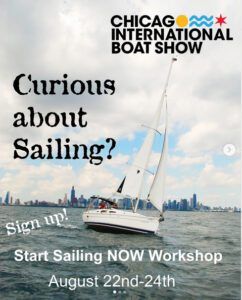
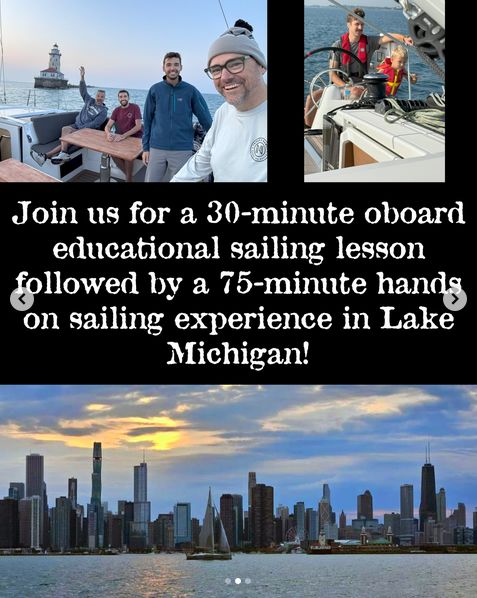
[First Sail offered 45-minute classroom sessions followed by 90 minutes of instruction aboard a Beneteau First 22. Presented by the American Sailing Association, the class was $65, but that included free admission to the Annapolis Show and a one-year membership to BoatUS, and the program sold out.]Sail America promotions for the Start Sailing Now program held at the Chicago International Boat Show in 2024. Similar programs are being planned for 2026. Images/ Sail America and Instagram
We launched our Start Sailing Now program at the Chicago International Boat Show. It’s very much like the Annapolis program and we’re pushing it out through the boat shows as well as within Sail America. The program is for people who are interested in learning about sailing but maybe have been too scared to go out. This gives them an opportunity to do a short classroom session followed by an instructional session on the water. We did it taking six people out at a time aboard a 35-foot boat with a captain. It was a pilot program, but at this point we’re scheduling it for 2026 shows because it sold out within a couple of weeks.
PS: How many people went through the course?
AC: We ran the pilot program for three days at the show and had nearly 70 people. We realized that if we can add more boats we can get more people out there. If we had three boats, all of a sudden you can have 200-plus people go out… These are highly valuable leads for the industry. Those people aren’t necessarily going to go buy a 40-foot boat right away, but maybe we can get them into small boats?
PS: What’s the next step? How do you get those people into boats?
AC: We’ve been pushing a couple different directions, including chartered experiences and sailing schools. We’re looking to our membership first to try to help them out.
PS: Was that pilot program sponsored by Sail America, or was it a member organization?
AC: We had three sponsors. One was SailTime [the fractional boat ownership franchise], which provided the boat and the captain. Yanmar and Superior Charters were also sponsors.
PS: Is Sail America going to be expanding Start Sailing Now in 2026?
AC: Absolutely. It’s very scalable, and I think it’s a fun activity for the community. We know sailing has its obstacles to get into, and I think one of them is just getting out there and trying it, right? We’ve certainly built up barriers. I mean, people see these yacht clubs, and they’re exclusive, and it’s tough to even walk through the front gates. So how do we kind of break that down a little bit and say, “All are welcome. We’d love to have you out there, too.”
Looking Ahead: Conference and Quarterly Data
PS: Are there any other initiatives that Sail America is pursuing in 2026?
AC: I think we’ve recognized that we need to do work as an organization to earn the industry’s respect and to earn their membership. During last year’s Sail America conference we took recommendations from our members, and in addition to coming up with programs to get more people into sailing, another thing on their wish list was more timely data on the state of the industry. So this year we’re going to start sharing our economic outlook data in quarterly reports.
PS: I take it boat and equipment manufacturers would be most interested in that?
AC: Yes, very much so. By the time our annual report came out, some of that data was a year old— some of it even older. So by coming out quarterly, we can just be a little fresher with the data and allow companies to be more reactive.
PS: Are there other things that Sail America is up to that are important to note?
AC: The one thing that we have continued to do—and that is really a focus for us—is the Sail America Industry Conference. We host it every spring, and this year it’s going to be March 25 and 26 in Newport, Rhode Island.
The Conference is where we get the industry together. It’s an opportunity for everyone to network and have a little bit of fun, but mostly to walk away with a return on investment for attending and to become inspired.
PS: Are there things on the agenda, speakers or sessions, that really speak to the issues we’ve been talking about?
AC: We’ve recruited experts from within and outside our industry to share how we can grow our businesses. Artificial Intelligence (AI) is also relevant these days. There are pitfalls as well as advantages in AI, so we need to be careful and aware of when to use it and when not to use AI. There are some potential strategic advantages that AI might provide, so that’s going to be discussed across a couple of presentations.
There’s also an opportunity to work with US Sailing [which runs the US Olympic Sailing team and is the governing body of sail racing rules in the US, working with World Sailing]. They’re going to give us an update on what’s happening with their new mission and how they’re going to be supporting sailing. They want to grow the sport and make racing more accessible with support for instructors and lessons. US Sailing’s chief operating officer, Andrew Clouston, is on our board, so it will be very easy for the two groups to work together…
A lot of the strength of Sail America is not necessarily within Sail America itself, it’s within all of our members. It’s the collective advertising and influence that we can bring to bear. If you look at just [social] followers for Sail America, it’s kind of small. When you start to add all the followers for Sail America members—all of us together—we can have quite a massive impact.
Conclusion
For those interested in joining Sail America or supporting (yet-to-be scheduled) “Start Sailing Now” programs in 2026, visit the Sail America website. To join the March 25-26 Sail America Industry Conference in Newport, RI, visit the information and registration page.








Interesting. I noticed that smaller boats disappeared from the boat shows just about 2010-2015. Other than dinghies, I think the last Annapolis show had maybe three boats smaller than 30 feet, and two of those were folding trimarans.
Another challenge is that fiberglass lasts. Bad for manufacturers, but good for beginning sailors … except that manual fix-it skills and the requisite interest, I think, are in decline.
But I honestly think the difference is a fundamental change in how we approach adventure. We want fake adventure on the internet. My other hobby is rock climbing/ice/climbing/mountaineering. The climbing gyms and some of the roadside crags are busy. There are classes, which there did not used to be. But the number of climbers in the mountains is way down from 90s. It seems that the people who take the classes have had their little taste of adventure and are done with it. The itch is scratched. I don’t think classes and programs actually lead to long-term interest. Almost the opposite, based on my experience with climbers.
There are many adventure sports in decline. The idea of tying up money in a boat or house, and the pride in ownership that comes with that, are declining. You can’t fix the old boat with AI.
Change is OK. It will happen anyway.
Good points, Drew. Small boats are still out there. At the Annapolis show Marshall Marine had a 23’ Sakonnet and, I believe, a 15’ or 18’ Sandpiper cat boat. J/Boats had the 22’ J/7. Flying Scot had their (19’) daysailor there. Aero had the Sunfish and Sole (both 13.5’). Saffier had at least two high-end small boats there.
Many smallish one-design classes (e.g., Melges and Lightning) are going strong, but you don’t see those at shows. They’re in yacht club and boat club fleets.
I see cost as the real limiting factor for sailing, but there’s a pretty vibrant trailerable scene. You can work on them in the garage or driveway and avoid the marina costs. It’s a K economy with the few rich folks buying the new and bigger boats and the masses opting for affordable used and trailerable boats.
The younger generations income potential has been plummeting for twenty years. Cannot sell boats to a economic class that no longer exists.
I totally agree. You are echoing my point on the “K” economy in my response to Drew, though with an emphasis on the plight of up-and-coming generations.