

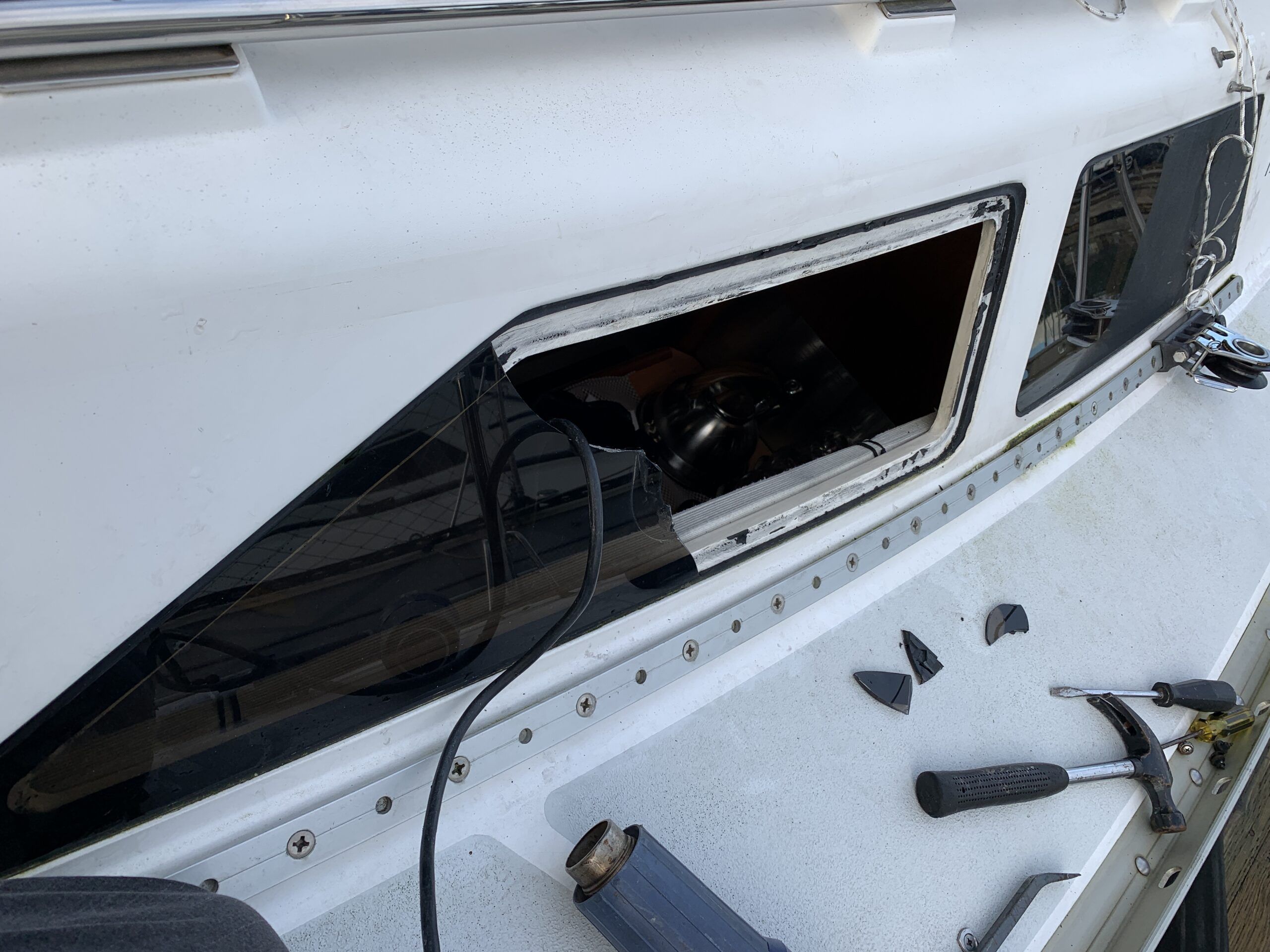
Many coastal cruising production sailboats designed during the heyday of the 70s and 80s emerged from the factory with plexiglass cabin windows. These larger-than-standard portlights allowed copious amounts of light into the cabin. Plexiglass windows were inexpensive, easy to install, and safe for boats not constructed for the rigors of ocean sailing. Different manufacturers mounted these windows in a variety of ways. Molded plastic frames as a one-piece unit or assembled aluminum frames were a favorite, or they were simply set into a shallow recess in the cabin trunk with an adhesive/sealant.
To continue reading this article or issue you must be a paid member. Sign in

Join Practical Sailor
Get full access to Practical-Sailor.com – more than 4,000 articles – for just $34.
Join today and save 42% off our full price.





In fact, acrylic is very slightly stronger and stiffer than polycarbonate. Polycarbonate is about 20 times more impact resistant, and acrylic resists UV damamge about 2-5 time longer, depending on coatings. I don’t think the choice was typically to save money, but rather just a matter of philosophy; which matters more, impact or haze resistance? If thick enough acrylic is strong enough, and virtually all opening hatches are acrylic. But I did crack a lens once by dropping an anchor on it (yup–that will about do it–didn’t take much).
If the prior window was installed using VHB tape (likely) a heat gun, a not-too-sharp scraper, and leather gloves will be your companion for hours. It’s the only practical way. Expect to apply heat just short of the softening point of the gelcoat. If you taped the perimeter the tape will likely melt if you are careless, so keep an eye on the that.
See “PS Tests Adhesive Removers,” December 2016 for the best solutions to remove silicone. Remove Marine Formula is many times more effective on silicone than any solvent. DeBond is for polyurethanes. A solvent wipe or water wash at the end is good, but let the removers do the heavy lifting. Read the instructions; they make a difference. Don’t just spray and wipe and expect them to work properly.
I recommend using VHB tape to secure the window. Most builders do it this way. Then fill the gap with sealant (use spacers around the edges). Butyl tape provides no retension and is not typically used for windows, only hardware that are secured with through bolts. Butyl tape has also been documented to cause crazing of acrylic windows. Hit or miss, depending on the formula. Avoid it for windows.
Dow 795 is the preferred sealant, at least in the US. No primer required, glazing specific, and also much easier to use neatly than polyurethanes. Very long life. PS testing has revealed the sort comings of polyurethanes for glazing, and the absolute necessity for using the specified primer (otherwise the UV attacks the bond through the glazing and the window can leak withing a year or so–the primer is opaque and prevents this).
See also “F-24 Portlight Replacement,” September 2023 for a different expereince. I’ve never replace framed fixed windows, only opening hatch lenses and frameless windows.
Thanks Drew! Your information is most helpful. I’ve read your articles for years and appreciate your extensive knowledge. I did not know about the DOW 795 and have never seen it in a marine hardware store. Another lesson learned along the way! I’m currently refurbishing the Bomar hatches on a Pacific Seacraft 37 and will give that a try. Thank you!
Excellent piece Drew – but would be very helpful to get advice on best way to fix crazed/scratched plexiglass to prolong life of existing ports (on a 2006 Sabre 386) – which are badly scratched, probably from having used paper towels to clean in the past. Getting mixed messages from different sources on fixes.
Hello Basil. Thanks for the comment. I’ve had very limited success with the standard headlight cleaning kits available at most automotive shops. But it only clears fine scratches and haze, doesn’t do anything for your typical scratches. The crazing is internal and, as far as I am aware, is not repairable. On my Islander the windows were replaced in 2004 and, due to crazing, need replacing once again. Sabre 386s are great boats! I sailed Maui to Victoria on one in 2016, great trip. I look after the boat for a non-resident owner but have not seen any crazing on the portlights yet. Lets see if Drew has any helpful hints.
Crazing is internal and unrepairable. The best cure is prevention by covering windows.
Buffing can work for surface damamge. Start with a coarse compound and work your way down. On my last boat the big ports crazed and the only solution was replacement. Same with my F-24. But small opening Beckson ports on my PDQ responded well to polishing once a year.
If there are sealing problems (leaks) buffing will almost certainly lead to replacement.
On a slightly different topic, do NOT buff solar panels. PS has posted on this. The action, whether machine or manual, results in micro cracking of the cells, to small to see but enough to cause a dramatic drop in output either immediate or within 6 months. The haze of the cover sheet scatters light but does not actual reduce light transmission that much (PS did some testing of that too). Just keep them tolerably clean, and a light waxing helps both hazing and by repelling dirt.