


Careful Application Saves Your Sanding Arm
Epoxy fillers can be used to fix surface imperfections or for reshaping appendages like keels and rudders to make them more efficient. The smaller the surface imperfection, the less viscous the fairing compound should be. When filling deeper holes or voids, check the manufacturers recommended thickness per application. It may take two or more coats to achieve the necessary thickness. Applying filler too thickly can cause it to sag or will result in an incomplete cure.
Fairing the Keel(s)
One of the more popular uses for fairing compounds is for shaping underwater appendages like keels and rudders so they are more efficient. Adjusting the NACA (National Advisory Committee for Aeronautics) profile, or airfoil shape, of a fin keel or rudder can create more lift to enhance windward performance. Altering the trailing edge can yield similar improvements.
Troubleshooting Marine Battery Issues
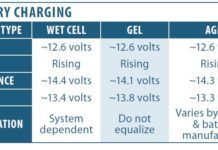
Ive had a bunch of friends troubleshooting battery issues lately. It would be really nice to have a chart that shows the battery voltage at rest and charging voltages for bulk/acceptance/float for lead/acid (flooded cells), gel cells, and AGMs.

Where Credit is Due: Ideal Windlass and Marinco
Our 20-year-old Ideal windlass seemed a bit wimpy last fall, so we pulled it and took it back to the Ideal (www.idealwindlass.com) factory in Rhode Island for a rebuild. What a place! It looks like a set for a Charles Dickens movie. However, the work is great, and the windlass now seems to work as good as when it was new. The work was on time, and the cost was about a 10th of the price of a new one.

Riprap & Product Updates: Safety Alert, Jeppesen Sold to Digital Marine, and More!
If you have a handheld NAMMO LIAB AB orange smoke distress signal onboard or in any of your ditch kits, remove it immediately. The U.S. Coast Guard (USCG) recently announced that it has withdrawn its approval for the smoke signal, and it is now considered a Do Not Use product by the Coast Guard. According to a USCG safety alert, the manufacturer changed the signals chemical makeup in October 2013, without Coast Guard approval, and the current signal might spontaneously combust when dropped.
An Eye for Seeing Storms
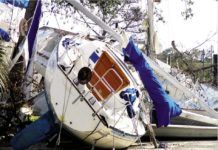
The news editor was old-school, skeptical of almost everything, so I was surprised when she dropped an envelope on my desk postmarked Fort Collins, Colo. Hurricane season forecast, she said. Make some sense out of it. Hes either lucky as hell, or knows something that the rest of us don't.
Through-bolting Fiberglass: An Inquiry into Failure Modes
How much load does a keel bolt or a winch through-bolt put on a hull or a deck? How thick should the laminate be at these bolt holes? How big of a backing plate is needed?
Sewn Splices Two-Year Followup
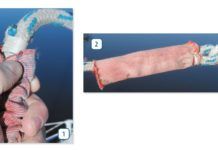
The true test of marine gear is not whether it works when installed, but rather how it functions after years in the field. To that end, we have left samples of sewing materials and sewn test samples in the sun, wind, rain, and snow for two years, and have also sailed with sewn samples in service on our test boat.
The No-sew Webbing Strap with Link Buckle
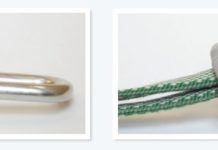
Weve sewn our fair share of eyes in nylon webbing, but heres an easy no-sew alternative for creating a webbing strap with a buckle (shackle) that can be used for easily lashing down the dinghy, a battery, or even holding up your pants in a pinch. It is based on stuff a sailor has on hand-webbing, a chain link, and a shackle-and is as strong as professionally sewn ends, plus it can be untied after loading. It has tested at greater than 85-percent breaking strength and 100 percent of minimum rate strength, and it works on both nylon and ultra-high strength materials like Vectran webbing.
Dustless Sanding
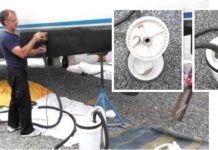
Responsible boatyard work requires dust collection. Whether its toxic bottom paint or ordinary sanding dust, it still makes a mess and can ruin a neighbors paint job-in-progress. Dustless sanders have hose connections leading to vacuum cleaners, but unless it is a sophisticated vacuum with multi-stage dust separation, those filters clog and dust flies.

O’Day 40 – A Budget Cruiser for the Bahamas
The O’Day 40 (1986) is one of those cruising sailboats that somehow slipped through the cracks of sailing history. Built during the final years...


Latest Sailboat Review
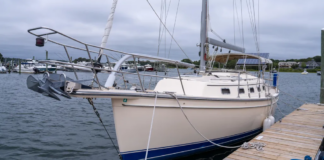
Island Packet Estero Used Boat Review
Florida-based Island Packet targets a relatively narrow niche, so the toughest competitors to its new boats are often older Island Packets. Introduced in 2010, the 36-foot, shoal-draft Estero is the company’s latest attempt to introduce a distinctive model that doesn’t stray too far from the company’s proven formula for success: moderate displacement, full-keel cruisers designed to be lived on, sailed far and in comfort, and endure the bumps, scrapes, and storms that cruising boats inevitably encounter. After sailing the Estero on Florida’s Sarasota Bay and inspecting its interior, construction, and systems, Practical Sailor testers noted that the shoal-water cruiser will appeal strongest to Island Packet fans who’ve been waiting for a shoal-draft, easy-to-sail boat that compares to the IP37 in terms of interior space. These strengths will be most apparent on intracoastal or riverine adventures like the Great Loop.