



Where Credit is Due: March 2016
I want to give praise to Doug Miller at Milltech Marine (www.milltechmarine.com), a supplier of everything related to AIS. For several years, I have used one of their AIS receivers hardwired to a small chartplotter. Recently, I wanted to upgrade to be able to send the AIS signals via Wi-Fi to my laptop. A few people suggested that Milltech had a dongle that would transmit the AIS data to my laptop, so I purchased the rather inexpensive unit. Being not very computer savvy, I couldnt get the thing to work, so I called Doug for help.
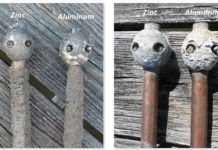
Which Anodes Work the Best?
A year from now, Practical Sailor will be reporting on sacrificial anodes, both zinc and aluminum, and how they performed in the salt waters of south Florida and the brackish waters of Chesapeake Bay. Sacrificial anodes are used to protect a sailboats exterior components from galvanic corrosion, a process during which more noble, cathodic metals like stainless steel cause less noble, anodic metals like aluminum to be eaten away by corrosion as they lose electrons.
Water-lift Muffler Advice
I want to build a stainless-steel water-lift muffler for my boat. The muffler will have a 2-inch inlet/outlet for a 15-horsepower OMC saildrive. What should the distance be from the bottom inside floor to the bottom of the outlet exhaust pipe?
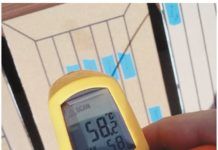
Maker Feedback Prompts Faux Teak Re-test
Our recent report on synthetic-teak decking options (see PS December 2015) raised a bit of a ruckus among the contenders in what is an extremely competitive market. The main bone of contention was our reported temperatures of the various materials after they were left in the sun. Several manufacturers reported that the temperatures we listed in the table accompanying the article were not consistent with their own findings.
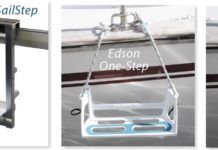
Search for Safe Boarding Boost
Anyone thats ever hopped on a Jacobs ladder at a fall festival can relate to the feeling of the rope-attached steps swaying wildly from side to side under your weight. Suspended boat-boarding steps can inspire that same unsteady feeling. Ascending the steps, which curve in along the chines of a boat, can throw a climbers center of gravity backward, away from the hull-possibly sending the climber into the drink.
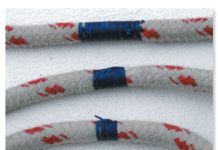
Fitting a Roller Furling Line
Replacing the roller-furling control line is an easy do-it-yourself job for the boat owner. Inexpensive, double-braid Dacron is a fine choice for furling lines on most boats shorter than 40 feet. On longer boats, you can opt for a furling-line material of more esoteric double-braids with less stretch. However, any line smaller than 3/8-inch diameter is too difficult to grip.
Treating Vinyl for Long Life
Vinyl protection is about the long run. In the Practical Sailor January 2014 issue, we reported on the performance of a host of clear-vinyl waxes and cleaners, as well as several different clear-vinyl window materials, after testing them for four months on panels. This report is the two-year update on the long-term test of those products, and already the first failures have appeared.
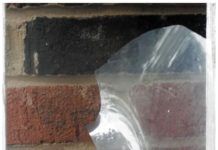
Long-term Testing Clear Vinyl
Our long-term test of clear vinyl and clear-vinyl treatments includes environmental outdoor tests with controls, as well as some real-world testing on one of our test boats.
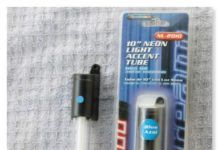
Do-It-Yourself: Seeing Neon Blue
There are simply too many white lights in and around a municipal anchorage. A required white anchor light must have 360-degree visibility. But a white light at the tip of a mast can get lost in the stars or a background of city lights, making it a poor marker for a sailboat 60 feet below. Also, a light in the sky is not in the normal plane of view of other small vessels maneuvering in an anchorage. An additional white light on a stern arch is a better marker, but it also can become camouflaged by city lights onshore and will be obscured, by a small degree, by the mast. But Inland and International Rules state in part no other lights shall be exhibited, except such lights as cannot be mistaken for the lights specified in the Rules, which makes the growing use of LED flashing blue or white lights and non-flashing red, green, and pink lights illegal to use as anchor or on-deck lights. Such lights are easily confused for lighted buoys, channel markers, lighthouses, or police boats.
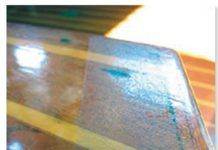
Do-It-Yourself: Salted Surfaces
While new finishes-paint, epoxy, or varnish-may be beautiful to look at, they are also as slick as can be when a little seawater hits the surface. You can cover your handiwork with nonskid tape; slather on a coat of bland nonskid paint; try one of the nonskid paint additives like crushed walnut shells (favored by PS Technical Editor Ralph Naranjo); or you can try an easy, age-old method that PS tester Drew Frye favors: salted varnish (or paint).
Lithium Batteries on Sailboats: The 3 Mistakes Everyone Makes
Lithium batteries are one of the most popular sailboat upgrades today—but they’re also one of the most misunderstood. In this Practical Sailor Saturday episode,...



Latest Sailboat Review
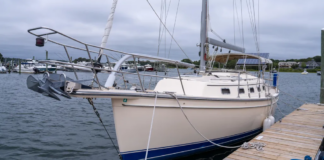
Island Packet Estero Used Boat Review
Florida-based Island Packet targets a relatively narrow niche, so the toughest competitors to its new boats are often older Island Packets. Introduced in 2010, the 36-foot, shoal-draft Estero is the company’s latest attempt to introduce a distinctive model that doesn’t stray too far from the company’s proven formula for success: moderate displacement, full-keel cruisers designed to be lived on, sailed far and in comfort, and endure the bumps, scrapes, and storms that cruising boats inevitably encounter. After sailing the Estero on Florida’s Sarasota Bay and inspecting its interior, construction, and systems, Practical Sailor testers noted that the shoal-water cruiser will appeal strongest to Island Packet fans who’ve been waiting for a shoal-draft, easy-to-sail boat that compares to the IP37 in terms of interior space. These strengths will be most apparent on intracoastal or riverine adventures like the Great Loop.