




EarthNC Software
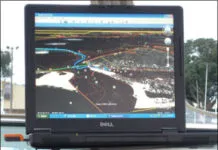
On a recent boat delivery from Michigan to Florida, I had the opportunity to try out some new computer-based planning software from EarthNC. EarthNC uses Google Earth images to present marine chart data by overlaying the charts on Google Earth satellite images. For $50, EarthNC provided 757 vector-format charts (raster format charts and other packages are also available) for the continental U.S., Alaska, Hawaii, and parts of the Caribbean. These charts can be used online or offline. When combined with a USB-connected GPS-and the ooPs (www.goopstechnologies.com) GPS software for Google Earth-EarthNC provides a real-time, moving map experience similar to modern chartplotters. EarthNC also has automatically updating weather maps with data supplied by NOAA.
Practical Sailor Tests Two New Handheld GPS Units from Garmin
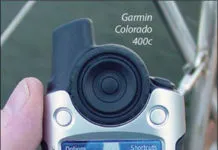
Garmin’s new scroll-wheel Colorado 400c and touchscreen Oregon 400c offer some unique features, but their multi-sport focus falls short in satisfying all of a mariner’s needs. Although both new units are high-quality handhelds, testers preferred an older-generation GPS, the Garmin GPSMap 76CSx, which was the Practical Sailor Best Choice in a previous test. Practical Sailor tests compared the units’ features, performance, ergonomics, and price, along with how well they meet sailors’ needs.

Practical Sailor Names 13 Products Best Gear of the Year
Practical Sailor’s annual wrap-up of the year’s best sailing equipment looks at our favorite top-rated products from November 2007 to November 2008, including the Facnor furler for light-air sails, Scad Solo external holding-tank sensor, Pelican Recoil LED flashlight, and Adventure Medical’s first-aid kit for coastal cruisers. In the boat maintenance category, Interlux’s Micron 66 bottom paint and Spray Nine’s waterline stain remover garnered Editors’ Choice picks. Foulie sets (jacket and bibs) by Gill and Helly Hansen were tapped as Practical Sailor Editor’s Choice in apparel, and a host of marine electronics made the list, including the Icom CommandMic III remote mic and Garmin GPSMap 545s 5-inch chartplotter sounder. Jeppesen was recognized for its top-notch electronic chart updating services. Other top gear picks were the Acco proof coil mooring chain and the Achilles HB315-LX fixed-transom inflatable dinghy.
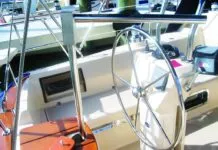
The Hunt is on for a Quality, Well-placed Emergency Tiller
A decade ago, Practical Sailor editors began scouring boat shows for the perfect emergency tiller and an ideal stowage system for it. Little more than a simple lever arm that attaches to the head of the rudder stock, the emergency tiller is the device a sailor relies on in the event a steering cable parts or theres some other steering system failure. Our seemingly simple search turned out to be a nearly fruitless enterprise. Boat after boat fell far short of delivering even an average emergency tiller. Heres a look at our favorites and favorite offenders as well as our criteria for a good emergency tiller and where to keep it.
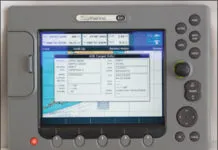
Practical Sailor Testers Take a Look at the Raymarine AIS250 Receiver
Automatic Information System (AIS) devices have been required on large commercial ships since 2002. Their popularity is growing in the U.S. recreational sailboat market, thanks to the Federal Communications Commissions (FCC) recent approval of AIS Class B transponders. Some devices allow users to send and receive information about a ship-location, size, speed, call sign, and MMMI number. Others, like the Raymarine AIS 250, only receive AIS broadcasts from other AIS-equipped ships. The Raymarine AIS250 receives AIS Class A and AIS Class B broadcasts. Practical Sailor found that the device performed well, and was user-friendly and easyto install. But, for a receive-only unit, its pricey: $980, or about three times as much as similar devices on the market. If you already have a Raymarine network and prefer to see but not be seen, then the AIS250 is worth considering.

Wanted: A DC-DC Converter
Ive created a 24-volt system by connecting two 200-amp-hour 12-volt batteries in series to drive an electric outboard as auxiliary power for our 25-foot sailboat. The 24-volt bank will be charged using a 24-volt charger on shore power and by a 24-volt series of solar panels when mooring. I would like to eliminate the 12-volt batteries. I bought a 24- to 12-volt converter to stand in place of the 12-volt batteries, but I learned that the converter is not compatible with driving any kind of motor due to the back-voltage created by the collapsing field when the motor stops. I have a freshwater pump and a motorized outboard-motor bracket, so this particular converter is out of the question. Do you have any suggestions? Must I maintain a 12-volt battery for all the 12-volt equipment or is there a step-down technique?
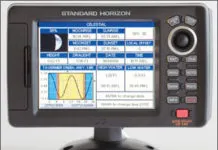
Marine Electronics Test: A Look at Combination Fishfinders and Chartplotters
The test field includes devices with 5-inch display screens that provide chartplotting capabilities and information and show detailed bottom contours on a single display screen. These combination fishfinder-chartplotters are fitted with high-powered sounders. Practical Sailor tested units for day and night visibility. Each plotter was tested with live GPS fix information. Chartplotter user-interface was tested by examining actions such as creating waypoints, building routes, and changing map ranges. Units tested were the GarminGPSMAP 545s, which uses Garmin’s Bluechart g2; the Lowrance LMS-525C DF (a Navico brand), which has an NMEA 2000 GPS sensor, uses Navionics cartography, and is capable of interfacing with a Lowrance radar; the Raymarine A60/DSM25 combo; the SI-TEX Colormax SE; and the Standard Horizon CP180.
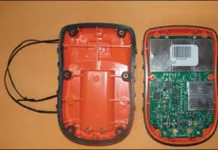
The SPOT Personal Messenger Lets You Communicate From the Far Reaches of the World
Until recently, mariners’ only choices for emergency locating devices have been emergency position indicating radio beacons (EPIRBs) and personal locating beacons (PLBs). Now there’s another product that bears consideration: The SPOT Satellite Messenger. EPIRB and PLBs are capable of only sending distress signals, but the handheld SPOT utilizes the GlobalStar Satellite Network to accomplish multiple tasks. Users can notify friends and family that they’re safe by sending their GPS coordinates along with pre-composed text and e-mail messages to their contacts list, which they setup online. They can seek help in non-life-threatening situations, and can send a 911 alert in critical emergencies. One of tester’s favorite features was that the SPOT system allows the user’s contacts to track his movement, in real time, on Google Maps. SPOT relays messages to an emergency response center, which in turn notifies search and rescue personnel, or—if no emergency exists—will let family and friends know the user is safe. SPOT works independently of cell phone coverage, so it works when your phone will not. Although testers liked the functionality of the SPOT, PS field tests call its durability into question, and over time, it will cost much more than an EPIRB or PLB. Gadget-lovers and those looking for an EPIRB backup should take a look at the SPOT. However, it should not be considered a replacement to traditional distress signals.

In the Interest of Science
There is a chance that our story on electric propulsion (starting on page 8) might be taken the wrong way. Our unequivocal "buyer beware" warning regarding this technology doesn't mean that Practical Sailor doesn't admire or respect the innovators in this field. Or that we don't appreciate the financial risks many have taken to advance the technology. Or that we don't like the idea of being free of fossil fuels and the racket of engines that burn them. However, at the end of the day, this publication has a duty to clear the air when the facts evaporate in a fog of irrational exuberance. Thanks to the support of you, our loyal subscribers who keep us ad-free, we are the only sailing publication that can poke holes in the emperors new boat without fear of being fed to the sharks.
Marine Electronics Test: Garmin Touchscreen vs. Raymarine Network
Multi-function displays (MFD) with 8- to 12-inch screens are riding a wave of popularity, due in large part to the ease of viewability of detailed navigational data. Practical Sailor evaluated 8-inch screens from Garmin and Raymarine and the two companies’ 12-inch displays. Both units in the Garmin GPSMAP 5000 series, the GPSMAP 5208 and the GPSMAP 5212, are touchscreen controlled and can interface with radar, a black-box finder, a weather receiver, or an Automatic Identification System (AIS) receiver through a Garmin Marine Network connection. Both also come pre-loaded with Garmin Bluechart g2 U.S. coastal cartography. The Raymarine E120 and Raymarine E80 can connect to and display a variety of information from numerous sources. Testers liked the intuitive software and networking capabilities. Raymarine uses Navionics cartography. All four displays tested are NMEA 0183 compatible and NMEA 2000 compatible.

O’Day 40 – A Budget Cruiser for the Bahamas
The O’Day 40 (1986) is one of those cruising sailboats that somehow slipped through the cracks of sailing history. Built during the final years...



Latest Sailboat Review
Island Packet Estero Used Boat Review
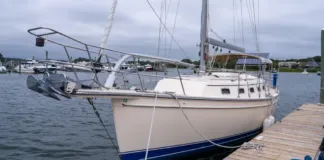
Florida-based Island Packet targets a relatively narrow niche, so the toughest competitors to its new boats are often older Island Packets. Introduced in 2010, the 36-foot, shoal-draft Estero is the company’s latest attempt to introduce a distinctive model that doesn’t stray too far from the company’s proven formula for success: moderate displacement, full-keel cruisers designed to be lived on, sailed far and in comfort, and endure the bumps, scrapes, and storms that cruising boats inevitably encounter. After sailing the Estero on Florida’s Sarasota Bay and inspecting its interior, construction, and systems, Practical Sailor testers noted that the shoal-water cruiser will appeal strongest to Island Packet fans who’ve been waiting for a shoal-draft, easy-to-sail boat that compares to the IP37 in terms of interior space. These strengths will be most apparent on intracoastal or riverine adventures like the Great Loop.