



The Bluewater Sailors School
Many years ago, when I was shopping for a boat to sail around the world, I sought out wiser sailors for advice. A recent college graduate, I had a ridiculously low budget but lucked into finding a boat that appeared fit for the task. It was a 32-foot gaff-rigged William Atkin ketch, a double ended Thistle design based on the Colin Archer lifeboats.
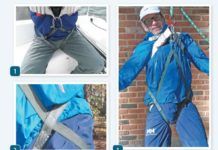
Leg Straps Put the Load on Fanny
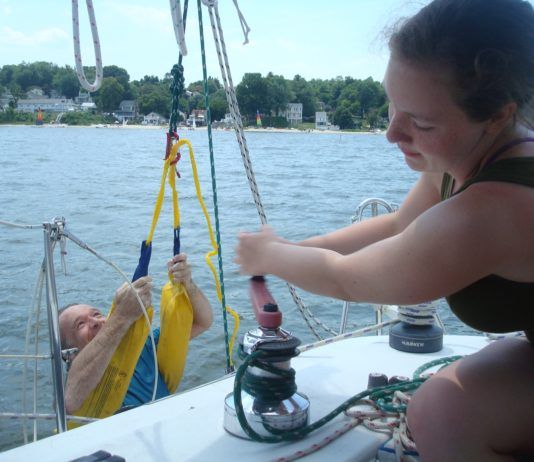
Considering the short comings of existing leg loops for harnesses, we designed an add-on set of leg loops that can transform any ISO 12401 chest harness into a harness capable of safely distributing the force of a epic fall, without adding significant weight and without inhibiting wearer moment.
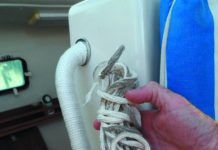
Wrapping Stainless Steel for Better Grip
The very first project tackled on my new-to-me catamaran a decade ago was to wrap the helm wheel with line. Our delivery trip home took place in late December on the Chesapeake Bay, and I didnt want to spend the next three days with an icy stainless steel wheel sucking all of the heat from my fingers. Instead, I spent a productive hour before dinner wrapping the wheel with line.
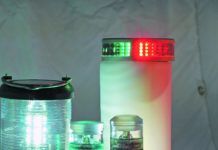
Coast Guard Seeks LED Input
Back in 2010, Practical Sailor and others raised the alert that a conversion to LED navigation lights can have some unintended consequences, including distorted color shifts. And weve long been concerned about LED lights, both interior and exterior, interfering with VHF and AIS radio transmissions.
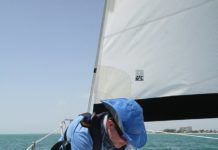
Do You Have a Safety Checklist?
The widely publicized death of Jon Santarelli, an experienced racing sailor who went overboard during this years Chicago Mackinac Race should serve as a wake up call to everyone in the sport of sailing. We need a checklist. But more importantly, we need to follow it.
Download the Full October 2018 Issue PDF
- Gear of the Year
- Non-destructive testing
- Testing Welds
- Fall Prevention
- Get Me Home Tool Kit
- Wrap That Handhold

Weather & Navigation Seminars Set for October 2018
On October 9-10, hell be conducting a 2-day introduction to celestial navigation. The course covers introduction to the basic skills required for celestial navigation. Topics include introduction to taking a sun sights with a sextant, reading time and arc, using sight reduction tables (Publication 229), reducing sights by calculator, and identifying celestial bodies.
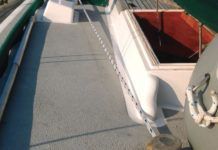
Non-Skid Paints and Adhesive-backed Mats
Over the years, Practical Sailor has conducted dozens of test comparing painted-on non-skid exterior coatings. Weve also compared the heavy-duty textured mats, including faux teak and cork, that are applied with adhesive. Three long-term tests of these coatings and mat products are still ongoing.
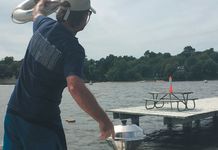
Ropes for Throwing
We all know the drill. A new arrival pulls toward an unfamiliar marina or fuel dock with a breeze blowing, and they can't quite get in. An inexperienced crew is rapidly dispatched to the bow and instructed to throw a line to a helper on the dock. They grab a coil of line, heave it . . . and it lands in a tangle in the water, scarcely halfway to the dock. Confusion erupts and the boat kisses a piling or nearby boat. If and when the line is successfully thrown, its a wet tangled mess aimed at your head.

Perfecting the Toss Requires Some Practice
Passing a line to a helper on shore is as basic a part of seamanship as tying a bowline. Youve probably seen an old salt seaman cast a line 40 feet as casually as passing the pepper, but more often youve seen the line launched with a huge arm swing, only to tangle and fall short of the mark. A few simple tips, all assuming you are right handed and you are throwing -inch line.
Bahamas for $5000? The Watkins 27 foot Sailboat
Is the Watkins 27 the ultimate small cruising sailboat? In this video, we take a deep dive into the Watkins 27 — a classic...



Latest Sailboat Review

Jeanneau 55 Boat Review
This recent sailboat from Jeanneau may as well be a spaceship. They’ve taken all the time-honored designs of a monohull aft cockpit and turned...