



International Sailing Federation (ISAF) Guidelines to Jacklines
The International Sailing Federation (ISAF), the world governing body for the sport of sailing, has established clear guidelines for ISAF-sanctioned events, and these are generally applied to offshore racing-ISAF-sanctioned, or not-around the world. Among the recommendations are the following:
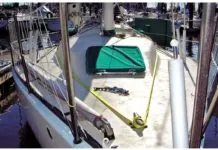
Jackline Installation Advice
Material selection is just one of many details regarding jacklines that deserve careful thought. If you are re-installing your jacklines, be sure to read our 2007 report and review some of the following tips that emerged from this test.
Fiber Lifeline Protection Plan
New, single-braid, high modulus polyethylene (HMPE) lines, such as Amsteel Blue from Samson Ropes, WR2 (wire rope replacement) from New England Ropes, and Vectrus from Yale Cordage, have revolutionized the way sailors think about standing and running rigging. Bit by bit, these low-stretch ropes are replacing wire rope on board. But the changeover is not without controversy.
Slicing, Dicing Abrasion Data
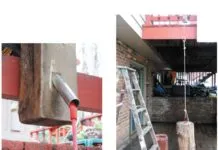
For testing, we used the same abrasion rig we used to test sewn eyes and rope (see PS March 2015). A modified wood lathe sawed line samples back and forth (a 3/4-inch stroke) at seven cycles per second through a 10-millimeter test stanchion hole. We tested each sample to failure, effectively condensing months or years of wear into just minutes.
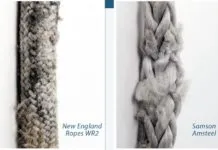
Visible Harm Doesnt Tell Whole Story with Amsteel
Our testing made us wonder whether we are better off with a core-and-cover lifeline with a tough cover, like New England Ropes WR2, or an uncovered rope like Samson Amsteel, which is much stronger than the smaller-diameter WR2 core. (Because of the way WR2 is spliced, the cover should not be counted toward strength.)
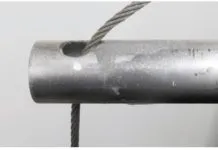
Check for Abrasion Before Switching to Fiber
To see how chafe points can develop on stanchions, we ran standard steel cable through our test stanchion holes for an hour. As expected, the sawing action wore a rough-edged groove, but several other things became apparent.
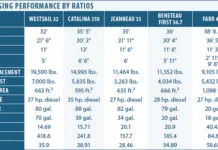
A Closer Look at the Rationale Behind the Ratios
Sailboat performance varies based on the eye of the beholder. Racers want light-air alacrity and a willingness to plane while cruisers want directional stability and reasonable speed with moderate sail area. A boats design dimensions and a few simple ratios give some hints about these attributes.

Necessity Breeds Innovation
Those who use citronella or Skin So Soft for an insect repellent will not appreciate these high-octane anti-itch remedies. But it is safe to assume that such a conservative attitude is reserved for those who are not in the thick of battle with a foe as formidable (and miniscule) as battalions of Lilliputians.
A Second Look at Safety Gear
We recently checked out some equipment that illustrates the challenges of designing and marketing new safety gear, one of the more tightly regulated sailing-equipment categories.
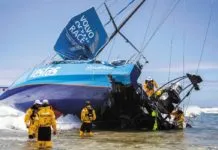
Operator Error Strands Vestas Wind
When it comes to speculation, it makes sense to do some research before second-guessing any maritime mishap. And with this in mind, Ive spent the last couple of months sorting through statements, Race Control press releases, and information deduced by the authors of the Volvo Race Independent Report (VRIR) into the stranding of Vestas Wind.
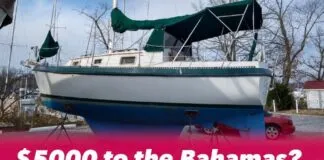
Bahamas for $5000? The Watkins 27 foot Sailboat
Is the Watkins 27 the ultimate small cruising sailboat? In this video, we take a deep dive into the Watkins 27 — a classic...



Latest Sailboat Review

Jeanneau 55 Boat Review
This recent sailboat from Jeanneau may as well be a spaceship. They’ve taken all the time-honored designs of a monohull aft cockpit and turned...