


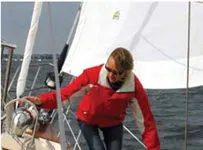
Long-term Test Evaluates Synthetic Lifelines
Sailboat lifelines have jumped back into the spotlight thanks to a growing acceptance of-and some controversy over-high-modulus rope like Dyneema and Spectra being used as an alternative to stainless steel. These high molecular weight polyethylene (HMPE) ropes are as strong as stainless-steel wire of equal diameter, yet they weigh far less. To determine whether the synthetic lifelines are practical for cruising applications, Practical Sailor launched a longterm, in-depth set of seatrials (linked with lab testing at the U.S. Naval Academy) aboard an Ericson 41. The evaluation compares several options and their installation, durability, and cost.

USNA Lifeline Test Reveals Weak Spots
During the time PS Technical Editor Ralph Naranjo worked as the Vanderstar Chair at the U.S. Naval Academy, he organized a research project that was carried out by first-class midshipmen (seniors) in the Mechanical Engineering Department. The goal was to design a steel box beam jig replicating the perimeter of a Navy 44.

A Non-standard Issue
One of the first things we research when designing a new product test are industry standards already in place. Frequently, there are none, or those that exist have little to do with the real world.
Anti-Seasick Bands
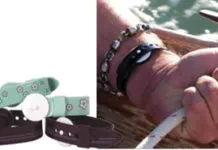
Always on the lookout for drug-free anti-seasickness options, Practical Sailor recently tested a new one designed to ease seasickness by activating acupressure points on the wrists. PsiBands are similar to other acupressure bands, including Davis Instruments’ Queaz-Away ($10, www.davisnet.com), which PS reviewed in the December 2009 issue. Acupressure bands are designed to stimulate specific nerves located at the inner wrists. Applying pressure at these points can provide relief from nausea.
Extreme Ocean Gear Testing
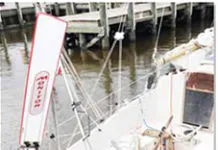
Matt Rutherford recently completed a record-breaking, non-stop solo circumnavigation of the Americas, covering 27,000 in 309 days, aboard his 36-year-old, 27-foot Albin Vega to raise funds for the Chesapeake Region Accessible Boating (CRAB) nonprofit group. Rutherford’s success was founded in his ability to make a boat with modest design and modest structural attributes behave well in a wide range of conditions. The journey was a true test of the boat’s seaworthiness, the skipper’s seamanship, and his gear’s durability in harsh conditions. Practical Sailor takes a look at the Albin Vega, the gear Rutherford found to be essential—like his Monitor windvane, Origo stove, and Harken furler— and the products that let him down along the way—like multiple GPSs and a Kindle e-reader.

Small Boats Open Big Vistas
In 2003, Matt Rutherford made a sight unseen commitment to cruising from his home in Ohio. Over the phone, he bought a Coronado 25 located in Trappe, Md. The boat needed a lot of TLC. He fixed what he could and learned to do without what he couldn’t afford.
Safety at Sea Part III: Rambler 100 capsize
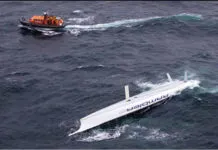
In our final review of three 2011 sailboat tragedies investigated by US Sailing, we offer a clear look at how even the best-equipped, most highly trained sailors can run into trouble at sea. Rambler 100-touted as the fastest monohull super-maxi on the planet and representing millions of dollars in research and design-lost its can'ting keel and capsized while competing in the August 2011 Rolex Fastnet Race. Sixteen crew struggled to stay on the overturned hull, while another five floated adrift in the Celtic Sea, trying to fight off hypothermia. Practical Sailor looks closely at US Sailings report, directed by retired U.S. Navy Captain Ron Trossbach, the Rambler 100 crews post-accident recommendations, and the safety lessons we can all learn from the accident.

US Sailing Investigator’s Recommendations
Ron Trossbach, the lead investigator for US Sailing in the Rambler 100 incident, recommended the following changes to US Sailing’s Offshore Special Regulations (OSR) and US Sailing Prescriptions. He also recommended that these be forwarded to the International Sailing Federation (ISAF) to be included the ISAF Special Regulations Governing Offshore Racing for Monohulls. The items in parentheses reflect the OSR section that would be amended.
Lessons learned
Ron Trossbach, head of the US Sailing investigation into the Rambler 100 accident, offered the following lessons that sailors can take away from the capsize.
Rambler 100 Recommendations
The crew of Rambler 100 made the following recommendations/observations regarding safety equipment. The recommendations were taken from crew statements provided to US Sailing and do not represent US Sailing’s own recommendations.
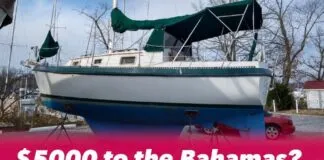
Bahamas for $5000? The Watkins 27 foot Sailboat
Is the Watkins 27 the ultimate small cruising sailboat? In this video, we take a deep dive into the Watkins 27 — a classic...


Latest Sailboat Review

Jeanneau 55 Boat Review
This recent sailboat from Jeanneau may as well be a spaceship. They’ve taken all the time-honored designs of a monohull aft cockpit and turned...