
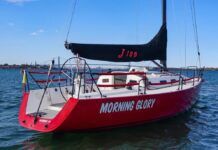
J/109 Used Boat Review
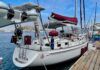
The J/109 is a 35-ft. boat that races well and has some comforts for short term cruising. It is a true racer/cruiser. The first...
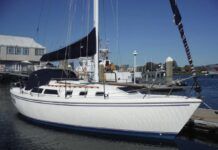
Catalina 34 Used Boat Review
American sailboat manufacturers have had their highs and lows, and many have dropped right off the map, but Catalina has been going strong for more than four decades, and looks to be gearing up for at least 40 more. If you want a history lesson in how owner Frank Butler navigated this company through a fickle, cyclical industry, you can check out one of our many reviews of Catalina boats online at www.practial-sailor.com. The more recent trends are the most relevant to this boat review, an update to one originally published in 1991.
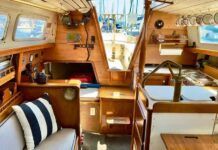
Ranger 33 Used Boat Review
The Ranger Yacht division of Jensen Marine was created in 1969 to build performance-oriented boats designed by Gary Mull. Jensen's Cal division had been successful with both racer/cruisers and pure cruisers, but the Ranger line was racier, with consistent styling and appearance throughout the series. Ranger stopped building the 33 in 1978, after 464 boats had been turned out. Many minor changes were made over the years of production, and boats built after 1974 are generally more desirable, with restyled interiors and a diesel engine option.
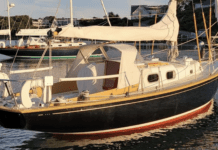
Pearson Alberg 35 Used Boat Review
While the Alberg 35 had moderate success as a racer, the boat was--and still is--a cruising boat. By current standards, the Alberg 35 is a slow boat for her length overall, with a typical PHRF rating of 198. By way of comparison, her replacement, the Pearson 35, rates about 174, and the Ericson 35-2 about 150.
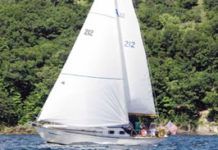
Alberg 35 Offers Classic Escape
The Alberg 35 dates back to the dawn of big-time fiberglass sailboat building. Its production began in 1961, just a year after Hinckley stopped building production wooden sailboats. Two years earlier, in 1959, Pearson built the first Triton, the boat that was the prototype of the inexpensive, small family, fiberglass cruising sailboat. The Tritons big selling point was a low-maintenance hull that Mom and Pop and the kids didnt have to spend all spring in the boatyard, getting it ready for the summer.
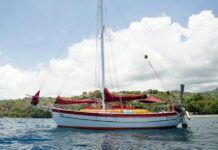
Hans Christian 34/36
Hans Christian 34/36 - While not a good boat for the weekend coastal cruiser, or for anyone who does much sailing in light-to-moderate air, this is an excellent choice for the serious blue-water sailor. This is a boat that will take you offshore to Bermuda or just about anywhere and will stand up to a gale. The 34/36 wont get you there fast, but it will get you there safely.
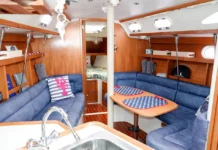
Catalina 320 Used Boat Review
The Catalina 320 is pleasing to the eye, partially a reflection of a finer bow entry. While it has a modest overhang at the bow and almost none at the stern, with a waterline of 28' it's clearly the product of the nearly plumb bow/reverse stern thinking so prevalent in architectural circles these days.
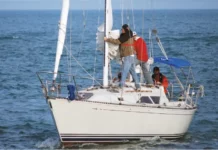
C&C 33 Mark II Used Boat Review
When the C&C company shut down operations in 1986, it was big news in the North American boating community. Since the companys formation in 1969, it had been a stalwart of the industry-the leading Canadian builder, by far, and one of the major brands wherever fiberglass sailboats raced or cruised.
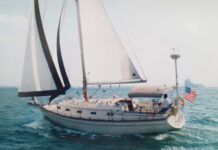
Island Packet 350 Used Boat Review
Bob Johnson's 1997 design is roomy and well-made. Though slow to gather speed upwind, she carries her way gracefully.
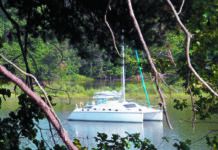
The PDQ 32 Cruising Cat Used Boat Review
PDQ Yachts in Whitby, Ontario, Canada, launched the Alan Slater-designed PDQ 32 catamaran in 1994 and built 53 of the boats in the following eight years. Practical Sailor first reviewed the PDQ 32 catamaran in April 1997, which happened to be when the test boat for this review update rolled off the production line. Heres a look at what testers have learned from coastal cruising this boat for 18 years and from other owners who live aboard.
Latest Logbook

Practical Sailor Logbook – September 2026
This month we tour the Hans Christian 48T — the offshore cruiser many sailors call the holy grail — walk the custom Antigua 60...
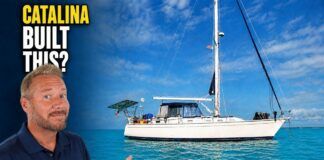
Video: Morgan 44 Review – The Catalina Cruiser Everyone Forgot
The 1989 Morgan 44 is a big center-cockpit cruising sailboat with Catalina DNA—but it may be one of the most overlooked boats of its...


Latest Sailboat Reviews
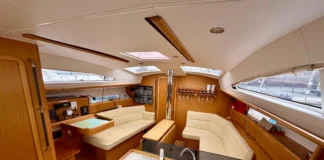
Jeanneau Sun Odyssey 42 DS Used Boat Review
This boat is dangerous for one simple reason—it looks like the answer. It’s big enough, pretty enough, modern enough, and suddenly, somehow, almost affordable...