
Mason 33 Used Boat Review
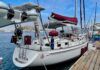
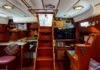
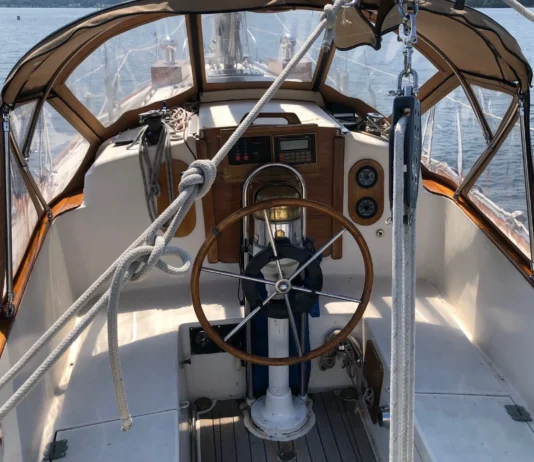
The Mason 33 was built in the mid and late '80s by the Ta Shing yard in Taiwan, and imported by Pacific Asian Enterprises in California. She is a moderate traditional design that harks back to the CCA handicapping rule of the 1960s. It might best be described as a modern full-keel hull, with a cut away forefoot and sharply turned bilges to reduce wetted surface. Though narrow and short on the waterline compared to modern lightweight fin-keelers, she is beamier, with shorter overhangs, than you would find on a typical 1960s design.
Beneteau 311, Catalina 310 and Hunter 326 Used Boat Comparison
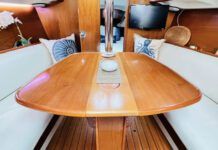
Our review of "entry-level cruising boats" - We chose the Beneteau 311, Catalina 310, and Hunter 326. They seemed to match well in terms of size, sail area, ease of operation, accommodations, and price. Dimensions are comparable, as are working spaces on the deck, the type and arrangement of gear, cockpit size, and space and furnishings below. All are equipped with a suit of sails and headsail furlers.
Beneteau 323 Used Boat Review
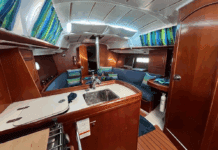
Beneteau recently added three new models to its line-up, including this 323 (which is actually closer to 33 feet LOA). It replaces the aging 311, which was only moderately successful in the US market. The new 323 couples good overall performance with a spacious cockpit and living accommodations suitable for four. During our test sail we learned that she's quick, and a bit tender. The Company …
Tartan 31
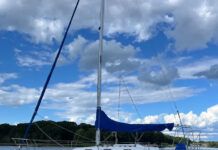
The Tartan 31 is one of the new line of performance cruising yachts from the venerable-and durable--Grand River, Ohio boatbuilder. In the last few years, Tartan Marine has come out with a range of new models, including the T-28, the 3500 and the 4600. A 41-footer is in the works. Both the 28 and the latest version of the 31 are part of the new Piper series, which are marketed in sailaway condition. Tartan has a reputation for solid construction and good workmanship and that's what the 31 is: solid and well put together. The hull is hand-laminated with alternating layers of chopped strand mat and unidirectional E glass. Behind the NPG/ISO gelcoat there's a layer of vinylester resin, which so far appears to provide the best osmotic blister protection available.
Capable Cruiser: The Seawind II
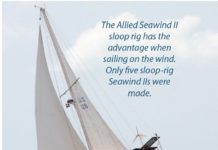
Allied Yachts secured its place in the boatbuilding pantheon with its original Seawind ketch, which was launched in 1962 and was the first fiberglass boat to circumnavigate, and the Luders 33, which was recognized as a classic design of the era preceding the fin-keel racer-cruiser. Unfortunately, while its products were heading for glory on the high seas, the company was headed for the boneyard, thanks to mediocre management, severe under-exposure, and the vagaries of the boat-buying public. But by the time Allied went out of business for the fifth and final time in 1981, they had developed a reputation for fashioning solidly built (if uninspiringly finished) boats, unabashedly oriented toward cruising.
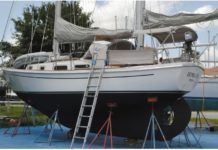
Seaworthy and Solid Seawind II
The hull of the Seawind II is a solid lay-up. The deck and cabin trunk are balsa cored. The top of the coachroof, in the way of the deck-stepped mast, is cored with solid, filled epoxy for greater compression strength.

Express 34, Hobie 33, Olson 34
Compared to conventional productions boats of the mid-1980s, the Express 34 and Olson 34 were lighter and faster, but still suitable for distance cruising. The Hobie 33, though most suitable for camper-crusing, was designed to be fast yet trailerable and capable of blue-water sailing.
The Allmand Sail 31
We were somewhat surpised, and impressed by the number of people living aboard the Allmand 31. For her size, she certainly does offer much space below and in the cockpit (one owner said shell easily sit six or seven in the T-shaped cockpit).The wide beam gives her a good deal of initial stability, though this is not the kind of hull form that you want to capsize as inverse stability will be greater than on a narrower boat (and one with a deeper keel).
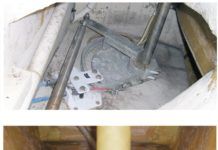
PDQ: Rugged Quality
The PDQ 32 is laminated using a modified epoxy resin (AME 5000). Tri-axial knitted fiberglass fabrics are used in the hull and deck. The mast is supported by a carbon-fiber reinforced deck beam. The hulls are solid fiberglass below the waterline and cored with Klegecell foam above the waterline, an arrangement that has proven very durable. Owners have not reported problems with blisters or structural cracking, only limited gelcoat crazing in highly stressed corners. Another PDQ 32 we inspected showed numerous construction shortfalls, including delamination and poor resin wet out, so a thorough survey of any used boat is important.
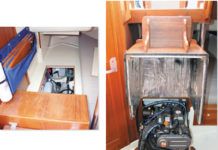
Living Small on the Big Sea
Readers familiar with the work of William Crealock-the renowned designer of the Crealock 37, the Cabo Rico 34, the Dana 24, and at least 30 other production-built vessels-understand that his designs are steeped in practicality. Crealock famously wrote: Seaworthiness in a cruising boat has to be the No. 1 consideration. It doesn't matter how cute the boat is if it doesn't get [to the destination] in one piece. And those familiar with his life are aware that his knowledge of sailing wasnt just grounded in the study of design, but also in extensive hands-on experience at sea-an imperative for any designer of boats intended for offshore.
Latest Logbook

Practical Sailor Logbook – September 2026
This month we tour the Hans Christian 48T — the offshore cruiser many sailors call the holy grail — walk the custom Antigua 60...
Video: Morgan 44 Review – The Catalina Cruiser Everyone Forgot
The 1989 Morgan 44 is a big center-cockpit cruising sailboat with Catalina DNA—but it may be one of the most overlooked boats of its...


Latest Sailboat Reviews
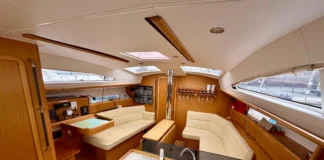
Jeanneau Sun Odyssey 42 DS Used Boat Review
This boat is dangerous for one simple reason—it looks like the answer. It’s big enough, pretty enough, modern enough, and suddenly, somehow, almost affordable...