
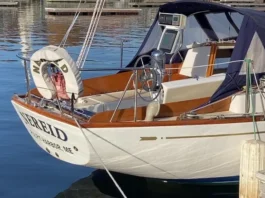

Freedom 33
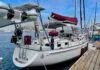
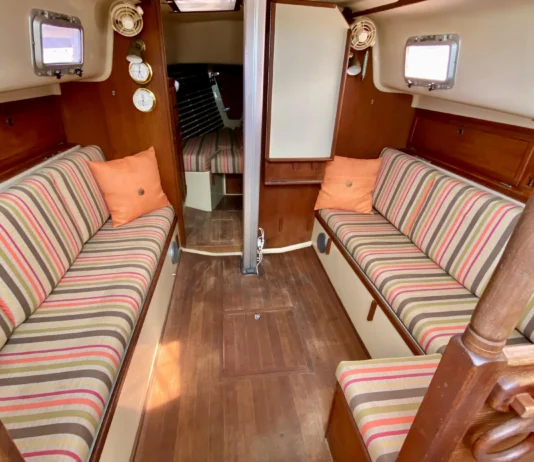
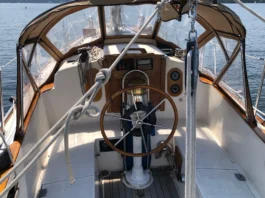
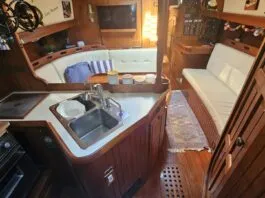
In 1972 Garry Hoyt set about developing the original Freedom 40. Discarding conventions one by one, he came up with a long-waterline, quasi-traditional hull form and a wishbone cat-ketch rig. In the intervening years Hoyt refined his rig and developed a whole line of boats: a 21, 25, 28, 39 (express and pilothouse models), and the 44. The Freedom 33 is no longer in production, having been replaced in the line by the 32, which is a single masted "cat sloop" with a self tacking jib and gun mount spinnaker. More rig innovation.
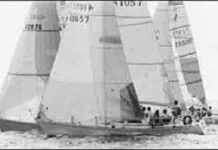
J/35
In design, the 35 looks like a typical Rod Johnstone boat, with short overhangs for a long waterline, relatively low and flat sheerline, a low cabin house, and a moderate well-balanced rig. Obviously, Johnstone knows something about the harmony between a boat's underbody and the water, but a large part of the boat's speed is also dependent on the light weight--10,500 pounds on a 30-foot waterline--as well as a good distribution of that weight.
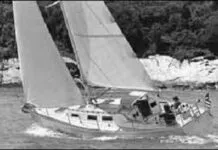
J/34c
In appearance, the J/34c looks much like her sister J/cruisers. She has a fixed shoal draft keel, a straight sheer, and a slotted Goiot aluminum toerail. Her waterline, at 30', is long. It leaves her little overhang for appearance.
Bristol 35.5C
The Bristol 35.5C, which also came in a full-keel version (without the "C"), is an extraordinarily orthodox boat. There simply are no extremes in design, construction or performance, unless it is in her ability to flaunt her stern downwind and burn a lot of boats when beating in light to moderate air.
C&C 33
C&Cs have been known for good-looking moderate designs, a tradition started by the original partners and the company's chief designer Rob Ball. Some models--like the early Corvettes and C&C 35s--have become classics of production sailboats, and (except for the Mega, a one-design 30-footer of the late 70s) it's hard to think of any C&C which has been extreme or unattractive to the eye.
PDQ 32
The PDQ 32 was introduced in 1996. The concept was to offer a smaller, lighter and less expensive alternative to the PDQ 36. One of the things we like about PDQ boats is the quality materials and generally clean workmanship. A modified epoxy resin (AME 5000) and tri-axial knitted fiberglass fabrics are used in the hull and deck. The mast is supported in part by a carbon fiber-reinforced deck beam. The hulls are solid glass below the waterline and cored with Klegecell foam above the water, an arrangement we think makes a lot of sense. Each hull has an air-tight comparatment forward, which provides a measure of safety in the event of collision, and the keels also have sacrificial sections. When you poke around in lockers, you don't see a lot of unfinished glass.
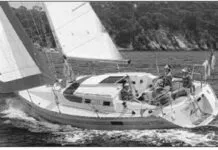
Beneteau Oceanis 350
Beneteau is the largest builder of sailboats in the world. The French company has made its mark not only in Europe, but in the U.S. as well, opening some years ago a plant in Marion, South Carolina, with headquarters in Charlotte, North Carolina. Probably more than any other company, Beneteau also has influenced sailboat styling--the so-called Euro-style, typified by smoked wrap-around windows, scoop transoms with molded-in steps, and lots of curvy interior shapes. The Oceanis 350, built between 1986 and 1993, is a reasonable example of Beneteau's impact on the sailboat market. About 144 were built in the US, more in Europe.
Latest Logbook

Practical Sailor Logbook – September 2026
This month we tour the Hans Christian 48T — the offshore cruiser many sailors call the holy grail — walk the custom Antigua 60...
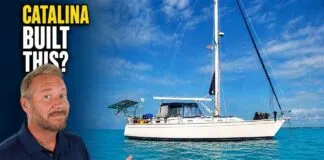
Video: Morgan 44 Review – The Catalina Cruiser Everyone Forgot
The 1989 Morgan 44 is a big center-cockpit cruising sailboat with Catalina DNA—but it may be one of the most overlooked boats of its...


Latest Sailboat Reviews
Bayfield 32 Used Boat Review
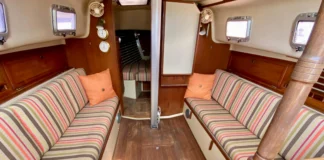
At first glance, the Bayfield 32 looks less like a fiberglass production boat from the 1980s and more like somebody shrank a traditional sailing...