

Nicholson 35
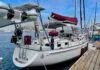
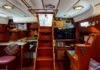
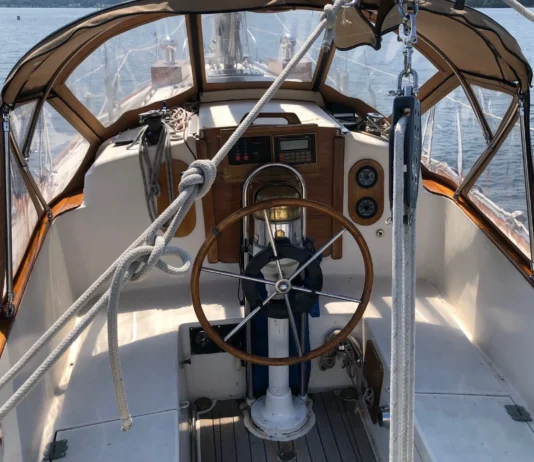
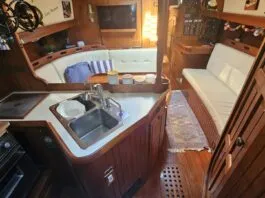
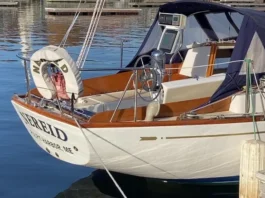
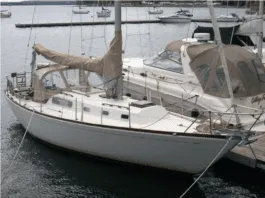
Just over 200 Nicholson 35s were built over more than a 10-year period, with production tailing off in the early 1980s. Most boats were sold in England, but a number were built for American owners, and still more found their way to the U.S. during the rampage of the dollar against foreign currencies in the mid 1980s. The Nicholson 35 is a cruising boat, plain and simple. Its proportions are about as common-sense and moderate as you can get. The boat is clean, almost austere in appearance, with very little exterior wood trim.
Niagara 31/35
Best known for his big race boats, Argentinean designer German Frers drew the lines of the Niagara 31. The 35, as noted, was drawn by Mark Ellis, who also designed the Nonsuch line, and more recently, the Northeast 37 motorsailer. The 35 came first, in 1978, and about 300 were built before its run came to an end in 1995. The Niagara 31 was built between 1980 and 1984. A less popular 26-footer also was built, as well as a 42.
UWB 333
The arithmetic of weights and displacements prevents us from ever realizing a trailerable boat that will sail at the preferred half-submerged condition of our hypothetical craft. But you can get a trailerable hull by this scheme that will sail about one-third submerged, which probably is close enough, and that boat will have more than enough righting moment for reasonable sail-carrying. You also can get a boat that weighs relatively little out of the water compared to its displacement in the water--exactly the characteristic you want in a blue-water trailer sailer. I describe this design as "Ultra Water Ballasted."
J/35
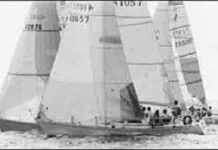
In design, the 35 looks like a typical Rod Johnstone boat, with short overhangs for a long waterline, relatively low and flat sheerline, a low cabin house, and a moderate well-balanced rig. Obviously, Johnstone knows something about the harmony between a boat's underbody and the water, but a large part of the boat's speed is also dependent on the light weight--10,500 pounds on a 30-foot waterline--as well as a good distribution of that weight.
J/34c
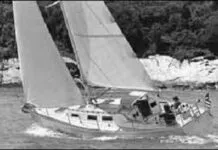
In appearance, the J/34c looks much like her sister J/cruisers. She has a fixed shoal draft keel, a straight sheer, and a slotted Goiot aluminum toerail. Her waterline, at 30', is long. It leaves her little overhang for appearance.
Freedom 33
In 1972 Garry Hoyt set about developing the original Freedom 40. Discarding conventions one by one, he came up with a long-waterline, quasi-traditional hull form and a wishbone cat-ketch rig. In the intervening years Hoyt refined his rig and developed a whole line of boats: a 21, 25, 28, 39 (express and pilothouse models), and the 44. The Freedom 33 is no longer in production, having been replaced in the line by the 32, which is a single masted "cat sloop" with a self tacking jib and gun mount spinnaker. More rig innovation.
Ericson 35
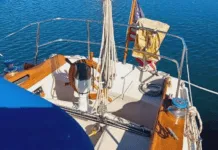
Ericson Yachts has gotten a lot of mileage out of 35-footers over the years. In 1965, the first Ericson 35 was a typical CCA cruising boat; in 1969, the Ericson 35-2 was introduced--an up-to-date racer/cruiser, with swept-back moderate fin keel, pronounced bustle, and semi-balanced shallow spade rudder. In 1982 it was replaced by the 35-3, a larger, more modern boat.
Corsair F-31
The F-31 presents an aesthetically pleasing design with its fine entry; low, 27-inch freeboard; and fine lines. A flat aft section prevents the stern from burying when the bow rises in heavier breezes. Even when sailed on a broad reach with the windward ama out of the water, Farrier believes that his multis are more comfortable than a monohull sailed at a comparable angle of heel. Owners agree that being able to launch from a beach, or sail into a shallow anchorage, adds to the boat's overall utility and their enjoyment of the sport.
Contest 35S
Conyplex, builder of the Contest 35S, is an established company that was a pioneer in fiberglass boat construction. In 1958, it began work on fiberglass Flying Dutchmans, and two years later introduced the Contest 25, its first cruiser. More than 5,000 boats have been built since, with about 600 of these being exported to the U.S. through Van Breems Holland Yachts of Westport, Connecticut.

Catalina 34
It doesn't take a lot of brains to see that Catalina is doing something right that a lot of other sailboat makers aren't. They're the largest sailboat builder in the country, and a terrible year for them would be Valhalla for almost every other manufacturer. With more than 1,000 built in seven years, the Catalina 34 has to be in the running as the most successful production boat of the 1980s.
Latest Logbook

Practical Sailor Logbook – September 2026
This month we tour the Hans Christian 48T — the offshore cruiser many sailors call the holy grail — walk the custom Antigua 60...
Video: Morgan 44 Review – The Catalina Cruiser Everyone Forgot
The 1989 Morgan 44 is a big center-cockpit cruising sailboat with Catalina DNA—but it may be one of the most overlooked boats of its...


Latest Sailboat Reviews
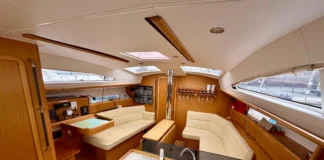
Jeanneau Sun Odyssey 42 DS Used Boat Review
This boat is dangerous for one simple reason—it looks like the answer. It’s big enough, pretty enough, modern enough, and suddenly, somehow, almost affordable...