

Heavy-duty Hull Gets High Praise
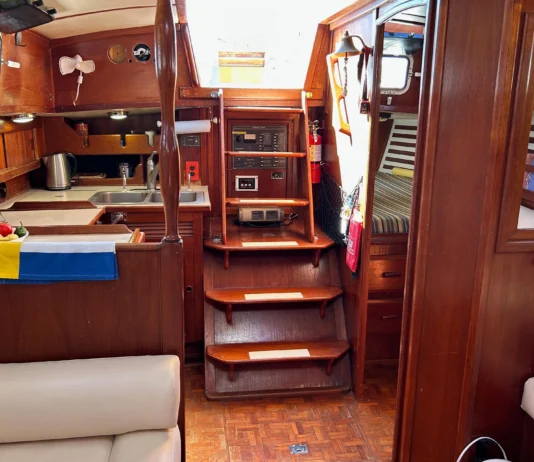
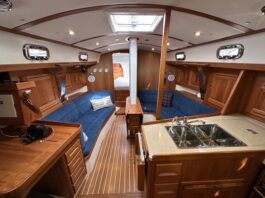
With more than three decades of hard use behind it-first in the charter trade and later in private ownership-the CSY 37 has very few secrets. All its warts are well exposed; as are its strengths. About two-dozen current and former owners responded to our survey, and we saw many consistencies in their comments. Most owners praised the boats rugged construction and stability and lamented its upwind performance. On the whole, the boat delivered what they expected of a cruising boat: namely a boat that would get them (and a fair amount of gear and provisions) safely and comfortably to their destination. Nearly all of the respondents had the owners version or B layout, and praised its livability. The following summaries and comments are representative of the majority of responses we collected.
Dissecting the CSY 37
Designed by Peter Schmitt, the CSY 37 is the mid-sized boat in the CSY line. Eighty-seven of these raised-deck cutters were built, primarily for the Caribbean bareboat charter trade. Schmitt has combined some features most often found in traditional boats-the oval stem, raised deck, and semi-clipper bow-with a relatively modern underbody featuring a fairly long fin keel and a skeg-mounted rudder. On paper, the boat looks pretty good. In person, she is rather tubby and high-sided, but that tubbiness means added buoyancy-not such a bad thing to have in a blow.
Owners Say Beauty, Solid Hull Outweigh Clippers Flaws
We spoke with several owners of Cheoy Lee 42s and 36s for this article, and among the most seasoned was Kieron OConnell, a two-time owner of Cheoy Lee boats-first an Offshore 31, now a Cheoy Lee Clipper 42. OConnell sailed the 42 from California to Australia. He had this to say about the Cheoy Lee Clipper 42.

Former Marketing Director, CR38 Owner Offers His 2 Cents
Practical Sailor reader Allen Taylor so loved his Cabo Rico 38 that he eventually started working for the company as the marketing director. Now, with his stint at Cabo Rico far behind him, the former marketing director offered this insightful view of the Crealock 38, which he lived on and cruised for several years. Although he still holds the boat in high esteem, he offered this list of potential trouble spots.
Deck, Hull-to-deck Joint, and Keel Merit a Close Look
As is typical of C&Cs, owners give the boat high marks for quality of construction, and in general, their enthusiasm is justified. The boat does, however, have a potential weak point. Hull: Like most C&Cs, the 40 was built with a balsa-cored hull. The result is a hull that is extremely stiff for its weight, but balsa coring is not without its potential for problems. In the event of delamination or rupture of the hull skin, the balsa coring can absorb moisture. Moisture penetration of the outer laminate could ultimately reach the balsa coring. It is imperative that a balsa-cored hull be carefully examined by a knowledgeable surveyor before purchasing a used boat.
BJ40: A Well-designed and Well-built Racer-Cruiser
The fiber-to-resin ratio was increased through a vacuum-assisted resin infusion, a process that better wets out the laminate and simultaneously squeezes out all the excess resin. The mechanical properties and blister resistance of vinylester resin are better than its polyester cousin, and this uptick in materials and laminating process dovetailed with the use of Divinycell foam to deliver a strong, stiff, one-piece hull with a an inward-turning flange. The BJ40 hull carries a 10-year warranty against osmotic blistering.
Used Boat Review: Gulfstar 36
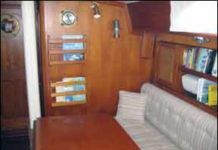
The Gulfstar 36, also called the Gulfstar 36 Auxiliary, was the smallest boat built by Gulfstar Yachts. Gulfstar, which produced 2,500 boats in the 1970s and 1980s, was launched by Vincent Lazzara, one of the early experts in fiberglass boat building. The Gulfstar 36 design is conservatively traditional-it was never called a racer-cruiser, but it was similar to many popular racer-cruisers and coastal cruisers of the time, with modest overhangs, a longish waterline, a moderately long fin keel, and a skeg-hung rudder. The designers are listed as R.C. Lazzara and David Jones.
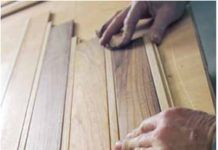
Estero’s solid FRP hull, balsa-free deck is built to last
Island Packet Yachts has been building cruising boats for over 32 years. It builds five different hull designs—about 80 boats per year—to American Boat and Yacht Council and European Category A (offshore) standards.
Esteros solid FRP hull, balsa-free deck is built to last
Island Packet Yachts has been building cruising boats for over 32 years. It builds five different hull designs—about 80 boats per year—to American Boat and Yacht Council and European Category A (offshore) standards.
Five Rides that Push the Limits of High-performance Sailing
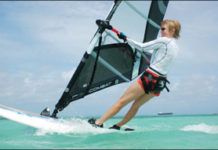
After sifting through the field of sailing sports cars on the market today, Practical Sailor identified five very different watercraft that met our speedster criteria. At the top end of our size and cost profile is yacht designer Bill Lees legacy, the Santa Cruz 37, a wolf in wolfs clothing that offers performance as priority one, two, and three. Next in line is the Andrews 28, a breakaway racer/cruiser that packs performance and a Spartan minimalists cruising package into a 25.7-foot waterline. Hard to miss is the Open 6.50, an out-an-out go-fast sportboat with room below for little more than a cooler and bevy of high-tech sails. For the diehard dinghy sailor, we highlight the quick-planing Stealth, a 14.5-footer that redefines reaching, and in true giant-slayer fashion, can fly by most 40-footers on a power reach. And if thats not action enough, we hop aboard a turbo-charged windsurfer, the Starboard Futura. Powered with a Neil Pryde sail, it runs away with the award for most speed and fun for our dollar.
Latest Logbook

Practical Sailor Logbook – September 2026
This month we tour the Hans Christian 48T — the offshore cruiser many sailors call the holy grail — walk the custom Antigua 60...

Video: Morgan 44 Review – The Catalina Cruiser Everyone Forgot
The 1989 Morgan 44 is a big center-cockpit cruising sailboat with Catalina DNA—but it may be one of the most overlooked boats of its...



Latest Sailboat Reviews
Bayfield 32 Used Boat Review
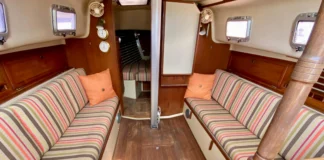
At first glance, the Bayfield 32 looks less like a fiberglass production boat from the 1980s and more like somebody shrank a traditional sailing...