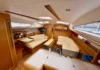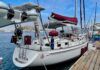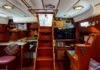

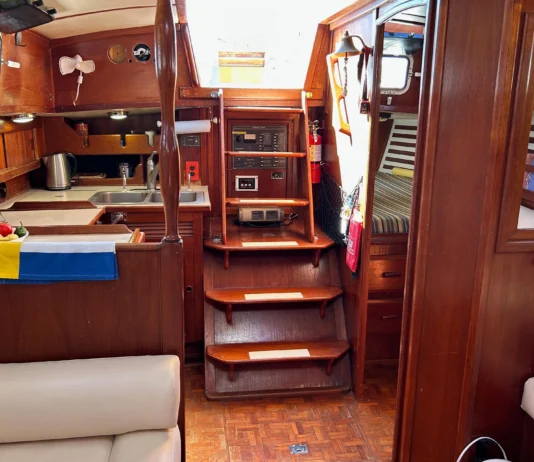
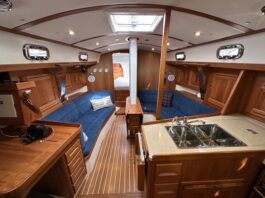
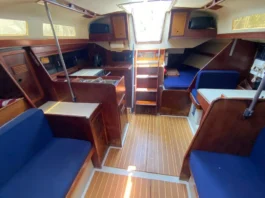
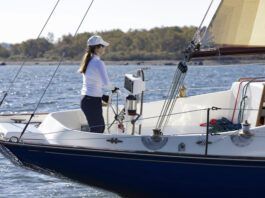
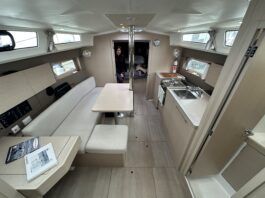
Jeanneau Sun Odyssey 37
This French cruiser has a nice all-wood interior, but a small sail plan for coastal US waters.
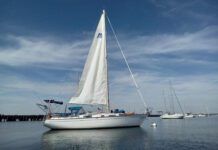
Morgan 38/382
In 1977, the Morgan 382 was introduced, designed by Ted Brewer, Jack Corey and the Morgan Design Team. According to Brewer, the boat was loosely based on the Nelson/Marek-designed Morgan 36 IOR One Ton. The most obvious difference between the 38 and 382 was the elimination of the centerboard and the addition of a cruising fin keel (NACA 64 012 foil) with skeg-mounted rudder. They are two completely different designs from two different eras in yacht design.
Block Island 40
In its heyday, the Block Island 40 had a good racing record. In the 1960 Bermuda Race six of the first 11 places were won by BI 40s, and in 1978, the BI 40 Alaris won her class. Its PHRF rating varies between rig (sloop or yawl) and fleet from a low of 156 to a high of 186. The average seems to be 165. It's difficult to make comparisons, but more contemporary boats with similar ratings include the Hunter 33, Irwin 34 Citation and Island Packet 38. But what's the point? The BI 40 is not a round-the-buoys racer. She's a cruising boat displacing 20,000 pounds.
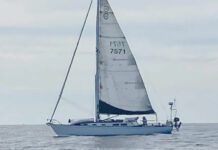
Cal 40
Three decades have passed since Lapworth drew the Cal 40. Today the Cal 40 is a dated design, having been surpassed in her revolutionary features by her descendents. She remains among the esteemed elite of racing yachts, but she is not especially light, long on the waterline, or fast compared to current designs.

Cheoy Lee Clipper 36/42
Cheoy Lee Shipyards of Hong Kong is one of the first molders of fiberglass boats in Asia. The Cheoy Lee Clipper 36 was built from 1969 to about 1988, if the BUC Research Used Boat Price Guide is to be believed. The Clipper 42 was introduced a year later, in 1970. Eventually both were replaced by the more contemporary designs of David Pedrick. We doubt that very many Clipper series boats were brought into the U.S. during the mid or later 1980s.
Columbia 36
The Columbia 36 was in production between 1967 and 1972. One reader estimates that more than 600 were built, making it a very successful model. The Columbia 36 was a pretty slick looking boat in its day, and though its lines have worn reasonably well with time, we're reluctant to call it a "classic."
Crealock 37
This is a conservative boat, devoid of construction razzmatazz. The hull is an uncored, solid laminate. For those living in colder climates and wanting more insulation, the boat can be built with either foam or balsa core, but these are added to the normal hull layup, resulting in a somewhat heavier boat with slightly reduced interior volume.
Freedom 36
Freedom Yachts were the invention of Garry Hoyt back in the early 1970s. An advertising executive and champion one-design sailor, Hoyt reached a stage in his life when he wanted a cruising boat, but he found the existing fleet ordinary and unsatisfactory. So the story goes he set about designing himself a boat. The result was the Freedom 40, an unusual-looking cruiser with a long waterline, conventional hull, and a peculiar wishbone cat-ketch rig.
Jeanneau Sun Odyssey 36.2
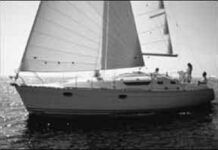
Though designed as a performance cruiser, the designers clearly intended the Jeanneau Sun Odyssey 36.2 to be comfortable at anchor. The French Euro-style favors wide scoop transoms, which the marketing agencies highlight through ads showing bikini-clad girls sitting seductively on the steps, shower head in hand. The 36.2 fits this stereotype.
Express 37
The concept for the Express 37 was developed in 1984 by Schumacher and boatbuilder Terry Alsberg of Alsberg Brothers Boatworks in Santa Cruz. Schumacher's objective was to design a boat that would excel on long ocean races that emphasize performance on reaching and running legs, that would meet the TransPac Race minimum size entry requirements, and also would have at least 6' of standing headroom.
Latest Logbook

Practical Sailor Logbook – September 2026
This month we tour the Hans Christian 48T — the offshore cruiser many sailors call the holy grail — walk the custom Antigua 60...
Video: Morgan 44 Review – The Catalina Cruiser Everyone Forgot
The 1989 Morgan 44 is a big center-cockpit cruising sailboat with Catalina DNA—but it may be one of the most overlooked boats of its...


Latest Sailboat Reviews
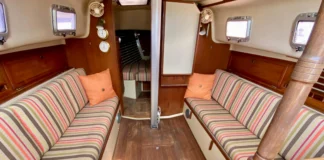
Bayfield 32 Used Boat Review
At first glance, the Bayfield 32 looks less like a fiberglass production boat from the 1980s and more like somebody shrank a traditional sailing...