

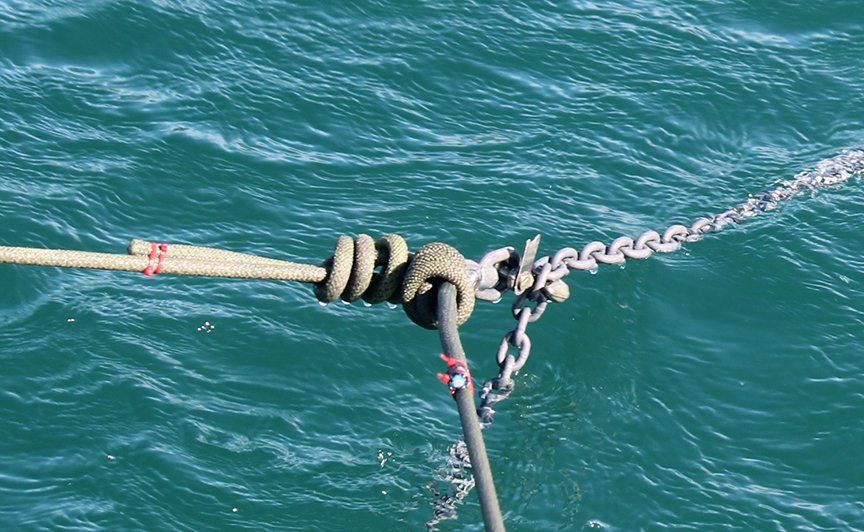
What length, diameter, and type of snubber do you use? What do you need?
The main purpose of a snubber is to reduce loads on the anchor and boat by adding elasticity to the rode. Usually made of three-strand nylon, the snubber joins a strong point on the boat—usually a cleat or a bit—to a link in the anchor chain. In between these two points the chain is slacked to allow the snubber to stretch. If a boat uses a mostly-nylon rode, a snubber can still be used to reduce chafe at the bow roller, hawsehole, or chock.
You can use a variety of hitches for attaching the snubber to chain, but a hook makes it easy to attach and detach. As wind and waves lift the anchored boat, the snubber stretches to reduce, if not eliminate, any shock loads that might jerk the anchor free of its holding or rip a cleat from the deck. In theory, the snubber sounds simple. In practice, there’s a lot more than meets the eye.
Over the years, Practical Sailor has been collecting information on boats that have dragged anchor and wound up lost or in peril. The results of many of our anchoring studies can be found in our ebook on anchoring and mooring, as well as in our online archives. To anyone who has spent a night pitching in an exposed anchorage, it would be no surprise to learn that in many dragging incidents the snubber parted, or was stretched to its limit—allowing the chain and boat to absorb some teeth-rattling shock loads before something finally gave.
What Our Tests Reveal
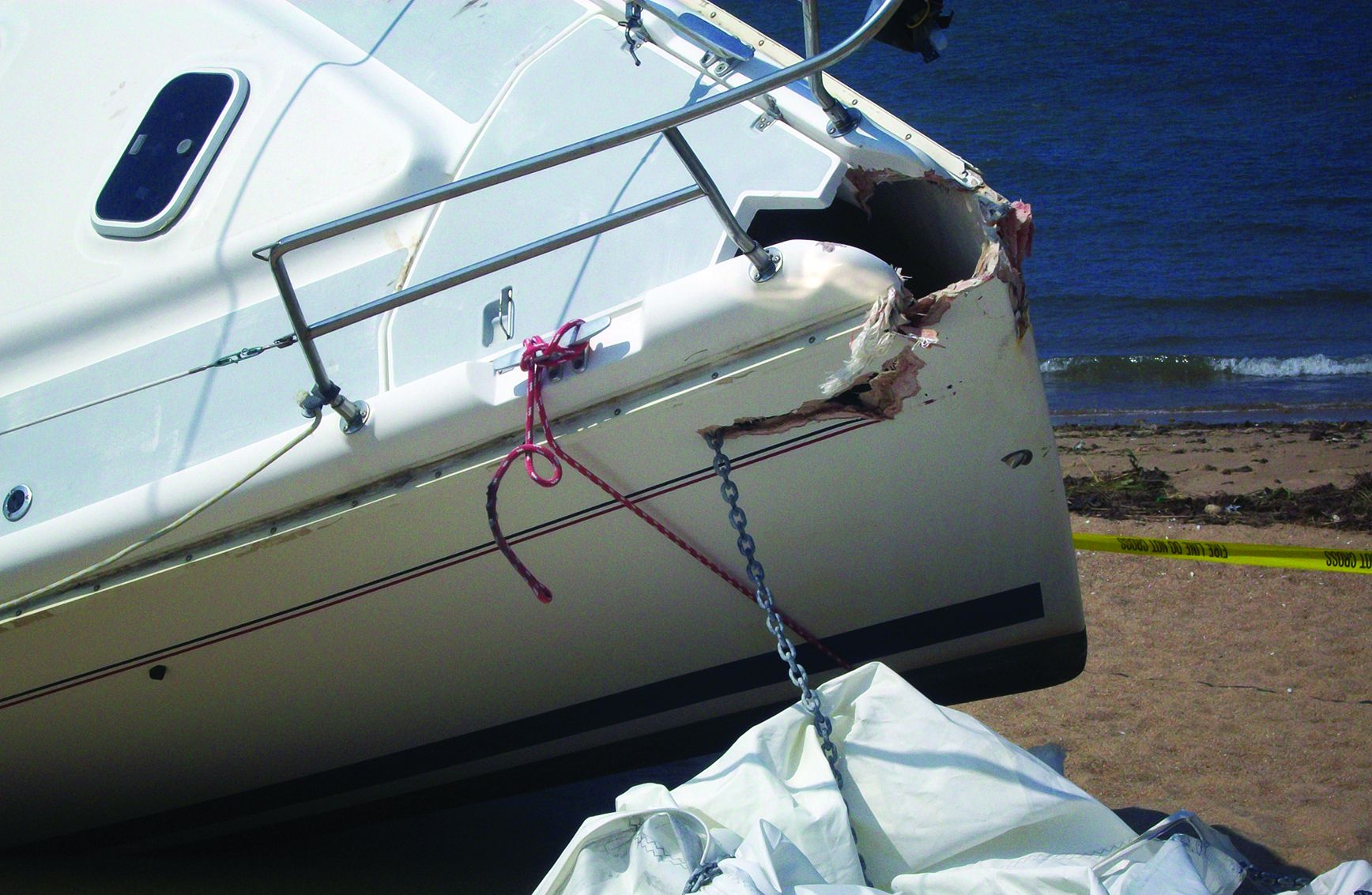
Based on the information we’ve gathered, PS testers devised a series of tests to explore the topic of snubbers in greater depth. Some of their findings run contrary to popular assumptions regarding snubbers. See “What Is the Ideal Snubber Size?” for the full report.
The first assumption is that an eight to twelve-foot long snubber is more than enough to absorb the loads when a squall rolls through an exposed anchorage. The second is that using a snubber hook has no effect on the strength of the chain. It turns out that both of these assumptions can lead to trouble.
A Night on Tosca
The topic interests me personally. One of the most harrowing nights I ever spent aboard my 32-foot ketch Tosca was when she was diving into steep chop among a small fleet of squid boats in an exposed anchorage near Thailand. Sustained winds blew well over 25 knots—gusts blew much higher. One after the other, my snubbers snapped.
On two separate occasions, squid boats, straining under their own anchors, bore down. Being able to adjust the anchor rode, yet still absorb the shock loads in the shallow (less than 20 feet) anchorage became a round-the-clock job. I finally settled on a length of 3/4-inch diameter three-strand nylon used for a kedge and deployed about thirty feet (Tosca weighed in at 12 tons). The engine ran through the night.
How long should a snubber be? What material? And what about diameter?
I’m hoping that you can tell us about the snubber arrangement you use for your own boat, and how it has performed—please leave your comments below.
Neeves’ Long-Snubber Solution
Here’s an example of the snubber used by one of our contributors Jonathan Neeves, who carries out many of our anchor and rode tests. Neeves uses this setup on a seven-ton, 38-foot catamaran that he sails in Australia.
After some rough calculations of loads, Neeves concluded that a snubber of about 30 feet long was the minimum he would need to absorb predicted loads at anchor. While it is hard to envision the idea of a 30-foot snubber extending forward from the bow, it need not extend 30 feet forward of the bow, as he describes below.
On most catamarans, the snubber is a bridle that extends outward from the bow cross beams and attaches to the anchor. Our bridle is formed using two 50-foot long lengths of lightly used 11-millimeter climbing rope (selected for its abrasion resistance and elasticity) and are attached to horn cleats on the stern. (The equivalent would be 12-millimeter nylon three-strand braid or eight-strand plait, either of which would serve well.)
We run the snubber up the side decks, through the stanchion bases. The legs of each bridle then pass through swivel blocks shackled to padeyes that we have installed at each bow. Although each snubber is fifty feet long, we only use about 30 feet; the rest is in reserve.
The individual snubber legs are joined at a shackle with scaffold or halyard knots (climbing rope is impossible to splice). The only tricky part of the installation is reinforcing the area where the padeyes are located. An alternative to the padeyes is to fit the blocks to the forward horn cleats. (We used to do this, securing the blocks with a length of nylon webbing so that they hung outboard.)
Adapting the System to Your Boat
The same system can easily be adopted for a monohull that uses a single snubber. The main variable is how to direct the snubber from the side deck to the chain hook. This will depend on the individual yacht, but fairleads would be an attractive option, probably requiring some form of chafe protection.
If you have a beamy or heavy monohull, a bridle can be more effective at reducing yawing, and yawing can exacerbate snatch loads. The amount of time you invest in developing a sensible system will depend on how much time you spend at anchor. We can be at anchor for three to five months each year, so we wanted something permanent.
More on Hooks and Hardware
For a complete report on snubbers and chain hooks, see “What Is the Ideal Snubber Size?” and “Changing Views on Chain Hooks.”
This article was published on 27 January 2016 and has been updated.









Good article Jonathan… I never really thought about all the variables in anchoring, until a boat near me parted anchor in a storm and fairly flew past my double-anchored boat with snubbers. It was close. Your idea of a bridle on a monohull is interesting as a way to add MUCH more elasticity to the snubber. I’m trying to envision it, and coming up with lot’s of questions: Cleat off the bridle ends at midship cleats, or stern cleats? I can imagine installing fairleads, but how would you prevent chafe? Would you still have 30′ of snubber line extending past the bow? You never said why a “snubber hook” would be a problem… is this something like a chain hook on truckers chains? It sounds like you have been approaching this as a science project… I really appreciate your efforts.
Great article; thanks. I used to use a farmers hook (galvanized chain hook) for the snubbers, but I found that these would sometimes detach; the second there was no load on the hook it unhitched itself. I have used rolling hitches with the 12 mm (1/2 inch line), but as my present boat is a bit of a chunky-monkey, find the 19mm (3/4 inch) line a bit less malleable, and does not seem to make as secure a knot. I don’t want a shackle, but wonder about the Wichard units
I drive a 36 ft ketch rigged vessel with a bowsprite. I use approx. 120 ft of 3/4″ snubber line, for 60ft on either side of the bowsprite, to ensure an even pull. I use the two lines mated to a single Mantus M2 chain hook. After each side is brought aboard, I take a loose single wrap around one of my two 12″ bow cleats, then aft for a few wraps around my primary’s then aft again to my 12″ stern cleats, where the line is finally snubbed. This arrangement ensures that the three structural elements help spread the loads.
I’m using a mantis chain hook to attach a 3/4 “ nylon bridle secured to breast cleats. This greatly attenuates shock loading aboard my 49,000 lb Californian 55.
Darrell, Roxanne, or Tim:
I’ve searched everywhere else looking for a Practical Sailor email.
I am a LIFETIME SUBSCRIBER unable to contact Customer Service. Will you please help connect me? Thanks,
206Giff
“What Is the Ideal Snubber Size?” link is broken (404- Not Found)
I also use used climbing rope – as a climber and a sailor! Depending, I either rig it to just one of the bow cleats, to both, or to a bow cleat and a mid-ship cleat if I need to deal with yaw or a cross current. Gives a ton of flexibility in my setup and is a good use for old rope, which I have plenty of!
Our sailboat has an eye at the waterline for attaching the snubber line. The eye is backed inside the boat with a large plate. (Boat is a Hans Christian 41T). Having the line attached low seems to help reduce the surge load. Granted, this is a single line solution but it has worked well through several situations like the one described on board “Tosca”. We also have two EDPM mooring shock absorbers on the snubber line (the only negative being that in lighter conditions it can create a “rebound” effect as it stretches and relaxes which causes some hunting at anchor, but in heavier conditions this isn’t the case). If one wonders how we deploy with the snubber line attached low on the bow, the answer is the snubber line is always attached on the eye and the bitter end is run up over the anchor roller and secured near the windlass. Have sailed about 4,000 nm this way and so far, so good.