

Estimating Galvanized Coating Thickness
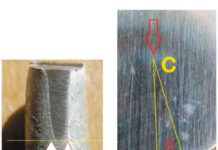
There are no industry standards for how thick a galvanized coating should be on an anchor chain or mooring chain, and manufacturers don't publish this information. Fortunately, with a bit of sleuthwork, you can determine just how good the galvanized coating is on your chain by carrying out a couple of tests on some sample links you can obtain from your local chandler.
Looking into High Test Myth
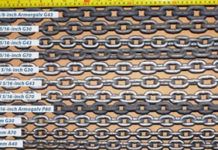
In recent years, our chain tests (see PS September 2006, July 2007, July 2008, and October 2012 online) were limited to G30 and G43 (high-test) chain. Our conclusions were pretty straightforward: We would avoid stainless steel for several reasons, the most persuasive being its tendency to fail without warning-as our test sample did. Recognizing that corrosion is what ends the life of most chains, we were not convinced that shelling out more money for the extra strength of G43 chain made sense. It lasted no longer than G30.
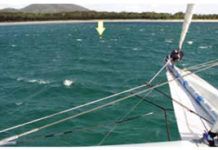
PS Asks Who Would Even Consider G7 Chain?
The value of catenary varies with the depth of the water. In shallower waters, bottom friction replaces gravity as a force of resistance against shock loading.
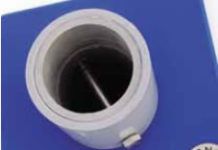
Moorings Soft Side
Every decade or so, local sailing clubs go through a re-evaluation of their mooring fields, looking for ways to improve or upgrade equipment without straining their budget. Island Mooring Supplies, the same Rhode Island-based company that introduced the splinter-free Deluxe Pickup Stick we featured in the April 2010 issue, has developed a new, soft mooring buoy designed to put an end to the annoying hull-knocking of conventional mooring buoys.
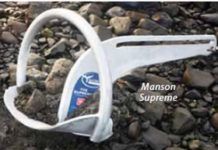
Real-World Anchoring
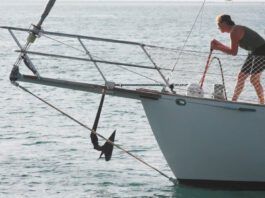
After nearly four decades of being married to my CQR plow anchor, I decided to try a new anchoring solution aboard my Ericson 41, Wind Shadow, and mounted a Manson Supreme on her bow roller. Ill be long-term testing the Manson, but heres a preliminary look at the CQR and the Manson.
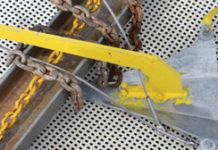
Anchor Rode Report
In our continuous research of ground tackle, we noticed that large oil rigs are often anchored into place with a spider web of stranded wire-or in some cases, Dyneema, a low-stretch, high-strength synthetic fiber. We wondered whether Dyneema or a wire cable might have some application in recreational sailboat anchoring, and we launched field tests to find out. These tests also looked at how changing the diameter of your anchor chain affects anchor performance.

Rodes Tested from Shore and Catamaran
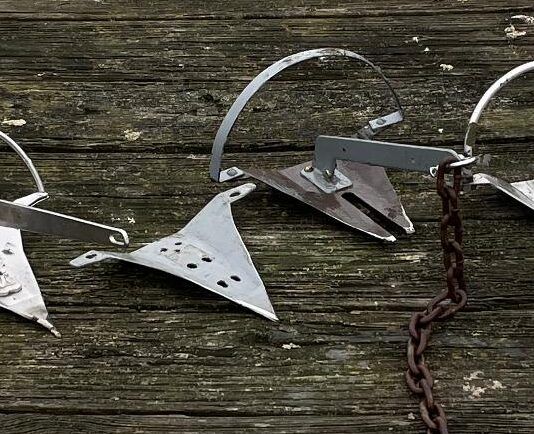
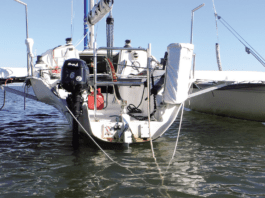
Our test anchors included a small, 11-pound Spade anchor, which we set using a chain winch off a beach in Pittwater, Australia. We set the anchors using two different rodes: 30 feet of 5/32-inch stainless wire strop that we fabricated using old lifelines and 33 feet of quarter-inch, short-link BBB chain. We extended each rode with 5/16-inch chain and aimed for length-to-depth ratio of a 5-to-1.
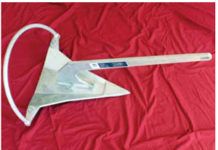
Mantus Upgrades to a Stronger Shank
Late last year, we had our first look at the bolt-together Mantus anchor. Although we liked the design, and prices were favorable (around $330 for a 35-pounder), we raised concerns about the shank strength, which by our estimation was the weakest of all anchors of a similar design.
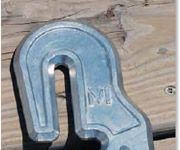
Mantus Anchor-chain Hook
Practical Sailor recently looked at various ways to take the load off the windlass and roller by means of a short rope snubber or bridle, but we did not talk about how to attach a snubber to the chain. The Mantus Chain Hook takes an innovative approach, and seemed particularly useful for catamaran owners with long bridles. Testers put the 1/4-inch stainless Mantus hook through more than 50 anchoring cycles and dozens of tide cycles aboard a PDQ 32. Find out how the Mantus fared.

Where Credit Is Due: September 2013
Alpenglow I would like to take this opportunity to express my gratitude to (and recommendation of) the folks at Alpenglow Lights (www.alpenglowlights.com). We have many of their fixtures and have contacted the company on numerous occasions for new sales, upgrades, and technical questions. Without fail, they have exceeded our expectations, from offering to perform upgrades at minimal cost, to telling us secret workarounds that enabled us to use locally sourced parts and supplies to re-invigorate their excellent lighting units.
Latest Logbook

Practical Sailor Logbook – September 2026
In September we tour the Hans Christian 48T — the offshore cruiser many sailors call the holy grail — walk the custom Antigua 60...
Video: The BEST Sailboat You Can Buy for $35,000 – Catalina...
If you’re searching for a mid-30-foot sailboat, affordable cruising sailboat, liveaboard sailboat, first sailboat, or a capable used sailboat for coastal cruising, the Catalina...



Latest Sailboat Reviews
Learning by Doing on a $5,000 Catalina 30 Mk II
When Davis’s mother started talking about wanting to do something “big” for retirement, Davis and Gloria half-jokingly threw out an idea that seemed suitably...