

All is Lost and Found
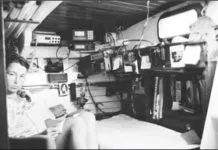
A photographer friend stumbled upon this photo of my wife, Theresa, from our cruising days. It was taken in Fiji around 1995. She doesn't usually look this serious; it probably had something to do with having two guests on board a cramped 32-foot Atkin ketch for a couple of weeks. I thought the image illustrated well something that Ive been thinking about lately: the value of resourcefulness while cruising. This notion of the self-sufficient sailor came to mind most recently while watching the movie trailer for All is Lost, in which a single-handed sailor (played by Robert Redford) tries to keep his beloved Cal 29 afloat.
Shockles Snubber Test
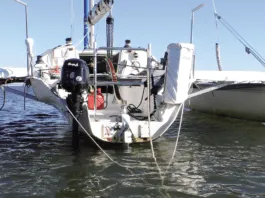
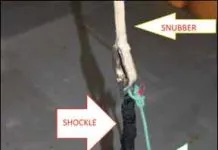
The string of anchor tests weve carried out in the last year presented a good opportunity for us to also test an anchor accessory: the Shockles anchor snubber. Makers claim it helps your anchor stay set by reducing the constant shock loads during strong winds or in rough seas. We did some real-world testing aboard a 6-ton Lightwave 38 catamaran in a range of conditions and anchorages, and we also bench-tested the snubber, using a load cell and chain winch.

Mailport: June 2013
How thick is too thick for the buildup of old layers of bottom paint? This question arises because I have just finished painting the bottom of my boat. Even though I diligently sought out potential flaking spots with my knife, while rolling on the paint (Pettit Ultima Eco), I would frequently get a mess caused by the paint flaking off. I have only owned this boat for three years, so I really do not know how many layers there are.
Anchor Tests: Bending More Shanks
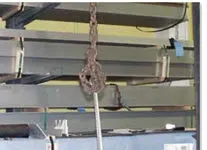
In the first part of this series on anchor-shank strength, we examined how the shanks of anchors that supposedly met the most stringent industry standards could bend under loads that a typical cruising sailboat could encounter. With this installment, we wanted to demonstrate how that might happen in a fact-finding field test. Based on our previous findings, we concentrated our study on a specific group of anchors and specific type of load. The anchors are regarded as super high holding power (SHHP) anchors, and the load was a sudden, snatch (or dynamic) load applied at a 90-degree angle to the direction each anchor was set.
Bends and Breaks: Anchor Shank Strength
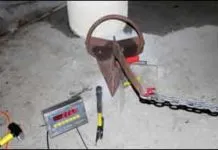
As more and more anchor-makers source their materials and move their fabricating offshore, Practical Sailor has been fielding an increasing number of questions about anchor quality. Is the tensile-strength steel used to fabricate anchors consistent with the application? Is anyone actually measuring shank strength? And how much does it matter? At the heart of this discussion is shank strength. There seems little point in having a high holding-capacity anchor, if the shank isn't strong enough to cope with projected loads.

A Second Look at Anchor Tests
Anchor testing at Practical Sailor has always been a controversial enterprise, sure to fire up someone. As one reader commented in response our most recent anchor report (PS, March 2013): Anchors are a whole lot like religion. No matter what the tests show, each of us has a favorite that well defend to the death! This month, our report on anchor-shank strength approaches the topic from a different angle. Rather than singling out specific anchors for holding power or design, we take a closer look at the way anchors are evaluated and promoted.
The Hassles of Hockles
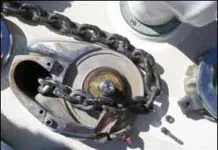
Taking the advice of a PS review, I installed a Lewmar V2 windlass on my boat in 2008. I went with the installers recommendation of 100 feet of galvanized chain and 100 feet of eight-part braid, connected with a rope-to-chain splice, and I have a Delta 35 anchor. I found that a chain hockle (a twist in the chain that jams the windlass) will terribly mangle the vertical windlass. I have just completed my second mangling and ordered replacement parts-but these parts will not save me from the next mangling. The Lewmar distributor told me to install a chain swivel, but PS has warned about this (PS Advisor, May 2010). Is an all-chain rode a dumb idea? Is there some solution?
Anchor Resetting Tests
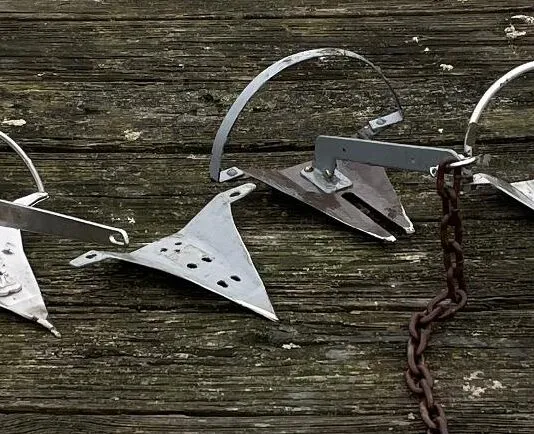
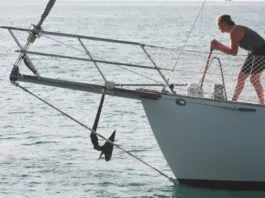
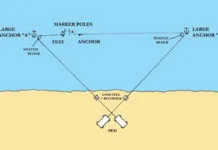
Practical Sailor has carried out dozens of anchor tests over the years. This month, we set out to compare anchor performance when the boat position changes under the forces of wind or tide, a shift that often causes the anchor to move and reset itself. The test compares 12 anchors, including some newer fixed-shank anchors-such as the Rocna and the Manson Supreme-and some concave fluke designs similar to the Spade, one of the strongest performers past tests. The test field included: the CQR, Spade, Ultra, Super SARCA and SARCA Excel, Manson Supreme, Rocna, Kobra, and the Lewmar Claw.
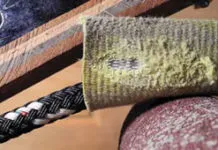
Round 2: Chafe Gear for Mooring and Dock Lines
With hurricane season in full swing and volatile fall weather approaching, storms can threaten the safety of sailboats by placing extra loads on dock and mooring lines. In the July 2011 issue, Practical Sailor evaluated rope chafe protection and found Fjords Chafe-Pro chafe guard trumped products from Taylor Made, Fiorentino, and Davis Instruments. This followup report-the result of aggressive bench testing and long-term field testing-compares the top pick Chafe-Pro to new mooring and dock line protection from Fjord and Robship, as well as do-it-yourself options like fire hose, leather, and a homemade Kevlar/Acrylic sandwich.
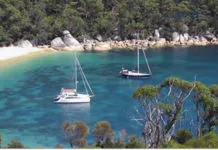
Anchor Testing and Rode Loads
Many published anchor tests focus on holding capacity, and most conclude that newer, concave fluke-design anchors such as the Spade, Rocna, and Manson anchors perform better than older, traditional anchors such as the plow-design CQR, claw anchors like the Bruce, and Danforth-style anchors such as the Fortress. But how useful is this data? Rather than just testing anchors to specific, fixed loads, PSs recent evaluation raises questions about the various wind-induced loads placed on anchors in real-life situations and how future anchor tests should be carried out.
Latest Logbook

Practical Sailor Logbook – September 2026
In September we tour the Hans Christian 48T — the offshore cruiser many sailors call the holy grail — walk the custom Antigua 60...
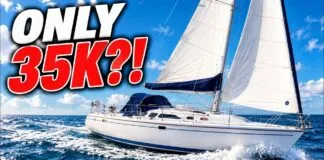
Video: The BEST Sailboat You Can Buy for $35,000 – Catalina...
If you’re searching for a mid-30-foot sailboat, affordable cruising sailboat, liveaboard sailboat, first sailboat, or a capable used sailboat for coastal cruising, the Catalina...

Latest Sailboat Reviews
Learning by Doing on a $5,000 Catalina 30 Mk II
When Davis’s mother started talking about wanting to do something “big” for retirement, Davis and Gloria half-jokingly threw out an idea that seemed suitably...