


Controlling Motion: Two Case Studies
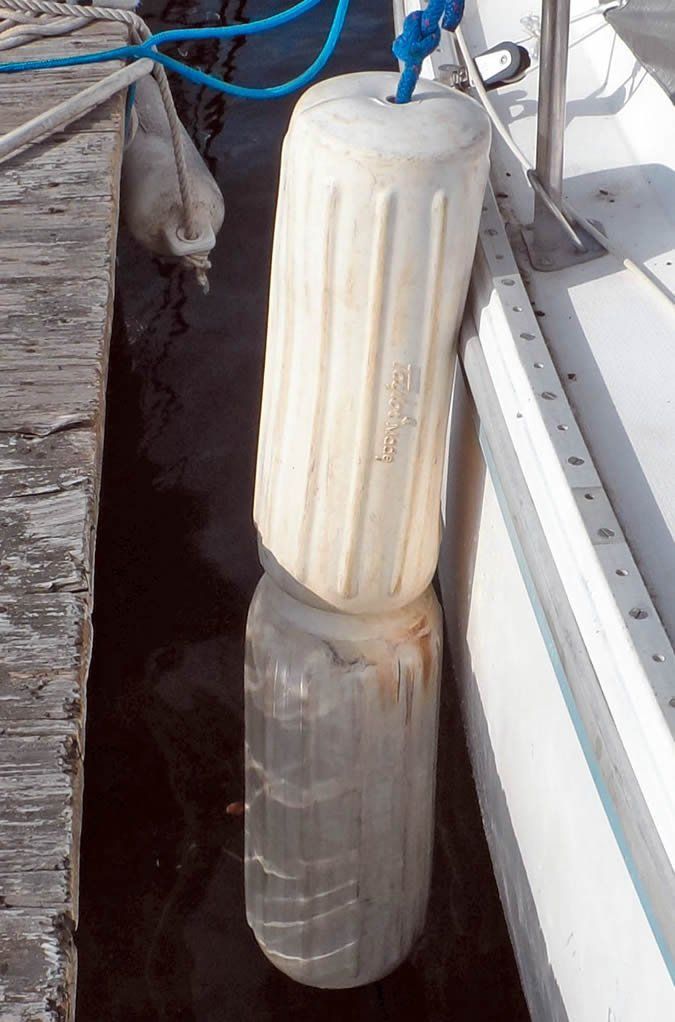
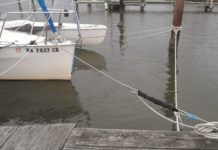
Securing a small boat between pilings in a wrong-sized slip is a common challenge. The dock line angles from the dolphins (outlying pilings) are too narrow for a beam wind, allowing the boat to dance around, increasing forces, chafe, and even making it difficult to stand in the cockpit. During a recent winter near-gale we measured dockline forces on several smaller boats that reached four times higher than the static wind load. If the recommended size dockline was used, the rope would be operating beyond its working load limit in real storms and could fail. Increasing the line diameter would result in more jerking and chafe.
Banish Junky Anchor Rode Markers
For the boat owner who thinks he has everything, there is yet still another bit of electronic wizardry…a widget that tells you how much...
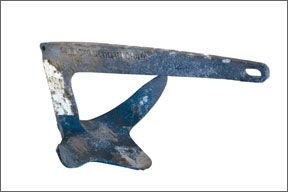
Testing the Limits of Tiny Anchors
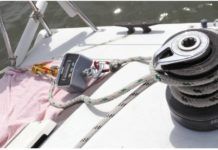
Each anchor was pulled in both a straight line and at 90 degrees in both soft mud and firm sand at a 10:1 scope. All findings regarding load were recorded with a calibrated load cell. Testers performed the 90-degree test by lightly setting the anchor (with a 15-pound load in mud, 40 pounds in sand) and then slowly pulling at a 90-degree angle, as though the wind or tide changed. Additionally, each anchor was used day-in, day-out aboard an inflatable dinghy to evaluate ease of use and real-world effectiveness.
The No-sew Webbing Strap with Link Buckle
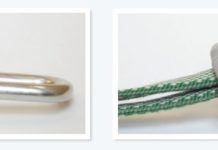
Weve sewn our fair share of eyes in nylon webbing, but heres an easy no-sew alternative for creating a webbing strap with a buckle (shackle) that can be used for easily lashing down the dinghy, a battery, or even holding up your pants in a pinch. It is based on stuff a sailor has on hand-webbing, a chain link, and a shackle-and is as strong as professionally sewn ends, plus it can be untied after loading. It has tested at greater than 85-percent breaking strength and 100 percent of minimum rate strength, and it works on both nylon and ultra-high strength materials like Vectran webbing.
Assessing the Anchor Kellet
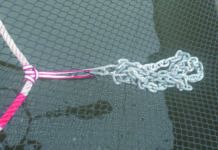
One of all-chain rodes most popular features among cruising sailors has little to do with anchoring-and everything to do with stowing. With a well-designed bow roller, windlass, hawse hole, and chain locker, your rode and anchor will deploy and stow belowdecks faster and with far less effort than nylon rode requires. But for a smaller boat without a windlass or deep chain locker, an all-chain rode is often impractical. Even cruising sailors who are perfectly equipped for all-chain anchoring often find that their nylon secondary anchor better is suited for some anchoring situations.
How (Not) to Tie Your Boat to a Dock
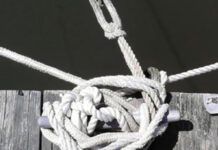
No sailor can resist the temptation to look over another sailors work, and nothing draws the eye faster than your neighbors docklines. We like to know our boat and our neighbors boats will be where we left them when we return, not rubbing together or worse. Sometimes, however, a stroll down the dock makes us nervous. This gallery of rogue docklines represents only a taste of what PS tester Drew Frye found within a short walk of his slip. How many of these will come loose during the next storm?
Clear the Decks: Anchor Wells and Bow Rollers
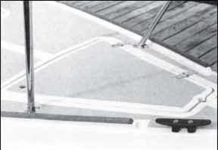
Ever since some ancient mariner broke a toe tripping over the killick stowed in the bow of his curragh, sailors have sought to solve the mysteries of ground tackle stowage. The solutions have been endless, and as a rule compromises. A significant portion of the interior volume of a 19th century warship was given over to the storage of anchor rode. Even aboard modern boats, the search for the proper stowage of several anchors and chain, plus hundreds of feet of sometimes slimy nylon anchor line, is one that occupies both designers and boat owners. Two "modern inventions" — the anchor well, and the bow roller — have greatly eased many of the problems of ground tackle stowage. But even these developments vary greatly in quality and design, some creating more problems than they solve.
Chain, Chain, Chain:Mooring Rig Test Begins
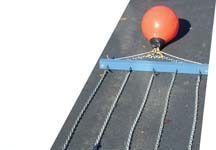
Slips too expensive? A mooring may be your answer. We search for the toughest chain.
Master the Sailing Basics: Never Stop Learning the Little Things
Seamanship is about big concepts and small skills. They work together, but we see them differently and they represent different types of learning. Big...
Mailport: Tourniquets at Sea
Add a tourniquet to your first aid kit and know how to use correctly - it is less likely to accidentally loosen or inflict additional tissue damage.For further training, I would refer you to the American Red Cross, they have a Basic and Advanced First Aid certification, and along with the American Heart Association offer classes in cardiopulmonary resuscitation, and the use of automated external defibrillators (AEDs).
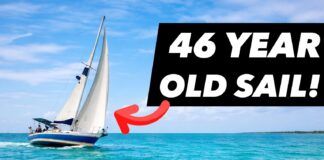
How Long Do Sails Last?
How long do sails actually last? Sailmakers often say cruising sails last around 10–15 years, but what happens when you discover a sail that’s...



Latest Sailboat Review

Jeanneau 55 Boat Review
This recent sailboat from Jeanneau may as well be a spaceship. They’ve taken all the time-honored designs of a monohull aft cockpit and turned...