


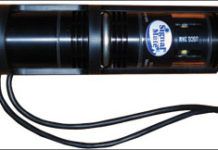
Spreader Light Test
Sailors often have a love-hate relationship with spreader lights. They can turn a dark deck into broad daylight, making foredeck tasks much easier, but the downside is the pitch-black abyss that extends beyond the deck. Testers reviewed 10 LED and xenon lights designed for mast, deck, and spreader mounting. We considered useful light output, power draw, durability, and price. The test field included lights from Dr. LED, Forespar, Hella, Scandvik, and Signal Mate.

Seeing the Light on Night Vision
A few weeks ago, I found myself in the desert at night and reflected upon how much the wide expanses of sand and rock in the American Southwest resemble the sea-especially after the sun has set. Away from the loom of the lights of Moab, Utah, my wife and I stood in an empty parking lot looking to the east, where the pyramid peaks of the La Sal mountains were silhouetted by the light of the full moon, still invisible below the horizon. Wed arrived to Arches National Park at night, driving through the blackness, following our headlights to the third or fourth pullout on the winding road into the park. We missed the sign identifying the pullout, so the geographical feature that the viewpoint was meant to serve remained a mystery.
Rope vs. Wire Lifelines
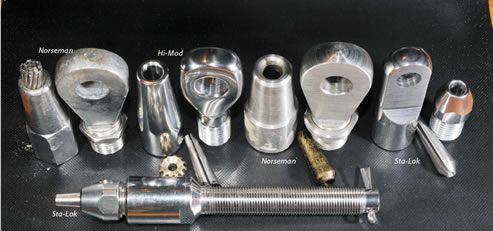
Three years ago, I bought a 1968 Hinterhoeller HR28 from a local junkyard that had paid $250 for it with plans to salvage the lead keel and Sawzall the rest. Ive spent almost three years on an amateurs refit. Now, I need new lifelines. I know that plastic-coated wire is out-of-favor and that race-sanctioning bodies now approve of high-tech (and high-priced) ropes. What risks am I taking if I just use a cheaper and thicker rope-something like Samson LS 3/8-inch with a tensile strength of 3,700 pounds? Stainless-steel 3/16 lifeline wire is rated at 3,700-pounds breaking strength. Are tensile and breaking strength the same?
Mailport: July 2013
A few issues ago, you had a short article on deck hardware (blocks, traveler, cars, etc.) that included Garhauer, and you mentioned that the manufacturer offered individual parts and complete systems that allow conversion from on deck to cockpit adjustment of the car position. We recently installed the EZ adjustable genoa car system from Garhauer and are very pleased with the results. This equipment fits on existing traveler tracks, is easy to install, and performs as advertised.
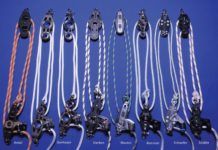
Mainsheet Tackle Bench Test
Stroll through your local marina, and youll likely see plenty of resurrected, vintage sailboats sporting fresh paint and new rigging, but all too often, antique mainsheet blocks have somehow escaped the upgrade. Part of the reason for this oversight is that the sheaves get only an occasional, no-load test spin, and all but the most severely deteriorated pass the scrutiny. A mainsheet tackle upgrade can be a relatively inexpensive investment that pays high dividends in improved sail efficiency. Practical Sailor tested eight 4:1 mainsheet tackle systems sized for 20- to 30-foot sailboats to find out which is the best. The test field included fiddle blocks and fiddle blocks with cams from Antal, Garhauer, Harken, Ronstan, and Selden.
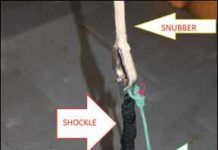
Shockles Snubber Test
The string of anchor tests weve carried out in the last year presented a good opportunity for us to also test an anchor accessory: the Shockles anchor snubber. Makers claim it helps your anchor stay set by reducing the constant shock loads during strong winds or in rough seas. We did some real-world testing aboard a 6-ton Lightwave 38 catamaran in a range of conditions and anchorages, and we also bench-tested the snubber, using a load cell and chain winch.
Summer Sailing Gear
Summers warm breezes and lazy weekends have arrived, so PS testers have put together a lineup of cool toys and tools for the dog days. Tower Adventurer Inflatable Standup Paddleboard: Inflatable SUPs are sprouting up everywhere on the Internet; many boards are identical, made by different brands at the same factories in China. Quality varies. Generally, boards 6 inches or thicker offer better stiffness and stability, making them easier to ride.

Mailport: June 2013
How thick is too thick for the buildup of old layers of bottom paint? This question arises because I have just finished painting the bottom of my boat. Even though I diligently sought out potential flaking spots with my knife, while rolling on the paint (Pettit Ultima Eco), I would frequently get a mess caused by the paint flaking off. I have only owned this boat for three years, so I really do not know how many layers there are.
Anchor Tests: Bending More Shanks
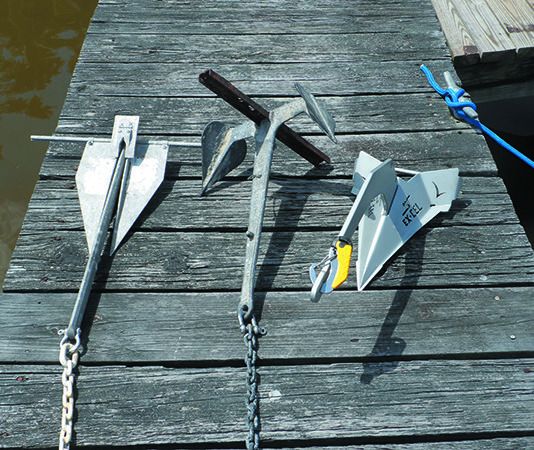
In the first part of this series on anchor-shank strength, we examined how the shanks of anchors that supposedly met the most stringent industry standards could bend under loads that a typical cruising sailboat could encounter. With this installment, we wanted to demonstrate how that might happen in a fact-finding field test. Based on our previous findings, we concentrated our study on a specific group of anchors and specific type of load. The anchors are regarded as super high holding power (SHHP) anchors, and the load was a sudden, snatch (or dynamic) load applied at a 90-degree angle to the direction each anchor was set.
Bends and Breaks: Anchor Shank Strength
As more and more anchor-makers source their materials and move their fabricating offshore, Practical Sailor has been fielding an increasing number of questions about anchor quality. Is the tensile-strength steel used to fabricate anchors consistent with the application? Is anyone actually measuring shank strength? And how much does it matter? At the heart of this discussion is shank strength. There seems little point in having a high holding-capacity anchor, if the shank isn't strong enough to cope with projected loads.
Lithium Batteries on Sailboats: The 3 Mistakes Everyone Makes
Lithium batteries are one of the most popular sailboat upgrades today—but they’re also one of the most misunderstood. In this Practical Sailor Saturday episode,...



Latest Sailboat Review
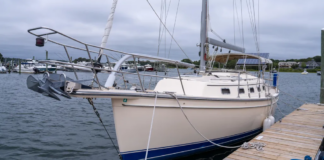
Island Packet Estero Used Boat Review
Florida-based Island Packet targets a relatively narrow niche, so the toughest competitors to its new boats are often older Island Packets. Introduced in 2010, the 36-foot, shoal-draft Estero is the company’s latest attempt to introduce a distinctive model that doesn’t stray too far from the company’s proven formula for success: moderate displacement, full-keel cruisers designed to be lived on, sailed far and in comfort, and endure the bumps, scrapes, and storms that cruising boats inevitably encounter. After sailing the Estero on Florida’s Sarasota Bay and inspecting its interior, construction, and systems, Practical Sailor testers noted that the shoal-water cruiser will appeal strongest to Island Packet fans who’ve been waiting for a shoal-draft, easy-to-sail boat that compares to the IP37 in terms of interior space. These strengths will be most apparent on intracoastal or riverine adventures like the Great Loop.