

While you may feel the pressure to constantly update your boat tech, its important to understand which features are worth opening your wallet for. The latest advancements offer ways to stay connected with loved ones and monitor your boat from afar, for example, among myriad other features. The latest developments in solar, batteries/controllers, cloud-based apps, fridges and beyond allow sailors to navigate and live at sea in more modern ways, while the advancements draw less power and come in lighter weight packages. As a boat surveyor, I’ve seen how boat tech has been changing over the decades and what follows are my observations as to what new tech is most popular—and which tech needs further development before its worthwhile to invest in.
Note: Although most of the components listed in this article have been available for some time, it’s only recently that a focus has been put on making them more efficient and more affordable.
Solar
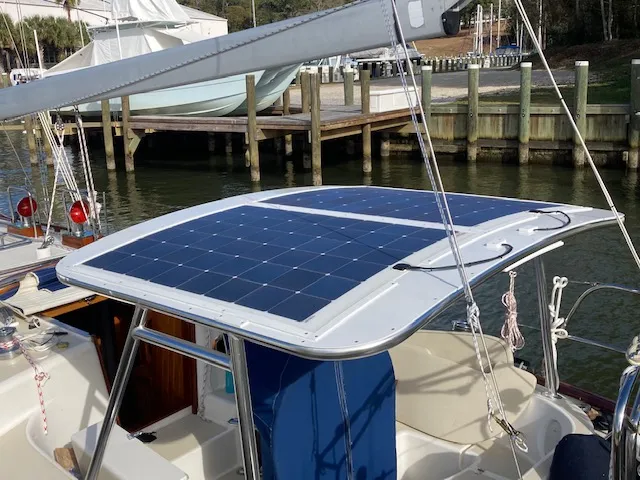
Smaller, lighter, thinner and more efficient—solar panels are no longer the big beasts that they once were. Rigid panels have improved a lot but remain big and take up a lot of space. Flexible panels are a great alternative and can been seen more frequently on sailboat biminis. Although currently being outperformed, flexible panels are still relatively new technology and are steadily improving.
As technology advances, some recent prototypes that have gained interest are titanium cells, anti-solar panels that produce energy at night and double-sided cell panels that catch the sun’s reflection from the water, in turn doubling your solar input.
Batteries
Lighter, high amp hours and maintenance free. Are there any downsides to LiFePO4 lithium batteries? This question can be argued, but the pros outweigh the cons many times over. The days of the heavy lead batteries with their maintenance are gone. Lithium gives you added amp hours, reduced weight and an average of 5,500 discharge cycles, making them last an average of fifteen years. Up and coming is a wall mounted 12-volt unit. They are currently only available for 48-volt systems.
Lithium iron (LiFePO4) batteries are safe to have on a boat compared to the lithium-ion batteries that are a fire hazard and used in electric vehicles. Don’t be too quick to entirely dispose of your lead or AGM batteries. They are still recommended to start your engine and use on powered winches and windlasses, see “Lithium Batteries for Small Boats,” Lithium Batteries for Small Boats: Install Guide,” and “Lithium Batteries for Small Boats: Troubleshooting.” Lead batteries can provide the large rush current with its cold-cranking amps that lithium batteries struggle with.
MPPT controllers
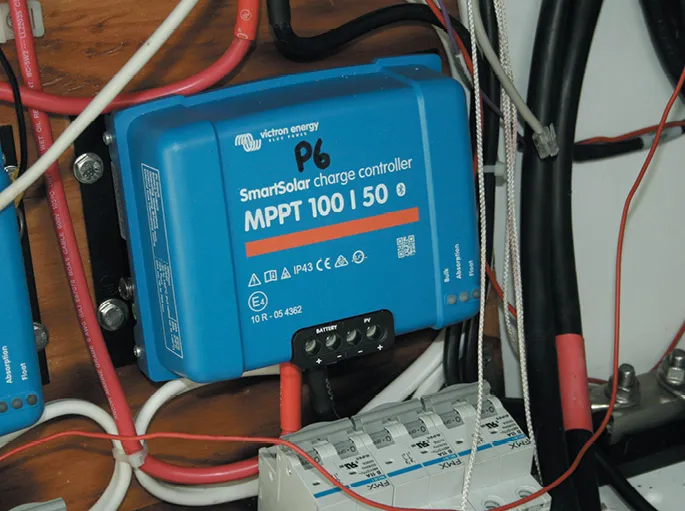
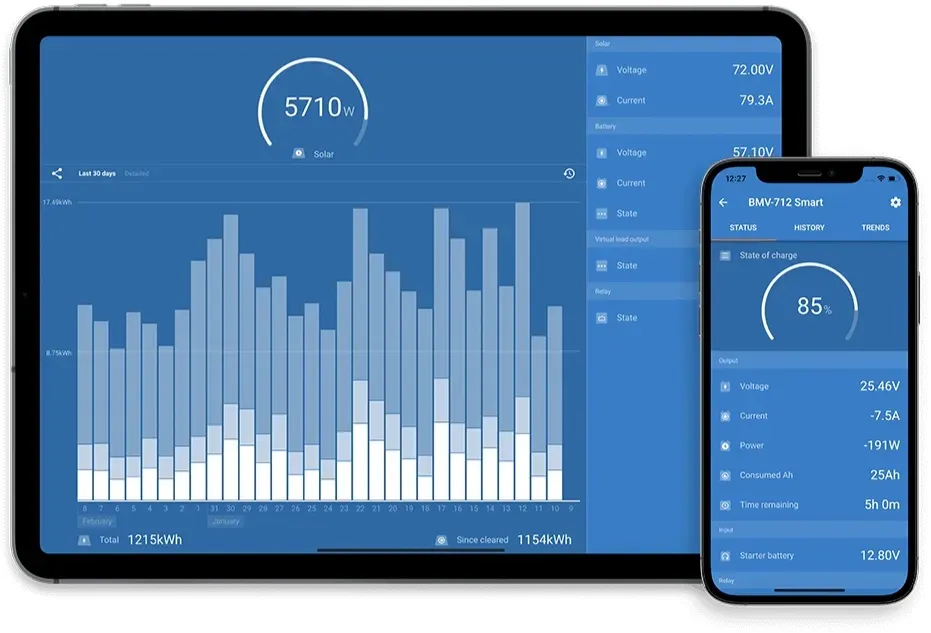
MPPT controllers have been around for years. They efficiently distribute the solar input from the panels to your batteries and increase the necessary output during consumption. Many of the MPPT controllers now have integrated Bluetooth and a such as VictronConnect for your smartphone, laptop or tablet. No more need for a battery shunt or a secondary battery monitor. You can view exactly how the solar system is working. The software will display the wattage or amperage input and output. It will tell you what your battery percentage is, and you can even customize the software to give your daily, monthly or yearly averages.
Bluetooth only works when you are in a certain range, usually on your boat which in most cases is all you need. For those that want to check their solar system from anywhere in the world, a cloud system is now available and is discussed further in this article.
Fridges and Coolers
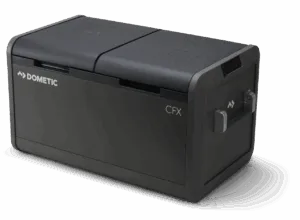
No major changes have been made to these systems except for the amperage draw. What used to be an average of 6 amps has dropped to an average of 2.5 amps. The coolers are still heavy and bulky, and the fridge inserts basically look the same. The advancement of the lowered amperage draw is beneficial for those cruising.
The Dometic brand has a very high-end portable cooler with a high price tag averaging USD $1,200. Many sailors are using Dometic because of their rugged aluminum construction, ultra-low power consumption and reliability. Other brands such as BougeRV, Bodega and ICECO also sell reliable coolers at a much affordable price.
Chartplotter
A great invention that has been around for decades. Gone are the rolled-up charts that tore, got wet and ruined from charting routes. They took up precious stowage space and were expensive. Chartplotters changed all of that and just like any other electronics screen, they now have touchscreens. You can scroll and zoom in and out quickly and precisely, see “Which Chartplotter is Best For You?”
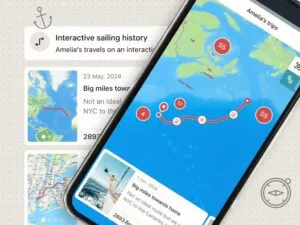
The integrated software lets the navigator share their screen with any other device onboard. From the chartplotter at the helm to the tablet in the cabin and the smart phone in the states room, everybody has access to the destination. Navionics is by far the most popular and advanced marine navigation app that enables this. Thanks to apps such as SeaPeople and Argo, the folks back home can follow your travels and live vicariously.
Note: You might also want to keep a few paper charts in case technology fails, see “When Electronics Fail: How to Navigate After Lightning Strikes.”
The downside is the added cost to the already expensive anti-fouling paint. The average price for a 32-ft. boat system is USD $1,100.00. However, anti-fouling paint has really increased in price over the years so if an ultrasonic system prolongs the paint, it might be worth trying.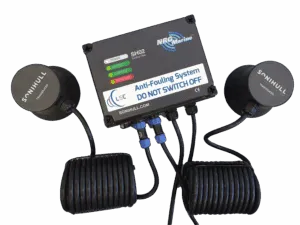
Satellite Communication
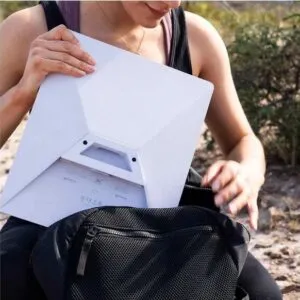
Not too many years ago, it was difficult to imagine yourself cruising and still being able to work online. Starlink changed that and is still evolving. The new Starlink Mini, which was released less than one year ago, is the size of an 8 ½ x 11-in. sheet of paper and doesn’t weigh much more. It draws 2 to 4 amps and can be permanently mounted or taken with you on shore. The setup is simple, and the hardware is minimum. The download and upload speeds depend on the location and amount of users nearby, but having a video call is rarely a problem.
The Starlink mini sells for USD $500.00 and offers two monthly data ROAM package option. Package one is USD $50.00 and gives you 50 GB monthly, while package two has unlimited data for USD $165.00 per month. This is a great option for coastal cruisers. Some may find the price tag a bit steep, but I think most would agree that it is worth the freedom of movement it allows.
Cloud Integration
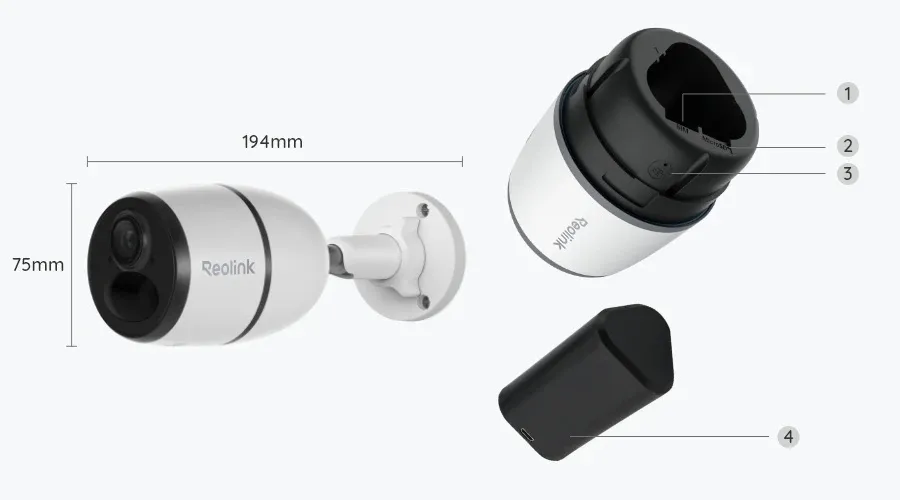
Cloud integration is definitely the buzz word of the last few years. Cloud software has replaced our USB thumb drive for our laptop, given us ample space to store our music and movies, and most recently given us access to our boat while being anywhere in the world. With cloud integration you can monitor your solar input, battery levels, your boat’s location via GPS, security cameras and even monitor your bilge.
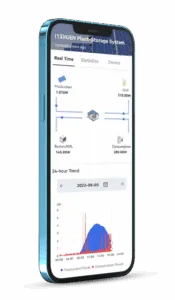
Two of the most popular apps to monitor the solar system are Solarman and SolarCloud. They are free of charge on Google Play Store. If you’re interested in keeping an eye on the location of your boat while away, iTagPro and i-Track are both highly recommended GPS trackers. They are made of plastic, are the size of a coin and very inexpensive. They come with their own tracking app.
Security cameras usually come with their own proprietary software included when you purchase the security system. One of top-rated sellers is called Reolink. Its system allows you to watch live streams over the web, save your data in a cloud and offers night vision capability. For some this is peace of mind and for others it’s an added stress factor of being able to monitor your boat from afar.
Conclusion
There’s a common factor in nearly all the advancements in the article. They draw less power. Everything new must draw less power and I believe the trend will continue. Solar will be more powerful, lithium batteries might be replaced with something even better and anything digital will have more memory and better graphics.
It’s impossible to keep up with technology at today’s rate. We would be installing a new kind of system every six months. We must be content at some point with what we have or else we will never truly enjoy our sailboat. Although we are living in a time of progressive change, it’s important to remember to enjoy what we have and sail.







Great article Ray!
I must add that when it comes to navigation aids, one can not ignore the advancements in navigation apps, as well as their conveniences.
More and more they are becoming popular with boaters all over. On my boat I do have a full array of interconnected devices using SeaTalk etc.
However I find myself using my navigation app more and more. I’ve learned all it’s features and use it anywhere on the world on any boat. No need to relearn a new navigation device when on another boat, such as a bareboat charter.
Although I have three apps on my phone and tablets, my app of choice is Savvy Navvy.
A few thoughts: for LifePo, aside from using agm for start batteries and windlass, it is also important to have primary navigation systems with a fully non LifePo backup. We to often see LifePo systems shutdown suddenly with out warning, leaving mariners with a “dark ship” scenario.
Another technology issue is digital switching and controls. Basically when the network goes down all digitally switched systems are off line. This could be navigation lights, chart plotters, on some boats even the bilge pumps. Networks should be segmentented into discreet categories. IE the galley controls need not share a buss with the auto pilot (but they usually do).
Always weigh the true gain of technology, like massive gains in efficiency verses the consequences of systems than cannot be repaired or over ridden at sea. A modern high-tech charging system may be good, but a high-tech electrical backbone may be un-reliable and difficult to to trouble shoot and repair.