

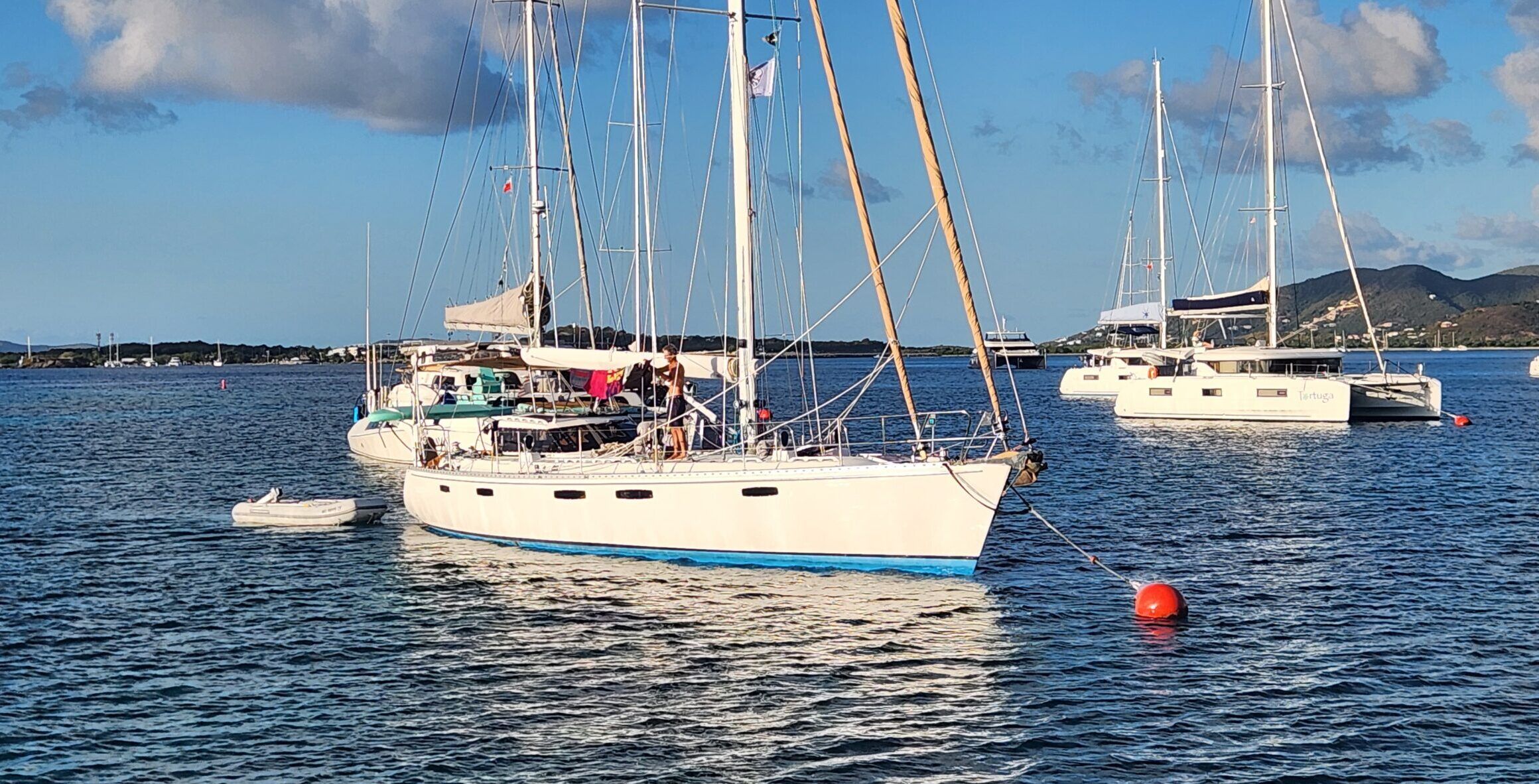
In “Anchoring Basics: Choosing Gear and Setting the Hook,” I reviewed the basic anchoring gear and techniques used to properly drop and secure the anchor. Besides safety, the objective was to provide sailors who hesitate or avoid anchoring simply due to lack of confidence the info needed to anchor successfully. After a great day of sailing, anchoring in a quiet anchorage, whether for the night or just a few hours, can really augment the total enjoyment of the whole boating experience.
To continue reading this article or issue you must be a paid member. Sign in

Join Practical Sailor
Get full access to Practical-Sailor.com – more than 4,000 articles – for just $34.
Join today and save 42% off our full price.






Those are very good hand signals I find talking over them quickly before an evolution is helpful. For getting off anchor under sail it helps to use the sails and natural swing to “sail” your way forward towards the anchor. If you time it correctly the anchor can come off the bottom on a closehauled course making for a clean exit
Hi Benjamin anc thanks for taking time to share your technique. It is indeed a good way to sail off the hook and have done so in quiet anchorages. Easier to do with someone at the helm.
Sticky bottoms present an additional complication. If there was wind and waves overnight, or even if the anchor was well-set, it is not just coming up. It is stuck, or at least it will take a minute or two of steady pressure for the suction to break.
Sailing the anchor out with these bottoms is more challenging. Everything will go perfectly, or the boat may stalls over the anchor. You can still sail away, but it will involve drifting back and falling off after the anchor has weighed. Plan for both. Obviously, you will need to get it up clear of other chains quickly. I’ll practice in an empty cove, but not with boats I might drift into.
Power or sail, a means of taking strain on the rode, other than a windlass, should be ready at hand. A chain stopper. A cleat. A chain hook and length of line. It might take 30 seconds. It might take 15 minutes. Rushing is a good way to break something or lose control.
The other challenge is getting a heavy anchor onto the roller. Anchor turners, such as the Boomerang, help. Most anchors will align with the boat if you are backing slowly as you raise the anchor, and most will turn the wrong way around if you are going forward. It’s about hydrodynamics. I’ve learned to let the boat drift back after breaking the anchor out, because 95% of the time the anchor will come up the right way. Motoring forward, I’ve seen many boats struggling to turn the anchor around, often failing entirely. Should that happen, get clear, and then lower some rode and try again while backing. Whether a swivel helps would start a long debate.
Thank Drew. All good points, some of which I mention in Part 1. A sticky bottom, where the anchor actually being held tight in the mud or soft clay, is indeed a challenge. I would not attempt to sail out in this condition as raising the anchor under these conditions can be time consuming. The best is knowing, whenever possible, what kind of bottom your about the drop the hook if. If muddy, soft clay or rocky, I tight a long sinkable line onto the head of the anchor with a float. This way, besides letting other boaters know where your hook is, you can also use that same line to lift the anchor up from the front. Many anchors have been saved this way as well!
My boat is 30′ long and has no windlass but I love departing under sail. To reduce the windage, I usually wait until the anchor is out of the water before hoisting the genoa (I have hank-on sails). I prefer to hoist the genoa (or a smaller jib) because it goes up much faster than the mainsail and gybing isn’t a problem. In addition, this method doesn’t let the mainsail flog while I bring the boat over the anchor.
Merci Alain! Thanks for sharing your “sail-off-the-hook” method using only your foresail. I’ll give that a try next summer. But do you feel the foot of the foresail gets in the way while hoisting the rode manually?
While I hoist the rode, the foresail is flat on the deck, held by a sail tie. I try to stand as close as possible to the bow roller, to pull the chain nearly vertical. And it helps the chain to pile neatly in the locker.
I have a 36 ft sailboat and no windlass. I generally am a solo sailor. Most of the time I can raise the anchor as you’ve described. I typically lock the wheel to encourage the boat to track a little straighter while I haul up the anchor at the bow of the boat.
When I am unable to release the anchor from the bottom, or unable to gain enough forward momentum to overrun the anchor’s position (say in a stiff wind), I have a snatch block that I connect mid way to my toe rail track. I then take the anchor rode and bring it back through the snatch block to the genoa winch. This allows me to raise the anchor from the cockpit, as well as drive the boat. I can only raise the anchor until the chain reaches the snatch block, but this is generally enough to raise the anchor off the bottom. I can then motor to an area clear of other boats and put the anchor away properly.
Hi Stephen and thanks for sharing. I guess situations like that are the Mother of invention and ingenuity. Great technique to get out of a jam when more strength is needed to get the anchor loose.
I must be the contrarian. I find the anchor comes up right-way-round only if I allow the boat drift astern after breaking it free. The anchor aligns in the flow. They all do. I will drift at no more than one knot. Since there is no chance there is a boat within about ~ 100 feet astern (that’s where I anchored) and very little chance within 250 feet, I have at least several minutes to get the anchor on the roller. Since this generally takes no more than 20 seconds (not stowed, just on the roller) once the anchor is free, I have lots of time to walk back to the cockpit and motor into the clear. I’ve never felt rushed. I’ve never motored off with the anchor still in the water. No need.
As for leaving under sail, I can, but I would need a good reason if there were other boats around.
I don’t feel you’re a contrarian Drew. Sharing techniques is what we’re all about.
As for setting the anchor on the roller, while lifting the chain, if needed, I twist the chain as I am pulling it up, which it turn will turn the anchor for it to properly come up onto the roller. But 95% of the time, the anchor will twist itself properly as it comes onto the roller.
Some will add an anchor swivel link, but I am not a fan of these. I’ve seen too many break away, loosing the anchor. Also seen many improperly installed. When asked, I discourage the use of these.
We’ve never sailed off an anchorage, as it has seldom been practical in the locations where we’ve dropped the hook. For the past 10 years, we have used little or no engine assistance when departing most anchorages. I pull chain in with the windlass until it reaches a modest angle of water entry, then let gravity dropping the chain pull the boat forward. When the chain is vertical, I repeat the process. Several rounds of this and the boat is directly above the anchor and the chain taut, at which time we put the boat in idle-forward to break the anchor loose, then let it drift while the anchor is raised. If the wind is substantial, then some motoring to slack the chain is unavoidable. But more often than not, gravity on the chain is sufficient. And not needing motor or steering keeps relationships civil between captain and admiral (as do wireless intercom headsets).
Hi Karl, excellent technique for sure. But one must be careful not to put too much stress on the windlass. Do your technique is good, letting the weight of the chain do the work.
Keeping the Admiral happy is also a very important consideration….
Thanks for reading PS and taking time to share that technique.