To provide the best experiences, we use technologies like cookies to store and/or access device information. Consenting to these technologies will allow us to process data such as browsing behavior or unique IDs on this site. Not consenting or withdrawing consent, may adversely affect certain features and functions.
The technical storage or access is strictly necessary for the legitimate purpose of enabling the use of a specific service explicitly requested by the subscriber or user, or for the sole purpose of carrying out the transmission of a communication over an electronic communications network.
The technical storage or access is necessary for the legitimate purpose of storing preferences that are not requested by the subscriber or user.
The technical storage or access that is used exclusively for statistical purposes.
The technical storage or access that is used exclusively for anonymous statistical purposes. Without a subpoena, voluntary compliance on the part of your Internet Service Provider, or additional records from a third party, information stored or retrieved for this purpose alone cannot usually be used to identify you.
The technical storage or access is required to create user profiles to send advertising, or to track the user on a website or across several websites for similar marketing purposes.










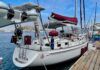
We have a Takacat 340 inflatable dinghy (11’) combined with a Torqeedo electric outboard that has served us well. The battery on the Torqeedo will last us about a week for going back and forth to shore or the beach at 3-4 knots cruising speed. We can store the dinghy either on a trampoline inflated on our Dragonfly 32 tri or in a float compartment deflated.
I came to the comments to say the same. I saw it referenced in a UK YouTube channel or at least the concept (cat style inflatable), I don’t see many around the dinghy docks when cruising but maybe they are still unknown in the US.
Same setup as you torqeedo 903c. Can easily do 5kts with like 30% power. I have two batteries and I lift the dinghy and motor up on my davits.
Its super stable getting on and off, very lightweight and easy ride.
Previous owner of my boat passed me their bauer 10 sailing dinghy. Not stable, kinda heavy, def durable and slow through the water with the torqeedo.
Also have the 340 and love it! Powered anyway…rowing, it tracks like a drunken sailor and needs constant course correction. We have an old 2hp Yamaha two-stroke that can be lifted with two fingers. It’s about 25 lbs full of fuel in the on board tank and is incredibly reliable. I’ve often lusted after the silence of the Torqeedos, but I keep waiting to have problems with my gas outboard to justify the price. I might be waiting a while. Using a friend’s 8HP outboard, we got 2 adults and a child up on plane with a little weight shifting. For regular planing travel, I’d want a 9.9HP, but it’s rated up to 15HP. It cuts through choppy water like a boss. And it’s a dry ride. Because it’s a catamaran it its the waves differently and is less thrown off course somehow. Turning is also different. It does’t lean into a turn like a v-bottom boat. It just turns flatly and will slide sideways if you’re being really aggressive with a turn.
Completely agree on the stabiltiy. You can stand up and fish from it. And because the pontoons are parallel and not pinched to a bow, you get a lot more effective space inside the boat. The open transom is dinconcerting at first, but it never fills with water unless you chop the throttle off plane at which point the stern wave overtakes you and poops the floor momentarily. The open back really shines after a beach trip: you just wash the sand right out the back!
It stows in two bags. One for the boat and one for the floor and accessories. We lash them in between the shrouds and cabin top. Inflating it on the foredeck of our 34′ boat is comical and we also make good use of the spinnaker halyard for hoisting. For my family’s use of weekend cruiging on the Great Lakes, the 340 works well. It ferries full-sized mountain bikes from the boat to land and has lots of room for fishing gear. If I were choosing one for long term cruising, I’d get the small 260.
I’m not sponsored, just a fan. We bought our boat from Great Lakes Watercraft and some accessories directly from Takacat Americas, both stores were a pleasure to do business with.
Thanks to all the Takacat fans. Seems like a good option for a bigger boats, but if inflating it on a 34′ boat is “comical,” it would be too big for my 30-foot boat.
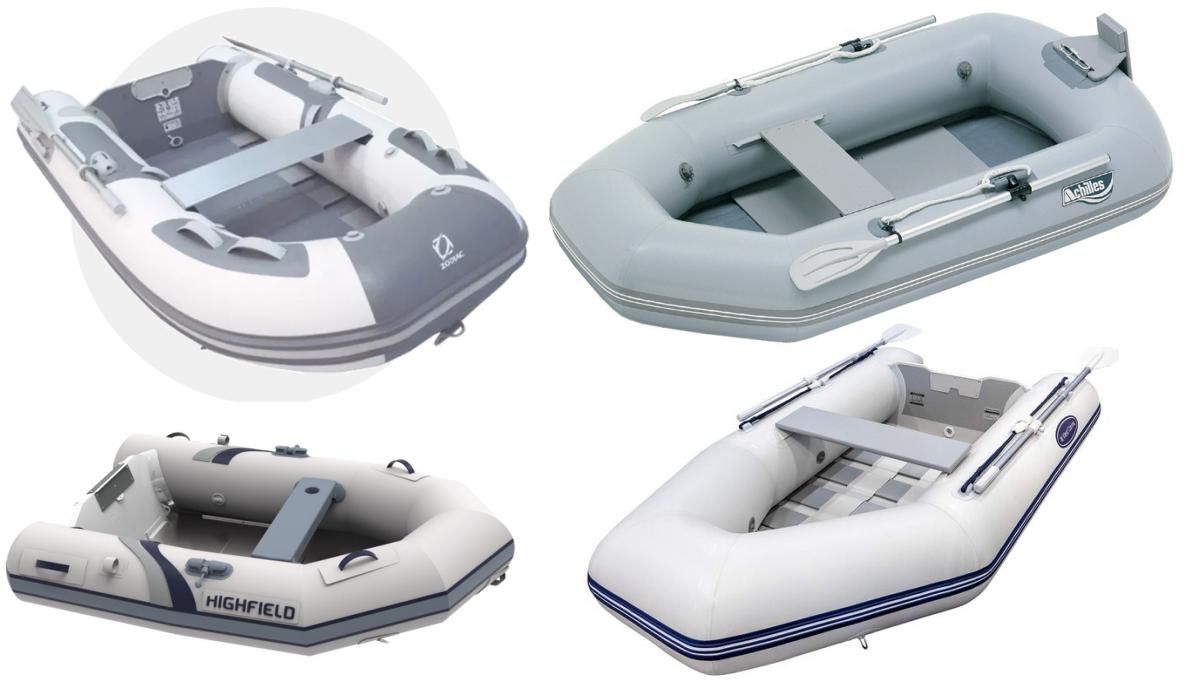
I’ve used for years during my med cruises a small cheap (€ 420) 220 air floor dinghy and must say that the small diameter of the tubulars made sure that, even if only in 2 people, we always got a bit wet, even in the smoothest sea state. Last year I took advantage of a promotion and got for € 699 a roll-up zodiac 260 and life changed. With an Remigo electric outboarder we can ride from the roads down into the marina/village port in 4 people without any problem. With a bridle I lift it up with the main halyard using an electric winch handle so no efforts, and in case the sea gets rough I can deflate it, roll it up and either lash it on the foredeck or store it in in the locker, as needed. Only 2 negative point: (1) Specific to the Zodiac is that the original floor slabs all broke after short use, it’s chinese fake wood or whatever; I bought new slabs of 2 mm thicker marine-grade-certified plywood, coated it in varnish and, problem fixed. (2) You wet your feets as there is no bilge, so mind to have a waterproof bag for your footwear with a small tovel. Once I finish the summer cruise, it goes folded back into my garage and I keep on board the smaller dinghy for any case / hull clening etc. Best regards.
Thanks for sharing your experience. There are comments on West Marine’s site about broken floor boards, which seems to be a common problem for rollups with wood slat floors. I’ll keep your solution in mind if and when I have to replace broken slats.
I opted for a low cost PVC catamaran dinghy form AquaMarina. I was tempted to go with a higher quality takacat but wanted to see if an inflatable would work for me. It is 73 lbs with a 14psi drop stitch floor and 4 4.5psi air chambers for the tubes. Rated for 900+ lbs. It rows surprisingly well and motors along nicely with a 2.5hp Suzuki. I built a fiberglassed, plywood board, 5″ wide, that spans the width of the floor and is inserted under the floor near the bow. A 4″ nylon strap runs under the board and has stainless rings sewn in at the ends. This strap attaches to my davit lifting gear and provides a secure method of raising and lowering the dinghy. These boats are/were available for less than 1000 dollars.
Lifting slings are expensive. You seem to have gone above and beyond coming up with your own alternative. My solution (just for lifting, not for davit stowage) was to attach the to legs of the towing bridle as normal on the D rings on each side of the bow and then knot the tow line to a lifting point on the inside of the transom. The shackle of the main sheet or Spin halyard attaches to the connection between the bridle and the tow line for lifting.
Many years of used inflatable floor dinghies convinced me that a RIB is a better solution if you have the room–but they are not so great when your landing zones are mostly rocky and require dragging over sharp surfaces in high tidal range locales. Now that I’ve downsized to a 25 footer, I’m using an inflatable SUP for the ultimate in ultralight dinghy solutions! Definitely not for everybody, but if you’re comfortable on them they’re a lot of fun for exploring shorelines and creeks.
Thanks for sharing your experience. I’ve been looking at rigid inflatable kayaks that use the same rigid, drop-stitch inflation chambers as inflatable SUPs. With a kayak you can sit down and get a bit of protection from waves. My balance isn’t very good and I also want to lug gear including a folding bike, so the SUP isn’t an option for me.
Thank you all, very informative & worth considering.
I went the 10′ Portabote route and have been using it for 20 years. It finally needs replacement and I will replace with the improved new version. It has much more volume for its size than an inflatable and maybe even the Takacat. We carry two disassembled road bikes in bags and two people in the dinghy to do bike rides on cruises. You wouldn’t get that much stuff in an inflatable. It also rows much better than an inflatable and it doesn’t leak air. I have carried it in the cabin of my C&C 34+ when racing to a distant destination so I have a dinghy when I arrive. If not racing, it tows easily or can sit folded in the space between the shrouds and cabintop. I have assembled it on deck and used a spin halyard to lift it into the water. I have used Suzuki 2.5 and Honda 2.3 engines for years, but after battling to keep them running after accidental dunkings, I am moving to an ePropulsion eLite next year (17 lbs).
Thanks for your comment. I have seen more than a few Portabotes lashed to the lifelines of sailboats over the years. Your comment led me to the Portabote website, where I discovered that the 10-foot model weights 116 lb when fully assembled (including 69 lb for the hull, 23 lb for the transom and 18 lb for three sets). Ouch! The weight capacity for that boat is 507 lb. whereas my rollup weighs 53 lb and has a capacity of 992 lb. I appreciate that the Portabote can’t be punctured and it surely planes better with less horsepower. Nonetheless, my back dictates that I go with a rollup inflatable (or an even lighter inflatable kayak). I’ll just have to be prepared to patch a hole or two over the life of the product. Over seven years of (admittedly light) use of my (air floor) PHP-310, it never experienced a hole or leak and I ended up selling it for $450 on eBay.
We love our 45’ Island Packet. We have been cruising from Miami to the Bahamas, where a serious dinghy is essential, for 11 seasons. I started with an air floor inflatable. But it was a hassle to deploy or tow. Then I invested in davits and a Hypalon dinghy made by Mercury (who no longer makes inflatables). After 8 years it started leaking at the seams. Finally, while in the remote Exumas, it blew out a seam which could not be patched. We had to head back to Miami. Now I own a GoDu all aluminum dinghy and have thrown away my patch kit. I do not intend to ever have a dinghy fail me in a remote location again.
I’ve seen the GoDu at shows and it looks pretty slick. I’m sure it’s a perfect companion for a 45 ft. boat, but a bit of context for those with smaller boats and smaller budgets: the entry-level 8.5 ft. GoDu weighs 149 lb. (without a motor) and costs $7,695. The 10.5 ft. model weighs 178 lb. and starts at $8,995 (again, both measures without a motor).