

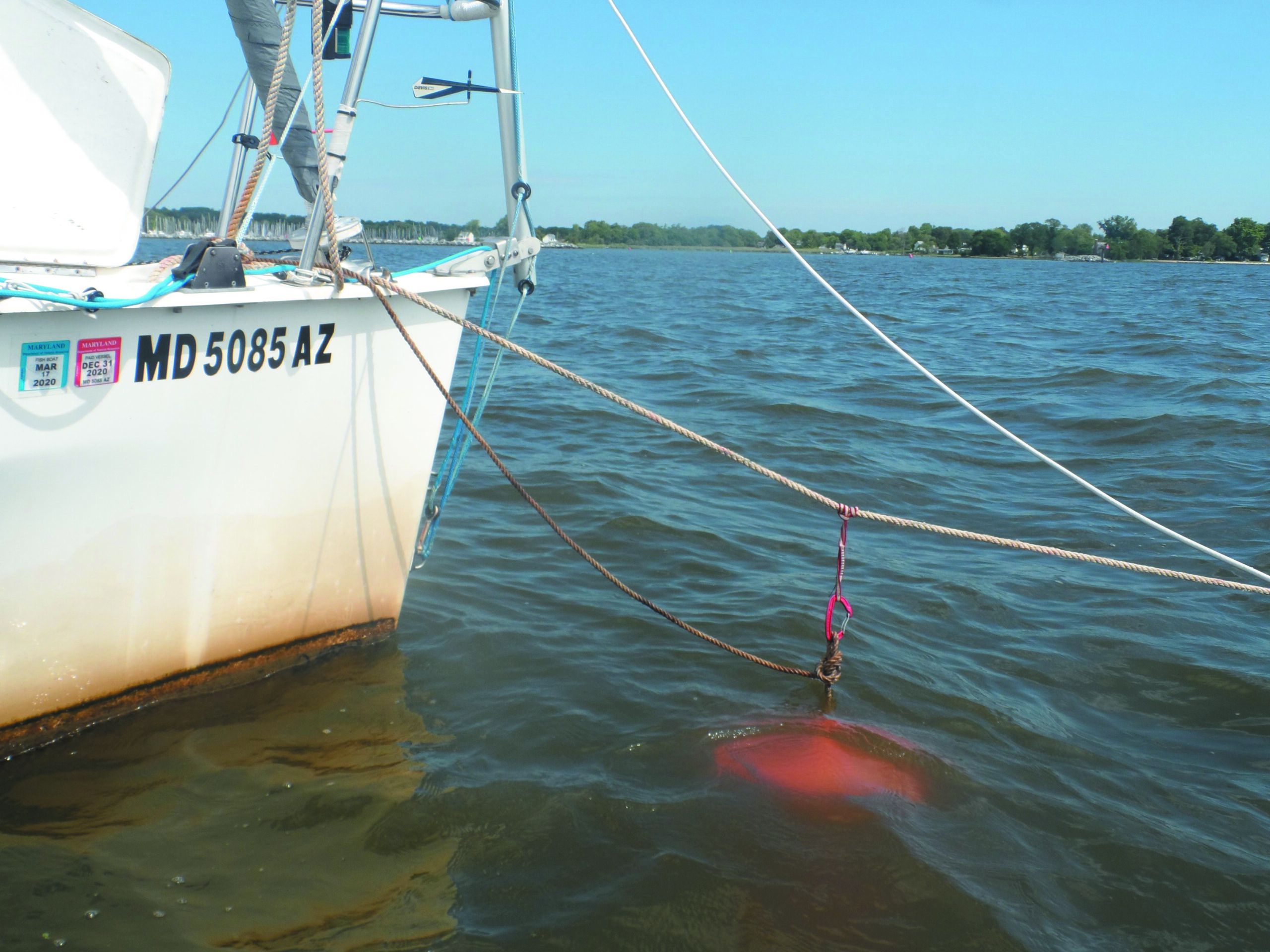
Yawing is the result of imbalance between windage (you want it aft) and underwater resistance (you want it forward). If the center of windage is forward of the center of lateral resistance, the bow falls off and the boat sails off in an arc around the anchor, until forced to tack and return, the cycle repeating every few minutes. Fortunately, there are many things we can do to alter the balance or slow the cycling, and we tested a few—see “Rest Easy with a Riding Sail,” and “Accessing the Anchor Kellet.”
Riding Sails
Like the feathers on the back of an arrow, they keep the boat straight. The sail adds some drag, but this is much less than the wind drag of a yawing boat.
Hammer Lock Mooring
A second anchor is lowered on very short scope (1.2 to 1.5:1 scope) until it just drags, or maybe takes a light set. It is helpful to lower the anchor at the extreme of swing, but not vital, since the wind will change over time. A claw-type anchor is excellent in this application, most new generation anchors are good, and pivoting fluke anchors (Danforth-style, or Fortress) are poor.
If the wind shifts and you have not moved in sync with the other boats, simply lift the anchor until the boat swings and then lower it again. Increasing hammerlock scope slightly in stronger winds will give it a better bite, but keep it well short of the primary anchor to avoid fouling of the anchors and twisting of the rodes in case the boat swings more than 180 degrees, as a result of tide or wind shifts.
Do not use if there is grass or coral.
All-Chain Rode
Chain rode is always helpful. It reduces swing by dragging on the bottom and by reducing the effective length of the rode. However, once the wind picks up enough to lift most of the chain off the bottom it is less effective.
Kellet
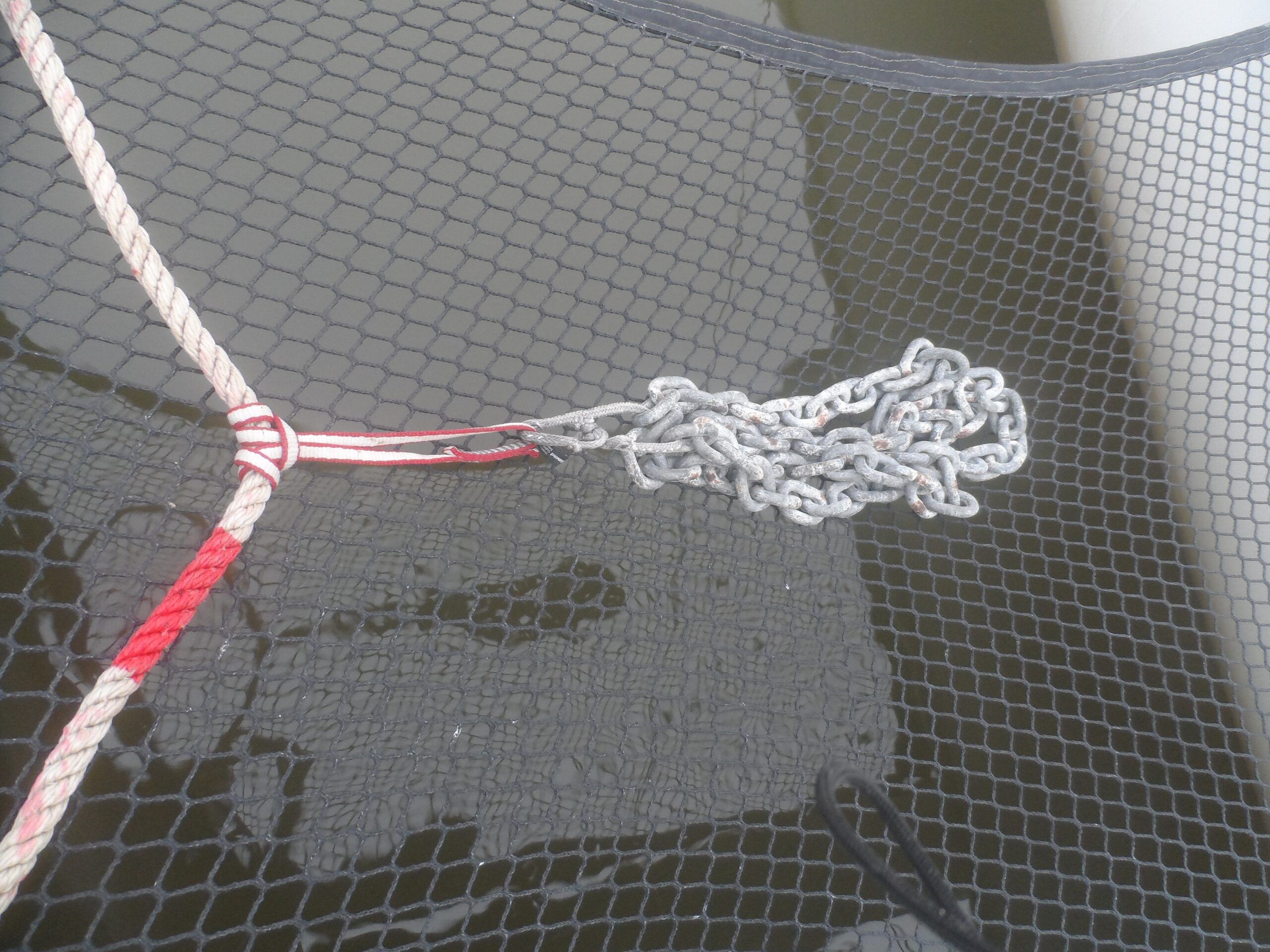
Adding weight to the rode has a similar effect as an all-chain rode, but it is much lighter and thus somewhat less effective. It is a valuable aid to rope rodes, causing them to mimic the swing pattern of a boat on all-chain rodes. A kellet made from a loop of chain is easier to handle than a lump of iron and won’t make a hole in the deck when you drop it.
Bridle
Although this does not alter the balance of the boat like a drogue on the bow or a riding sail, it helps bring the bow back to the center by providing a strong side force. It is very effective on multihulls (wide bow) and much less effective on monohulls (narrow bow).
Windage
There are things that make yawing worse—a dinghy on the bow is the most common example. Reachers on bowsprits also contribute. Both act like riding sails at the wrong end.
Boards Up/Boards Down
With rudder down and the centerboard up, the bow quickly falls off and the boat sails all over the place. Some of the liveliest boats are centerboard/ dagger board types that lift the boards to prevent marine growth or reduce rattling in the case, but leave the rudders down. You can often pull just the rudder up with very little extra yawing.
Bottom Line
We’ve used all of these methods to reduce yaw, each according to the situation. On a multihull, a bridle is the go-to method. For a monohull with a chain rode, a riding sail is generally the next step, or possibly a hammer lock, if you keep two anchors on the bow. With rope rode, a chain kellet is a good starting point. We keep the dinghy off the bow and lower the reacher if we expect a blow. We may anchor with the board up or down, but never with the board up and the rudder down. If the board goes up, the rudder goes up.
TECH GUIDE: YAW PREVENTION MEASURES COMPARED
| ANTI-YAW MEASURES | CENTER BOARD | RUDDER | SWING ANGLE | RODE TENSION AT 20 KNOTS | MULTIPLE OF WIND-ONLY LOAD ON RODE |
|---|---|---|---|---|---|
| NO BRIDLE | Up | Down | 135° | 170 lbs. | 2.83 |
| NO BRIDLE | Down | Up | 100° | 147 lbs. | 2.46 |
| DROGUES | |||||
| ROCKER STOPPER | Up | Down | 100° | 120 lbs. | 2.00 |
| ROCKER STOPPER | Down | Up | 90° | 110 lbs. | 1.83 |
| SEABRAKE GP24L | Up | Down | 90° | 110 lbs. | 1.83 |
| ROCKER STOPPER | Down | Up | 80° | 100 lbs. | 1.67 |
| OTHER METHODS | |||||
| RIDING SAIL (FIN DELTA) | Down | Up | 42° | 106 lbs. | 1.77 |
| HAMMER LOCK MOORING | Down | Up | 35° | 90 lbs. | 1.50 |
| CHAIN RODE | Down | Up | 85° | 135 lbs. | 2.25 |
| 10-POUND KELLET | Down | Up | 80° | 131 lbs. | 2.18 |
| BRIDLE (2:1 LEG/BEAM, DYNEEMA) | Up | Down | 40° | 95 lbs. | 1.58 |
| BRIDLE (2:1 LEG/BEAM, DYNEEMA) | Down | Up | 12° | 67 lbs. | 1.12 |
This article was published on 20 December 2021 and has been updated.



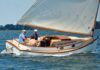
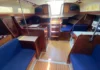
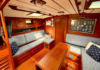
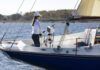
Anchoring off the stern instead of the bow can also be very effective at reducing yawing. Van Dorn makes a good case for this in Oceanography and Seamanship.
Yes, anchoring from the stern reduces yawing. Ventilation can be improved in no-wind situations. But PS tested this and learned/confirmed there are many negative factors, explaining why you very seldom see this:
1. Boats don’t meet the waves as well stern first. This is even worse with wide transom boats.
2. Pitching is worse because the distribution of buoyancy is different.
3. If there is ANY rain or spray, the livability and ventilation of the boat is worse stern first. The companionway must be closed.
4. There is more noise (waves hitting the transom).
5. Handling the anchor is awkward, because the roller, chain locker, and windlass are at the bow.
We tried it a number of times, on several very different boats, and switched back every time. It didn’t work for us. Your boat may be the exception; try it.
Our conclusion was that there are better ways to control yawing. Boats are designed to go forward.
See “The Science of Stern Anchoring,” March 2023.
I somehow missed your excellent article on stern anchoring. You are right about the many disadvantages. My NorSea 27 has a canoe stern, a stern anchor locker and a kedge anchor ready to go. Even so I almost never anchor off the stern, for the reasons you list and because I fear the rode fouling on the Monitor wind vane frame. Still, as you note, the simple physics of reversing the windage/clr makes stern anchoring reliable and effective if not always practical. It’s also easier on the bottom than a hammerlock or even just yawing. It may yet come in handy, though I hope not for riding out a blow. Most of the time just keeping windage aft is enough. Do you know how big an effect roller furled sails have on yawing?
I do know the roller furled reacher, on the bow sprit, is a problem on my F-27, but the roller furled jib really is not. In general, jib are not a problem, but the new generation of reachers and sails on sprits are a problem. As always, it’s boat-specific. I don’t like leaving the reacher up, anyway.