To provide the best experiences, we use technologies like cookies to store and/or access device information. Consenting to these technologies will allow us to process data such as browsing behavior or unique IDs on this site. Not consenting or withdrawing consent, may adversely affect certain features and functions.
The technical storage or access is strictly necessary for the legitimate purpose of enabling the use of a specific service explicitly requested by the subscriber or user, or for the sole purpose of carrying out the transmission of a communication over an electronic communications network.
The technical storage or access is necessary for the legitimate purpose of storing preferences that are not requested by the subscriber or user.
The technical storage or access that is used exclusively for statistical purposes.
The technical storage or access that is used exclusively for anonymous statistical purposes. Without a subpoena, voluntary compliance on the part of your Internet Service Provider, or additional records from a third party, information stored or retrieved for this purpose alone cannot usually be used to identify you.
The technical storage or access is required to create user profiles to send advertising, or to track the user on a website or across several websites for similar marketing purposes.


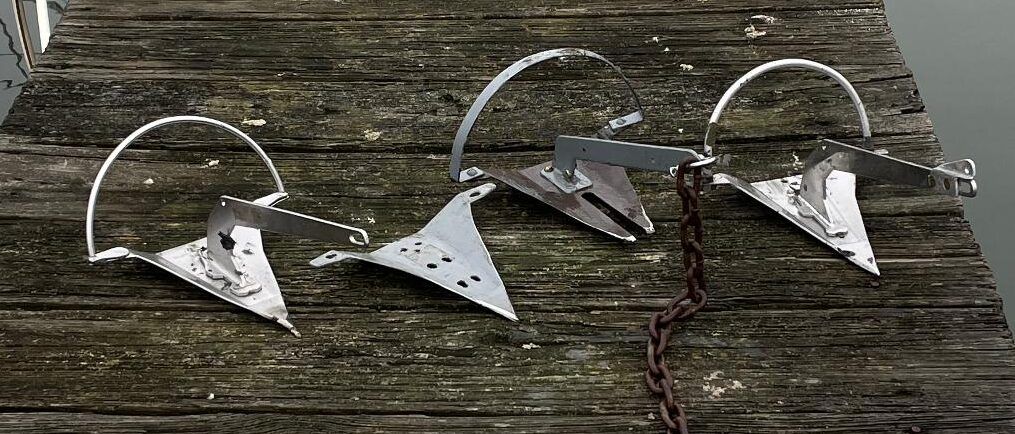



So, what is the best all-around shape to carry if you can’t carry more than one anchor? (25′, 8000 lb boat.)
a. The preamble to the article was trimmed for length, but the inspiration for the project was to was to build a better multi-purpose anchor for the Chesapeake Bay. The mud here is notoriously problematic. To research the subject systematically, I built a modular system that would allow over 100 combinations of fluke, roll bar/wings, and fluke, plus tweaks. I wrote up the findings. But fundamentally, this was a quest for a better Chesapeake anchor.
b. There are several more parts to the article, including shanks, roll bars, and non-rollbar solutions. These other parts, and how they work together as a whole, are at least as important as fluke design.
c. There is no best anchor. There are good compromises. You need to carry more than one anchor anyway, in case you lose one or need two for some reason. They can be two all-around designs, or one can be a specialist (Fortress for kedge and mud, or perhaps a rock pick).
But if you can wait, the Mantus/Viking shape has the best all-around performance IMO. Single dihedral flukes like the Rocna jam soil to the center and tend to clog more. Heel kick-ups are also to be avoided because of clogging.
But there are other important factors. Aft shank locations help (Viking), the fluke angle must be in a narrow range, and if fouling with mud and weed are issues, non-rollbar designs seem to have the edge. We’re not fans of ballast, since it is wasted weight and makes the toe fat (resistance). We don’t love plow shapes.
There are good anchors that break all of these rules. The Excel looks like a plow. The Spade has ballast. The Mantus has a lower fluke angle than we like and a roll bar, but is a fine all-around anchor, because the wide roll bar and fluke design work together. In the end, we built a Chesapeake Bay-specific layered mud anchor, that after a full season of sailing has never failed to set and hold strong the first time. It outperforms everything in our test arsena herel, and we have one of everything. But that does NOT mean it is the best all-around anchor. It is just the best anchor around here.
I always read your articles and book with great interest.
I make anchor testing myself in Denmark.
I have a comment to your graphs “Holdigg Capacity versus scope.
It is a tiny detail, bur is that not what we try to understand?
I think that it is NOT correct to extrapolate the curves down to Scope 1:1
In my own testings I realize, that all the anchors have a starting scope where they NIP – or START TO BITE.
And that is for the best ones at Scope 2,5:1 (BRUCE and Delta and Viking)
This also means that a BRUCE does actualy have A LITTLE holding at Scope 3:1
Many anchors only start to “bite” or “nip” at 3:1.
My experience with this is in relatively clean sand with only rope rode.
This means thay the extrapolation in your graphs shuld go down to “Scope” 2,5:1 og Scope 3:1 depending on how the different anchors perform in this special situation.
You can se my web (please copy the URL): overg.dk/anker-holdeevne-med-og-uden-kaede/
My web is in danish, but in this page there are many graphs showing, that no anchors has any grip at all with steeper rode than with Scope= 2,5:1 or 3:1
1:1 scope. Extrapolation to 1:1 scope relates to the break-out force required to recover a well-set anchor. However, it is extremely variable and does not relate to actual anchor performance. The data was created (in a different article) by setting the anchors at 20:1 scope at 20% of holding capacity at that scope, and then shortening the scope to the stated values.
We tested using a polyester rode and no chain, such that the stated scope reflects the true angle at the bottom, and is not influenced by the amount of chain and the depth of the water.
No, you can’t set an anchor at 1:1 scope, and in fact, if there is chain in the rode, the angle at the bottom is nearly always equivalent to very long scope during setting (relatively low tension), since the chain is still lying on the bottom. Many claims of short scope performance are based on chain rodes, and reflect the chain keeping the rode on the bottom more than the actual anchor performance.
Interesting to see the engineering.
For the types of bottoms we typically see in BC the You tube videos of Steve Goodwin (SV Panope) are amazing.