To provide the best experiences, we use technologies like cookies to store and/or access device information. Consenting to these technologies will allow us to process data such as browsing behavior or unique IDs on this site. Not consenting or withdrawing consent, may adversely affect certain features and functions.
The technical storage or access is strictly necessary for the legitimate purpose of enabling the use of a specific service explicitly requested by the subscriber or user, or for the sole purpose of carrying out the transmission of a communication over an electronic communications network.
The technical storage or access is necessary for the legitimate purpose of storing preferences that are not requested by the subscriber or user.
The technical storage or access that is used exclusively for statistical purposes.
The technical storage or access that is used exclusively for anonymous statistical purposes. Without a subpoena, voluntary compliance on the part of your Internet Service Provider, or additional records from a third party, information stored or retrieved for this purpose alone cannot usually be used to identify you.
The technical storage or access is required to create user profiles to send advertising, or to track the user on a website or across several websites for similar marketing purposes.













a. What do we know about the average life expectancy of electric motors? Many gas outboards live over 30 years, and the average is certainly over 15 years. Electric motors have seen many premature failures–to be expected with new tech–and have simply not been on the market long enough to assess life expectancy, I believe. If this is incorrect, please post. It’s a hollow claim without long-term experience.
b. Electric motors, like electric cars, have an electricity cost that is not that much less. Although elelctric motors are more efficient than internal combustion, if you consider power generation efficiency from fuels (about 39%, DOE), transmission losses (5%, DOE) and charging hysteresis (you charge at a higher voltage than you draw, 6.5%), the overall efficiency of an electric motor is around 30%, or not much better than IC. Check the math. research the numbers I have quoted. There is a lot of false marketing out there. The 120 MPG claim for an electric car is actually a more reasonable 35 MPG, if actual efficiencies and losses are considered.
The same logic applies to carbon footprint. Assuming the incremental electricity is generated with coal, fuel, or gas, the footprint for electric is not that different. This is obvious thermodynamics. The conversion is not efficient and cannot be.
The quiet is an advantage. I get that, I would love it. The electric user does not have to understand the choke. The user does not need to understand fuel management (keep the vent closed when not using, use a PS-tested additive). Oil changes are trivial (once a year you suck the oil out of the gas motor–10 minute job), but impeller changes are often handled by a shop. I do get it. But half the power, twice the cost, and very limited range seem to limit these to short-range harbor and day-sailing use. An electric outboard is a different challenge than an electric car.
Interesting.
Batteries are sure to fail within 7 to 10 years, and they are expensive (roughly half the cost)? Not sure about the longevity of motors and gears (as you write, it’s too soon to say).
Based on my research, the cost of electricity for recharging is far lower than the cost of gas (particularly with today’s gas costs). With that said, don’t leave batteries and chargers plugged in longer than necessary and don’t top up when the battery still has, 70%, 80% or 90% power.
Electric motors have been around for a long time (first built in 1821). Haven’t heard of the premature failures you’re talking about.
The battery tech has been evolving quickly and has yet to be shown how long it lasts. I knew getting an electric outboard for my dinghy was going to be more expensive and have trade offs with speed and range. I got two batteries and it has been working great with my takacat.
I don’t have to keep gas aboard, I don’t need to worry about carborators, oil etc. It just works and the range has been plenty for my cruising needs. I can charge from solar as well. Might not be for everyone yet, but sliding through the water silently compared to the loud gas outboards I come across can’t be beat.
Yes. But let’s use numbers.
35 kWh (1 gallon of gasoline) costs about $6.30 delivered (DOE). An electric motor (including charging hysteresis) is about 80% efficient, while the a gasoline 4-stroke is about 32% efficient, so the equivalent “gasoline” cost of electricity is about $1.58/gallon, compared to a current average cost of $4.17 (AAA) at the pump. Less than half the cost. If you can charge off solar panels on the boat, better yet, but be aware that each gallon of gasoline-equivalent is 2900 Ah, or at least several days’ worth of output for a large array (a week for most of us), assuming no other draw. If that is your plan, you need to allot quite a few panels to feed the tender, depending on cruising usage. It could be a plan, but only for a large cat with a large hard top covered in panels.
I like the idea. The products are certainly improving. The energy density math remains a strain.
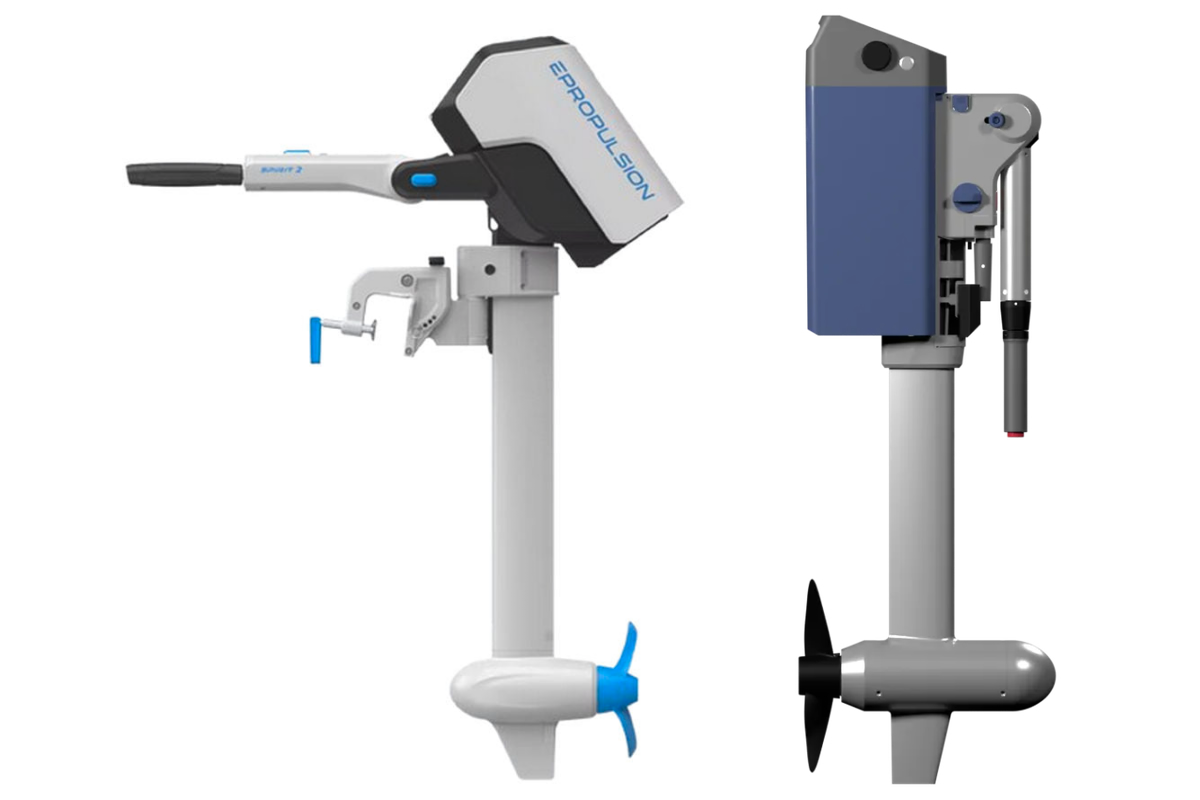
I have an epropulsion 1+, used it for 5 seasons. Use is for fairly short dinghy rides from the anchorage to shore to get supplies and tour around whatever town or shore where we anchor. For that it is great. My priority is keeping gasoline off the boat for safety, and to me that is worth any downsides and extra purchase costs.
Thanks for sharing the details of your experience. It’s very helpful to would-be buyers.
I love my Torqeedo Travel for my dinghy. It lightweight and always starts. No pulling a cord to get it to start. But what I love the most is how quiet it is. I have to take the dog to shore in the morning when the anchorage is quiet, and I love that we can slip quietly through the water to shore. The only downside if there is one – shouldn’t leave the lithium battery plugged in if not onboard.
Thanks for sharing.
I had a fantastically reliable Nissan 8hp 2 stroke for about 30 years. It weighed 55#, which today would be an 85# 4 stroke. It lived on the stern rail when not in use, and required a lifting boom and white knuckles to get there. Its fuel tank sat tied on the deck using valuable space and always seeped a little and smelled. It was a fire hazard.
My Torqeedo weighs 28#, which I can carry from the quarter berth to the dinghy easily. It doesn’t
smell, isn’t a fire hazard, and is virtually noiseless. I gave up speed. I’m 73, my need to go fast has diminished over the years.
Easy does it! Thanks for sharing, Bob.
For 25 years we have been using the Minnkota 12 volt 55lb thrust motors to help dock our fleet of 23’ Pearson Ensigns (www.soundsailingcenter.com). They will run with no issues for 3 years, then the switches start dying, then we replace the motor after about 4 years. Given that they require zero maintenance for 3 years and are super reliable and easy to use, we have been pleased w them. They cost about $320- They will push an Ensign into about 15knots of wind max. In calm conditions we get 2.5 – 3 knots. We have not found a significant difference in lifespan between the saltwater and freshwater versions in terms of lifespan. We have one boat set up w Lithium batteries – which raised the cost but also will likely last longer. For use on a Dingy a Lithium battery is the best way to go. We did try Torquedo years ago but they were too fragile for commercial use.
Martinis,
I have a sailor friend who has concluded that low-cost trolling motors are the way to go for dinghies. It’s eye opening to hear that the more powerful models can get light sailboats out of marinas and out to sailing waters. It’s a safe bet they last more than three years when they don’t see daily use and abuse.
I have a Newport NT300. I chose this particular motor due to the battery being separate and you can use any 36V battery. It has been working wonderfully. I have 800 Watts of Solar and a lithium battery bank on my sailboat. My battery bank is usually 100% charged by afternoon. The excess energy I am generating will more than charge my 50amp hour separate battery for the electric motor. I have used this motor for the last 2 months. It goes at a reasonable pace/ speed (measured around 5-6 MPH at high RPM ) and I have yet to drain my battery to less than 70% despite using the motor quite a bit over a weekend. In my set up, I have a secondary 50 amp hour lithium battery that I can charge while using the primary battery should I need more range. In terms of maintenance — almost none. I don’t have to change oils, use smelly gas or winterize. I don’t think the motor longevity will be the problem, but I do see the complicated electronic controls possibly being a problem in terms of longevity. i had a Honda 4 stroke outboard that was always difficult to start due to being very sensitive to moisture in the fuel and I had to be very careful what gasoline I used for that motor. I had left some gas in it once for too long and ended up having to clean and change the carburetor. I also had a 9 HP gas motor that would move at a decent pace, but it was such a hassle (due to size and weight) to remove and place on the dinghy, that it was not practical to use. The thing I like about the electric outboard setup is I can easily lift the motor and battery and I don’t need a dinghy davit to do so. I don’t leave my motor and battery at the dock so I do bring it with me when I am leaving, but it is not hard to remove or too heavy. Many of the other motors had proprietary batteries that were very expensive. With the NT 300 and a separate battery, it is only modestly more expensive than an equivalent gas engine, but will be cheaper in the long run in terms of gas and maintenance. *(provided I don’t have electronic control issues.) It is also so much easier and fun to use than my gas engines.
Great to hear all these details. It gives fellow readers good context on what to expect from such a setup. Thanks for sharing
I’ve had an Epropulsion Spirit 1 for 5 years, pushing a 2.9m tender when we cruise northern European waters for 5 months each year. This has included 2 mile each-way trips up rivers with strong tidal flows, shopping trips laden with heavy bags, choppy harbours and long explorations of environmentally sensitive areas. Until this year it was utterly reliable but what we found out later was a circuit board failure under the tiller arm crippled it. Even the techies couldn’t translate the error messages into clear diagnoses and our remote location and urgent need meant it was better just to replace the entire leg. Thankfully, these can be bought separately so the (still high) cost was at least halved.
I had considered buying another 4-stroke instead for a lesser price but having experienced the advantages of electric wasn’t keen to go back. We had no need to roar about on the plane and appreciated the powerful torque that more easily pushes a heavily-laden tender through adverse tide and seas. We wouldn’t have been able to enjoy incredible wildlife settings without disturbing the very things we’d come to see and would have to have stored and handled arguably the most hazardous substance you can put on a boat.
However, the real clincher was that for much of our cruising grounds – the west country of England to Wales, Ireland and up to Scotland – was that gasoline can be quite hard to locate. That was one of the reasons we ‘went electric’ in the first place. With a decent solar array onboard the eprop battery is charged quickly and with 10 hours range at an acceptable speed we’ve never once suffered from range-anxiety. I have to accept though that electric motors bring new modes of failure that we’re still learning how to mitigate; I now place a desiccant bag next to a better-sealed circuit board whenever laying-up.
Electric tender engines are far preferable for our requirements but other people may justifiably come to a totally different conclusion for theirs. I guess that’s sailing!
Thank you so much for this detailed and thoughtful comment. Nice to know that despite the potential vulnerabilities of electric outboards you are sticking with them. Do you store the outboard on the rail/exposed to the elements or in a locker? Any thoughts on storage or using a canvas cover to reduce the chance of water intrusion (assuming that’s why the internals went bad)?
Hi Doug; I’m grateful you sparked this interesting debate. When cruising I was storing the leg of the engine on the rail under a light cover and the heavier battery in a midships/centreline locker in the cabin. On laying-up the leg was placed in the lazarette. However, I’m thinking that rather than getting wet on the rail the cause was being kept for the winter months in that largely unventilated space and the factory-sealed box for the CB, while able to resist water directly wasn’t able to resist prolonged exposure to increased humidity. My own fault, in part.
Being able to split the leg/battery is a huge advantage for many reasons and hanging just the leg removes a substantial weight from one of the worst places on a sailboat to have it (another plus for electric). However, I’d still recommend coating any exposed circuitry or its housing with dielectric grease and placing as you say, a canvass or other suitable covering over it though taking care not to ‘seal the moisture in’. When laying up a desiccant bag goes next to the CB and importantly, the whole unit now goes under the table in the properly ventilated and controlled atmosphere of the main cabin.