

Sailing the west coast of British Columbia over the years has opened our eyes to the beauty of this cruising ground. From Washington State in the south, to Alaska stretching to the north, hundreds of islands and thousands of anchorages dot these blue waters and forested shores. It is a mecca to many sailors from around the world.
One of our favorite cruising destinations is the awe-inspiring majesty of Princess Louisa Inlet. It is situated 47 miles inland of the Salish Sea and requires sailing up the fiord-like Jervis Inlet just north of Vancouver on the Sunshine Coast. The mountainous shoreline drops steeply to the frighteningly deep blue waters. Although there are secure anchorages and marinas near the entrance to this inlet, the last 32 miles have no secure anchorages along the way. Once committed to the inlet, it’s go all the way or turn back.
To enter Princess Louisa Inlet, boaters must navigate through a narrow, sharply curved Malibu Rapids, a passage that is true to its name—there are indeed rapids. Tidal currents can reach nine knots. Prudent skippers check current predictions carefully since transiting Malibu Rapids can be an intimidating challenge. It’s no wonder Captain George Vancouver gave this cleft in the mountains a miss when charting this area in 1792. He was seeking the northwest passage, and this gap was deemed too narrow for sailing ships of the day. He missed one of the most beautiful inlets in the world.
A Return to Princess Louisa Inlet
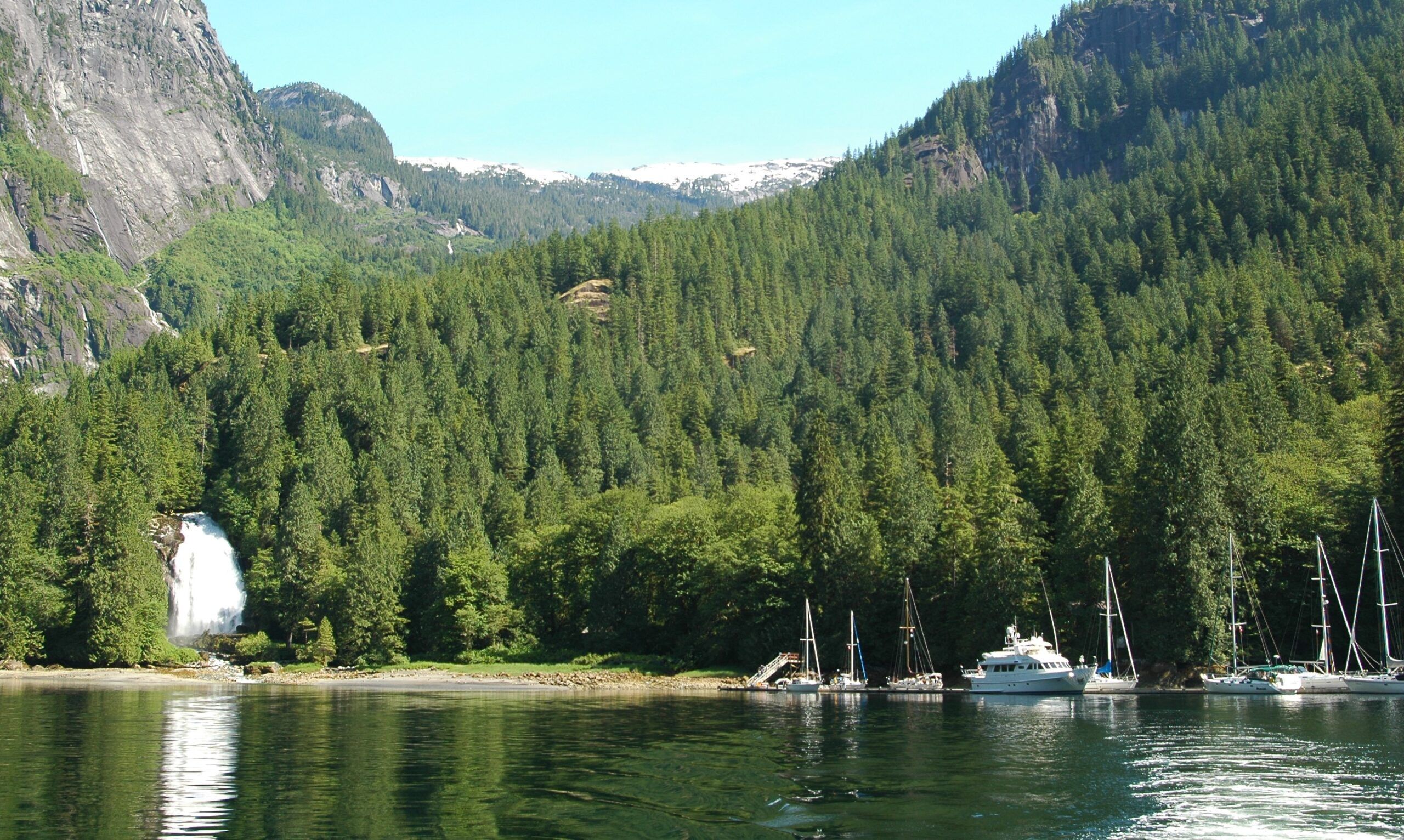
As an adventuring family, my wife Carey, daughter Nicky, and I were enchanted by the beauty and tranquility of this idyllic spot. We sailed our O’Day 25 to the inlet several times, drawn by the quiet beauty of this five-mile-long waterway, with Chatterbox Falls thundering at its head. With towering mountains displaying cliffs and waterfalls right to the water, Princess Louisa Inlet was beyond words. Photographs simply do not do it justice.
We had just moved up from our O’Day 25 to the luxury of our Islander Bahama 30. With all that extra room and carrying capacity we were ready for some serious cruising. A return to Princess Louisa Inlet was going to be on the cruising itinerary that summer.
A Hand-Me-Down Sail From the Dog
The Islander came with two sails: a well-used main and equally well-used genoa. Having sailed the O’Day with a cruising spinnaker, I was at a loss for downwind sails. The purchase of a spinnaker was beyond our budget that first year. Then a sailing buddy graciously donated a well-used symmetrical spinnaker that his dog had been sleeping on.
The sail raced for years on his Mull 33, and it was a bit oversized for our Islander, plus it had been sailed well beyond its life expectancy. It certainly didn’t crackle when stuffed in the bag. Then there was the odor of a wet dog every time we pulled it out of the bag. But it was better than no downwind sail at all. We spread the sail out on his driveway to cut the center horizontal panel out to reduce its height. After it was sewed back together, it was still oversized at the shoulders. But I wasn’t planning on using it in heavy winds anyway.
Practicing With the New-To-Us Spinnaker
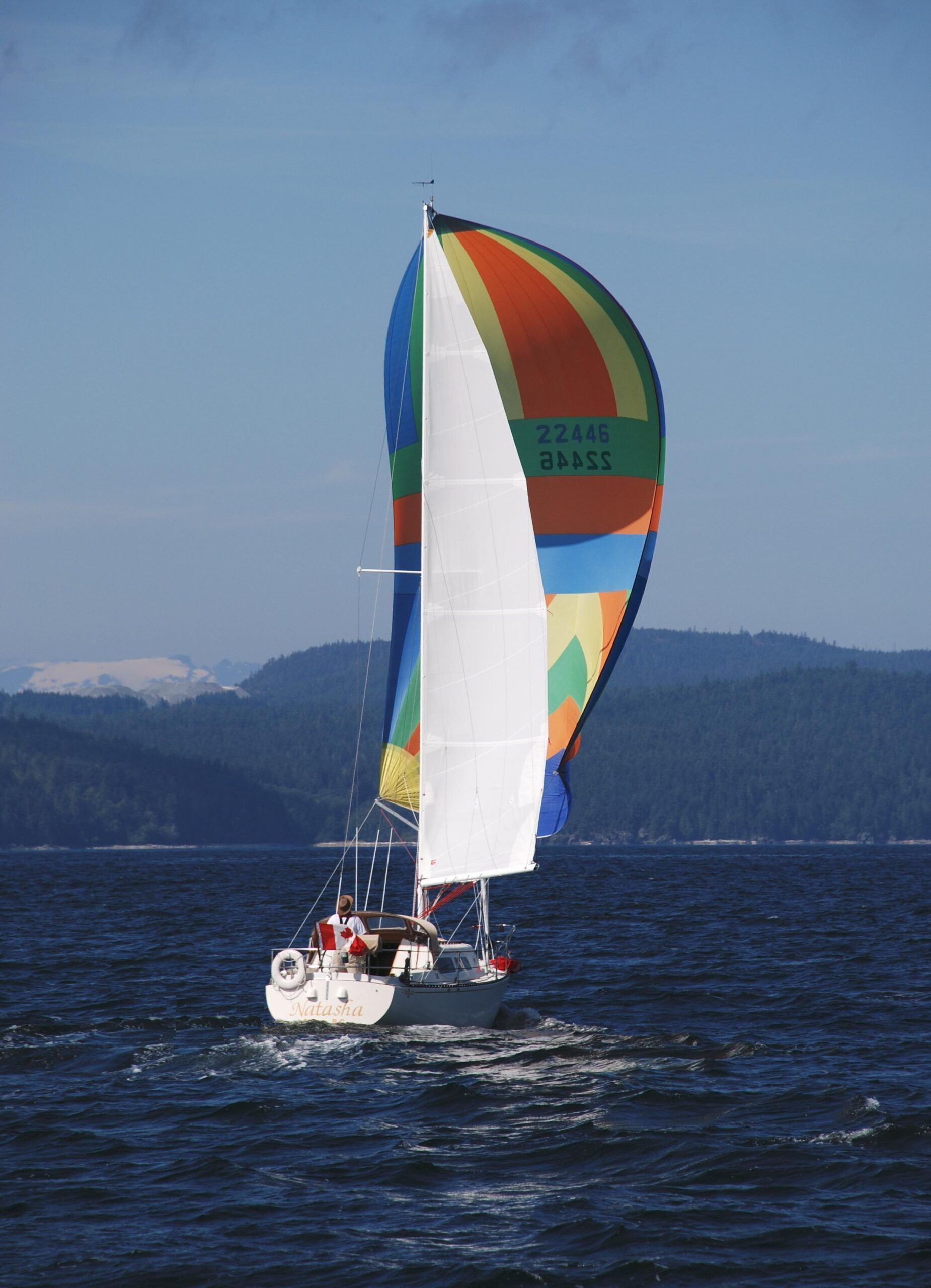
Spring sailing arrived and we enjoyed getting out on our new boat. I had the spinnaker up whenever conditions allowed, providing instructions to Carey and Nicky on how to control the big sail. The most important instruction was which line to release should the spinnaker get out of control. As I was the person going to the mast to perform the end-for-end gibe on the pole, Carey needed to know the difference between the guy and the sheet. The repeated mantra was to release the guy if the spinnaker was overpowering us. We could always douse it by pulling the sheet into the cockpit. It all worked out and we were getting comfortable with the intricacies of keeping it flying.
Mellow Summer Cruise Beginnings
The summer cruise started with a sail to the northern reaches of the Salish Sea, and the fabulous Desolation Sound. We enjoyed a couple of weeks in this sailor’s paradise with friends, then sailed south for a side trip to Princess Louisa Inlet on the voyage home. The Pacific High weather system was stationary off the west coast of Vancouver Island and was predicted to give us blue skies and warm breezes. Perfect summer conditions.
The morning of our sail towards Princess Louisa Inlet promised another stellar day. We motored over glassy water for the first little while; mirrored water reflected the majestic mountains. Timing to slack water at Malibu Rapids was critical and we needed to cover distance while awaiting the afternoon winds. Having sailed these waters before, we knew that in settled weather the up-inlet thermal winds would start around 11:00 a.m. and continue until near sunset. We’d done this before, it was old hat, and exciting just the same. We knew the morning clouds would burn off as the day progressed.
Navigating the Bends
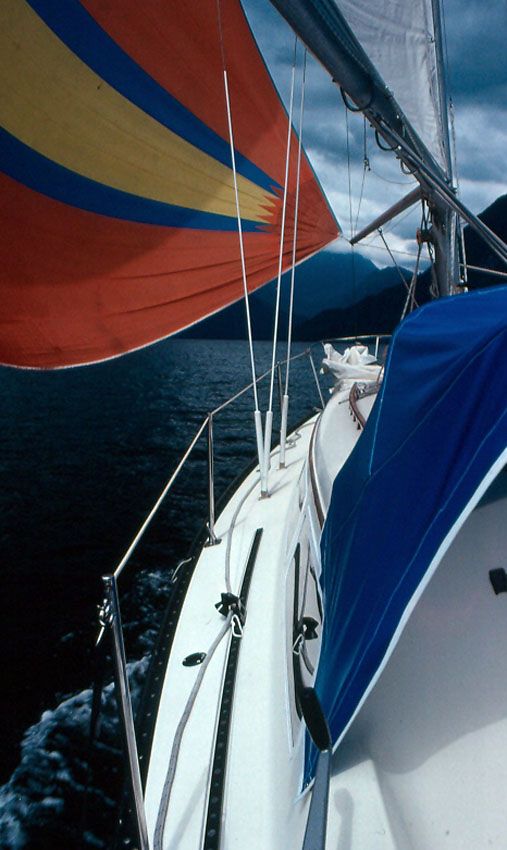
Right on time a breeze began rippling the water astern. I raised the main in anticipation of the breeze building—and it did, just as expected. The spinnaker was soon pulling us along at a fair clip, five knots registering on the knotmeter, boosted by the large tide flooding up the inlet. The scenery was breathtaking with not another boat in sight.
Jervis Inlet has a series of long right-angle reaches, some with sharp corners, others with long sweeping curves. The wind would bend around these curves and follow the reaches between the mountains—perfect conditions for downwind sailing. Gibing would be necessary. Instead of balancing the spinnaker while running directly downwind, I usually sailed on a broad reach, which is a safer, more relaxed way to control the spinnaker.
The wind was building nicely as we sailed along one of the sweeping curves, following the wind around. I calculated that we could get one more long reach across the inlet before the strengthening wind would force the spinnaker to come down. But first another gibe was in order. We had to clear the approaching cliffs of the nearby shore.
Preparing to Gibe
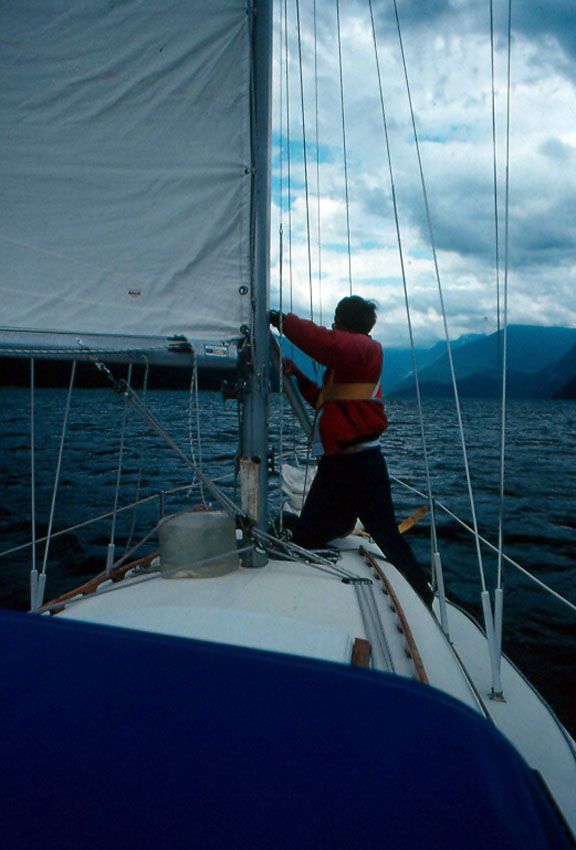
As we’d done earlier, Carey took the helm while I squared the spinnaker to the wind. Nicky, standing in the companionway, prepared to clear lines should they tangle. I went forward to the mast and, facing aft, nodded to Carey that I was ready. I had the spinnaker sheet in my hand as I removed the pole from the mast fitting, intending to slot the sheet onto the pole as the new guy. I happened to look back to see how Carey was doing as she slowly turned the boat to stay under the big sail—then I got the shock of my life.
A huge swath of dark ripples was rapidly approaching from astern. They were only a few boat lengths away, but hadn’t been there moments before. The first gust caught the top of the spinnaker—the sheet ripped out of my hand. The boat heeled ponderously to port and surged ahead, the spinnaker starting to rotate. Then the wind arrived on deck and all hell broke loose.
Spinnaker on the Loose
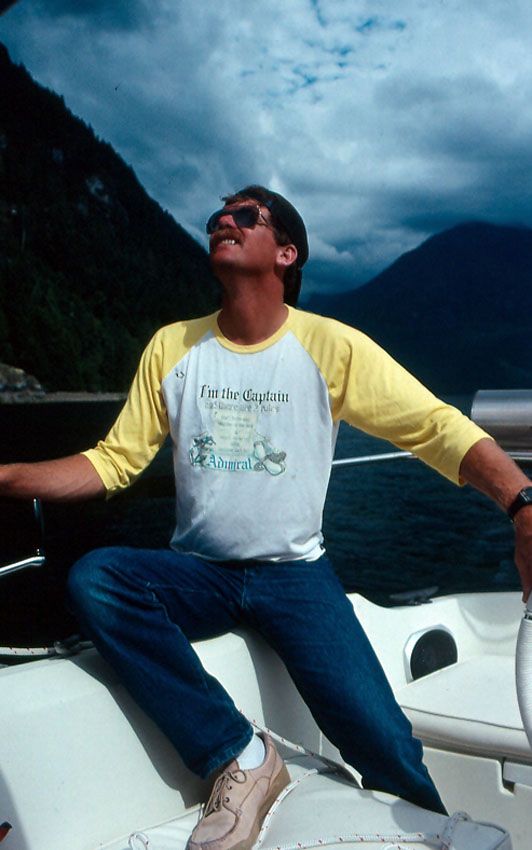
The big sail thundered over my head, with the guy still attached to the far end of the spinnaker pole. I grabbed the mast with my free hand to keep from going over the side, holding onto the end of the pole with the other. The boat slew to starboard towards the nearby cliffs, dragged over by the spinnaker that was almost in the water. Clutching the lifeline, Carey had the wheel hard over to port, trying to stay away from the shore. I shouted for her to release the guy. Even though I tried mightily, I couldn’t get the pole reattached to the mast, and I couldn’t hang on to the loose end much longer.
Suddenly the rudder dug in and the boat righted herself, veering off to port, the boom slamming over as the mainsail backwinded. The spinnaker collapsed for a moment and then filled viciously to starboard, almost throwing me off the cabin top. Both hands were now on the mast, I needed to stay aboard. The spinnaker pole was swinging dangerously loose behind me, held up by the topping lift and the still attached guy. Keeping my head down, I dispassionately noted that the spreader tip was almost in the water, with most of the spinnaker floating on the waves. I had to do something before the boat came back up. But it came back up too quickly.
I had no chance to do anything but hang on as the spinnaker boomed to port. In racing terms: death rolls. I could see Carey spinning the wheel fruitlessly, the spinnaker overpowering any directional control. Hanging on with both arms around the mast, I repeated my (polite) call to release the guy. I needed to get back to the cockpit but couldn’t let go of the mast, the boat was heeling over again, rapidly.
Regaining Control
Suddenly the guy whipped by my head towards the bow, the corner of the spinnaker leading the way. The wind ripped the wet nylon off the waves as the boat slowly lurched back upright, the spinnaker now a huge flag thundering to leeward. Carey straightened the wheel as we scooted away from the cliffs. I could see the top of Nicky’s head near the companionway, she was still aboard—a good thing! We were stable for the moment.
I quickly dropped the spinnaker pole onto the foredeck, not taking the time to secure it. I didn’t really care what happened to it as long as it wasn’t flailing about. I scrambled back into the cockpit. Carey, fear in her eyes, stayed behind the wheel as I rapidly took stock of our situation. We were momentarily safe, away from the nearby cliff, and in control. The wind was gusting near 20 knots and whipping the spinnaker into a frenzy of noise and vibration. We were on a broad reach, the mainsheet tangled at the traveller while we ran from the cliffs, whitecaps now dotting the water all around. We needed to get the spinnaker down.
Bloody Fingers
I grabbed the sheet from over the lifeline, pulling the foot out of the waves. Nicky carefully eased the halyard and, foot by foot the flailing wet mess was fought down into the cockpit and pushed into the cabin. We were almost back to normal. I turned back to give Carey some reassurance. She held up a left hand covered in blood. Shocked surprise was surely written all over my face. I took the wheel as she disappeared below onto the wet spinnaker covering the cabin sole, not a word said. I was dumbfounded, what had just happened?
She emerged from the mess below decks a few minutes later, left hand wrapped in a tea towel. After a few questions, it became clear that Carey had done exactly what I had shouted back to her; she had taken the guy off the starboard cleat—but didn’t let go. The immense pressure on the spinnaker as it caught the wind ripped the line through her fingers and off the winch. Ouch. A quick look showed the skin torn off the inside of her ring and pinky fingers, muscle tissue visible through the blood.
Seeking Help
We were still headed into the reaches of Jarvis Inlet, every mile a mile further from medical assistance behind us. The spinnaker problem was solved for the moment, but not Carey’s fingers—what to do?
I was aware that Camp Malibu, a large youth camp located ahead at Malibu Rapids, was probably active. It was mid summer and, with probably over 200 young people and staff on site, there was bound to be a medical facility. Turning back towards the nearest medical help would take just as long, if not longer, with the building inflow wind. But some immediate first aid was in order. We always carried a fairly comprehensive first aid kit and this was one of those times that it came in handy. A quick rinse with antiseptic solution and some ointment was applied. Wrap-around bandages completed the triage while we continued downwind under the main.
Once the flow of blood was stemmed, and we’d had time to calm our nerves, the genoa was raised to continue inbound at hull speed. It was actually a great sail. Whitecaps rolled past as we surged through the choppy water, a background of spectacular green vistas surrounding us as we sailed up the reaches towards the rapids. Except, of course, Carey’s fingers dampened the exhilaration. Nicky cleaned up the wet lines snaking through the cockpit and pushed the wet spinnaker into a corner of the cabin, out of the way.
Reassessing the Damage
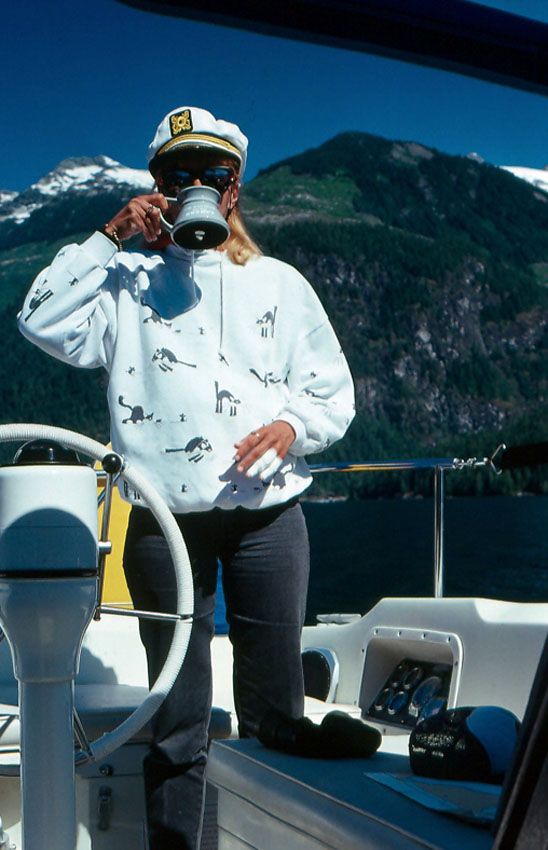
We arrived too early for slack water at Malibu Rapids. I could see white water along the shores as the flood tide poured through the narrow gap into the Inlet. There was too much current to risk entry to the guest dock inside. We tied up to the loading dock just outside the rapids. It was not designed for pleasure craft—the high dock was built to host the large camp ferry. But we were stationary and stable, and it was time for a second look at the fingers.
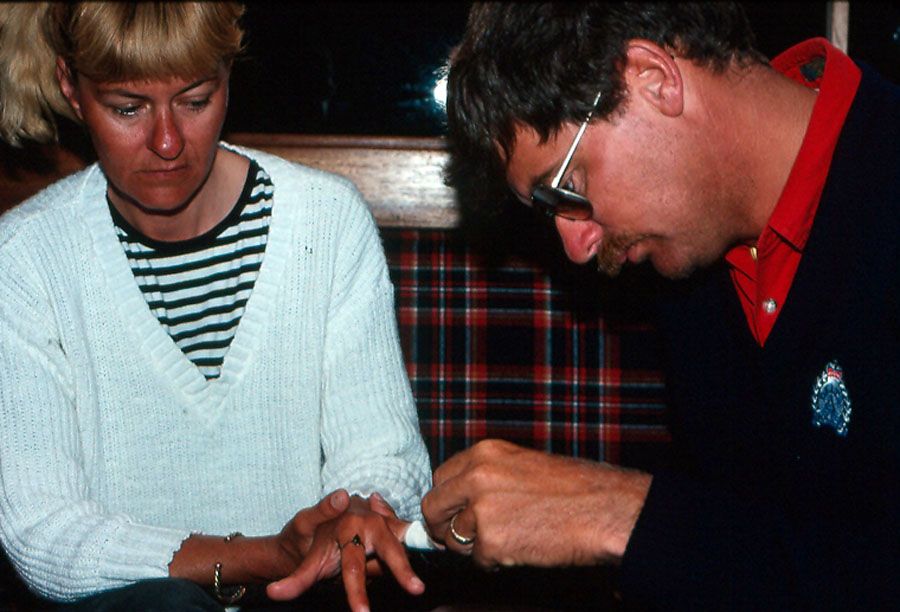
The injury was cleaned again, Carey’s engagement and wedding rings were cut off—gasp! Swelling of the tissue was likely to become an issue. Careful examination revealed injuries that weren’t as bad as first thought. Yes, it was a nasty burn/cut, but it was clean, and nothing was broken. The injuries were sterilized and ointment re-applied, then wrapped in clean bandages. There was not much more that could be done, even if we sought out medical staff at the camp.
Magical Princess Louisa Inlet
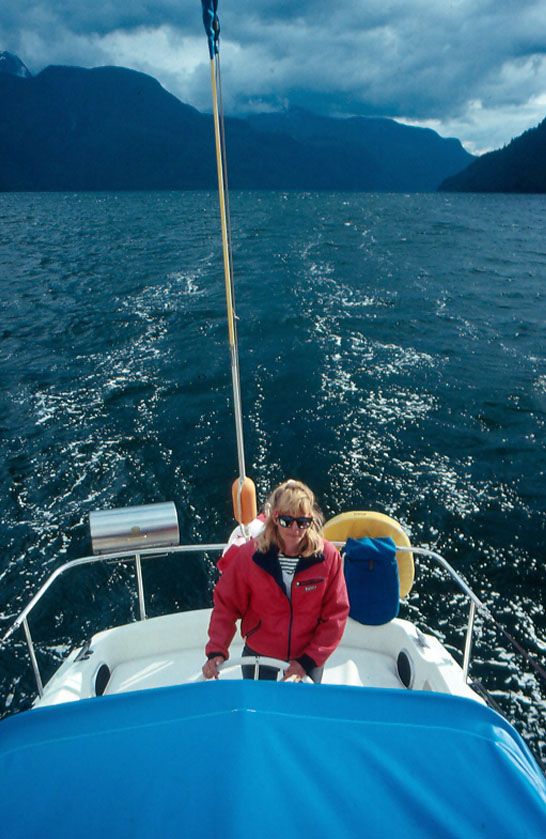
We waited for the current to slacken in the rapids and then powered into Princess Louisa as the afternoon sun climbed towards the mountain tops. The feeling was one of floating in a magical alpine lake, the still water a mirror stretching to the docks at Chatterbox Falls in the distance. We had all been through a traumatic experience, but the vistas before us were still captivating.
We tied to the busy public dock at the falls as twilight enveloped the inlet. Over the next few days the camaraderie of fellow boaters at the dock was as captivating as the mountainous vistas. Boats of all kinds arrived and departed, timed with current changes at Malibu Rapids. The morning sunlight sliding down the granite monolith towering over the glacial falls as the sun peeked over the mountains was something to behold. It needs to be experienced while sipping coffee in the cockpit.
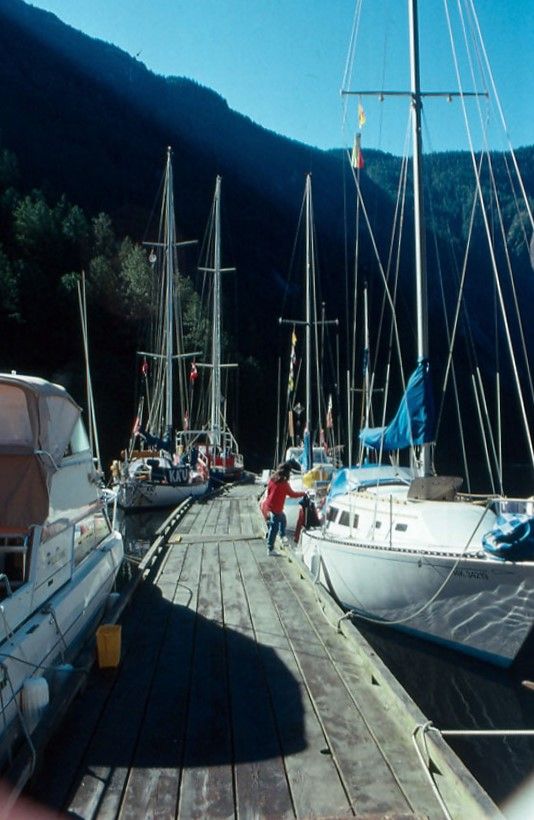
Friends arrived on their own boat and we regaled them with our tale of near catastrophe over evening drinks. Float planes arrived with daytime visitors, their powerful motors echoing off the surrounding mountains as they departed.
Bandages were changed twice a day with no sign of infection—pain medication and a few evening libations eased the discomfort. There was no talk of leaving early because of the injury. Carey can be a tough and stubborn lady at times!
Lessons Learned
The remainder of the summer cruise was far less eventful. We had a leisurely motor out of Jervis Inlet before sunrise to beat the afternoon thermals that can kick up the water, then a sail across the Salish Sea with a short visit to the Vancouver waterfront, then home. Carey’s fingers healed on their own with no complications. The rings were eventually repaired and put back in place.
Of course, since that trip, I generally don’t fly the spinnaker when Carey is on board—my concession to the “Happy Wife” mantra. I don’t want to lose crew—and a wife—who has suffered my idiotic tendencies for too many years.
In conclusion, if you think the spinnaker should be coming down because of rising wind, it should probably have already been done. And perhaps sailing gloves should come out of the drawer earlier.





I usually wear gloves even in light wind; why wouldn’t you in anticipated strong winds?
I’ve noticed that about 90% of “sailing disaster” videos on Youtube involve a spinnaker; my assym comes out occasionally on light wind days. No interest at all in a symmetrical; the boat goes well enough downwind with wing and wing sailing.
Thanks for the comment Matthew. This event occurred a few years ago and we’ve learned plenty since then. I’ve also flown asymmetrical spinnakers and, unless they are incorporated into a furler, can be just as problematic as a full symmetrical spinnaker. I don’t have the finances or desire to invest in a top-down furler and rather enjoy the challenge of a true spinnaker.