

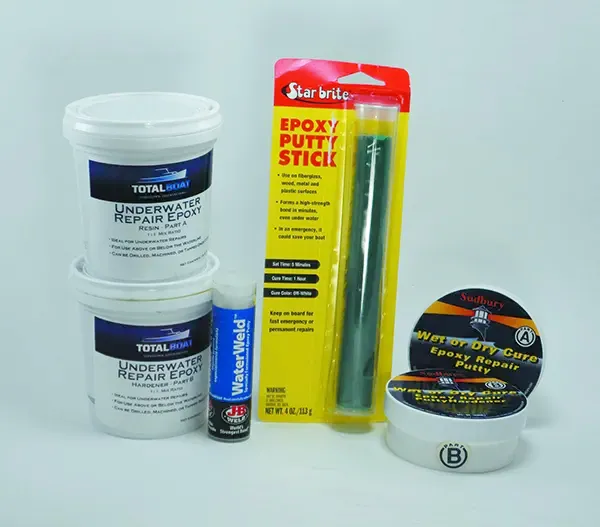
Although laminating epoxies can tolerate some moisture, we know that excessive moisture can prevent a good cure. So how can we manage an emergency repair, when water is seeping into the bilge through a hairline crack—or worse? Well, there are products intended for underwater use— we’ve used them, and they work.
Although a collision with a reef or shipping container is the nightmare scenario, it really isn’t that easy to knock a hole in the hull of a well-found boat. An enlightening article in Yachting Monthly about emergency leak repair methods noted that it took a marine professional armed with a hammer and chisel 25 minutes to breach the solid-laminate hull of their test boat.
If you rip a 2-foot hole in the hull, there is probably nothing you can do anyway. But far more boats are lost because of a smallish crack around a through hull, rudder tube, or bow thruster. We’ve hit some hefty submerged logs that were brought down by spring floods. The hull always bounced off with barely a smudge on the antifouling paint, but rudder shaft or daggerboard case was always more vulnerable, bending, cracking, and sometimes leaking. However, these leaks are fixable with a few scraps of wood and some screws—or even underwater epoxy.
What We Tested
In addition to their more traditional repair or laminating epoxies, many vendors also offer underwater cure products, designed for both temporary and permanent repair when hauling out and drying is not possible. The products we tested included Pettit Splash Zone, JB Water Weld, Total Boat Underwater Repair Epoxy, Star brite Epoxy Putty Stick, and Sudbury Wet or Dry Cure Epoxy Repair Putty, representing a cross-section of the types on the market.
How We Tested
First, we made up fiberglass test coupons, sanded them with 60 grit paper, and bonded them together with underwater epoxy. One set was made up dry, and the other set was bonded underwater. These were pulled to failure in shear to determine relative bond strength.










Searching for the best marine epoxy to do some repairs on my boat and other marine watercraft requires in-depth consideration. Thank you so much this information was certainly helpful
The going wisdom is that epoxy does not do well wet or underwater, in particular West. I beg to differ. After rebuilding the cockpit of a laser in our junior sail program, including the delaminating around the skupper, less than 10 min later before the resin even started to warm up the skies opened up.
Within a short period of time the entire cockpit was full of water. What was I to do? Well, years later that boat sailed by an entire cast of intrepid young sailers beat the heck out of it torquing the hull in heavy winds with too many kids on board and capsizing countless times because it is fun, West continues to hold up well.
Did you attempt to test kits from the hardware store for emergency water pipe repairs? For instance, RectorSeal’s Pipe Repair Kit, available at Home Depot? They use a water-activated epoxy that sets in 10mins. I wonder how they would do for below-water repair.
JB Waterweld is a Home Depot item. And it is one of our favorites. I have a JB repair that is now 6 years old, and I have not felt the need to revise it.
I love JB-Weld. It saved me in the Bahamas!
First a little background to set up the situation.
My boat Prestissimo has a steel lifting keel that is filled with diesel fuel, both to prevent rusting and to have a backup of 35 gal of fuel that I can pump out if necessary.
Every now and then, when I am anchored, and there is wind opposing current, the boat will swing around and wrap the nylon anchor rode around the keel. Once on our Bahamas trip it got pretty rough before I finally got it straightened out.
With the nylon rode stretching and contracting and rubbing across the back of the keel, the epoxy/glass layer wore through and exposed the steel to the salt water unbenounced to me.
We continued on our multi-month trip in the Bahamas, and one evening I noticed a tiniest thin line of oil film coming from under the boat as we were returning from shore.
I dove under the boat and discovered the rust and the tiniest little drop of oil popped out… about a minute later another drop.
JB-Weld Underwater to the rescue! I sanded off all the rust and onto the undamaged epoxy/glass, got back on the boat and kneaded the JB-Weld putty, dove under and massaged the putty into the hole and over all the exposed steel, and crossed my fingers that it would work.
I checked it regularly (any excuse to dive in the Bahamas) and it held for the next 3 months until we were able to pull the boat, weld the hole, and repair the epoxy/glass that protects it.
Now, when I anchor in conditions where my rode could wrap around the keel I lower a kellet about 2 ft lower than my keel.
It keeps the rode below the keel to prevent it from wrapping around the keel.
JB Water Weld has listed NSF certification for potable water so while the application would have some limitations, it can be used for water tanks.