


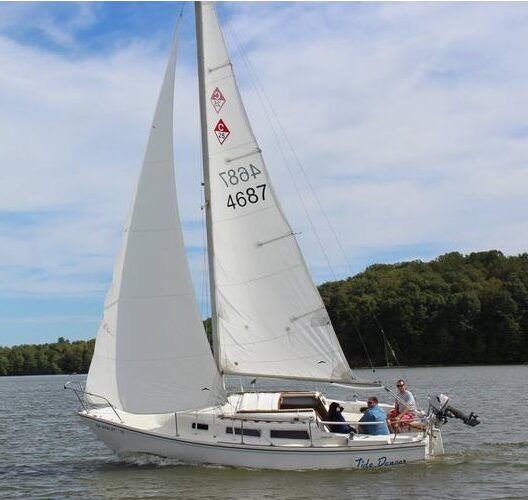
The Catalina 25 is not exceptionally fast, stylish or spacious compared to newer widebody models, and while the construction and workmanship are adequate, they too are not exceptional. But because of the builder’s strict adherence to a philosophy of offering a relatively spacious design, relatively well made, at a reasonable price, and backing up the product with generally good customer service, the Catalina 25 has turned out to be one of the most successful small cruising sailboats ever built, with 5,332 boats sold between 1976 and 1990, when the company ceased producing the model as demand tailed off.
Design
During those 14 years of production, the design went through a complete metamorphosis, starting out as a very simple and inexpensive trailerable swing-keel design, and ending as a relatively sophisticated minicruiser. As vice-president and chief designer Gerry Douglas says, “The last boats we built had diesel inboards, hot and cold pressure water systems, and extremely complex electrical systems. They were like little Catalina 34s. It was what people wanted in the late 1980s.”
Keel Configurations
If you consider all model years, you can find Catalina 25s with five different keel configurations: cast iron swing-keel, cast iron fixed keel, cast lead wing keel, cast lead fin keel without glass jacket, and in later boats, a lead keel encased in fiberglass. In the later boats there was a choice of fin keel, wing keel, or swing keel, and standard rig or tall rig. However, the swing-keel model, with a board-up draft of 2-ft. 8-in., accounted for well over half of total production.
Most Catalina buyers over the years have been cruisers rather than performance-oriented racers, and for many cruisers, the attractiveness of a boat suitable for shoal waters and trailering is undeniable. Relatively few Catalina buyers are avid racers, it seems. If the hundred or so owners who answered our survey request are an indicator, only a small percentage rate as important either the fin keels much more efficient foil shape and lower turbulence, or the greater light-air efficiency of a two-foot longer tall rig mast that increases sail area by almost 10 percent.
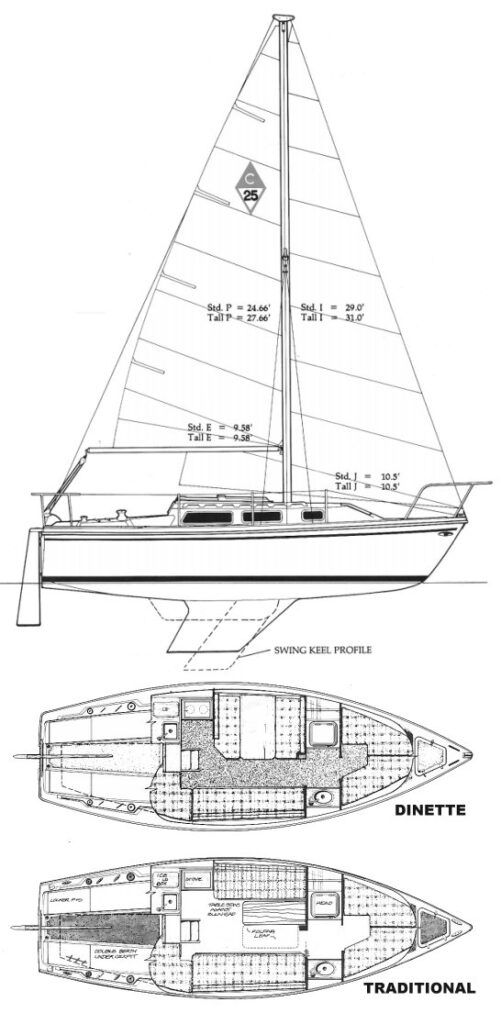
Sailboat Specifications Sailboatdata.com
Hull Type: Fin w/transom hung rudder
Rigging Type: Masthead Sloop
LOA: 25.00 ft / 7.62 m
LWL: 22.17 ft / 6.76 m
S.A. (reported): 270.00 ft² / 25.08 m²
Beam: 8.00 ft / 2.44 m
Displacement: 4,550.00 lb / 2,064 kg
Ballast: 1,900.00 lb / 862 kg
Max Draft: 4.00 ft / 1.22 m
Construction: FG
First Built: 1978
Last Built: 1994
# Built: 5866
Builder: Catalina Yachts (USA)
Designer: Frank Butler
S.A. / Displ.: 15.78
Bal. / Displ.: 41.76
Disp: / Len: 186.41
Comfort Ratio: 19.14
Capsize Screening Formula: 1.93
S#: 2.72
Hull Speed: 6.31 kn
Pounds/Inch Immersion: 633.73 pounds/inch
I: 29.00 ft / 8.84 m
J: 10.50 ft / 3.20 m
P: 24.66 ft / 7.52 m
E: 9.58 ft / 2.92 m
S.A. Fore: 152.25 ft² / 14.14 m²
S.A. Main: 118.12 ft² / 10.97 m²
S.A. Total (100% Fore + Main Triangles): 270.37 ft² / 25.12 m²
S.A./Displ. (calc.): 15.80
Est. Forestay Length: 30.84 ft / 9.40 m
Mast Height from DWL: 30.00 ft / 9.14 m
Model Year is Important
As the design developed over time, features changed enough so that in a number of respects the early boats are very different than 1987 and later model years. As a consequence, it’s imperative for prospective buyers to know what model year they’re looking at when shopping for used boats. Prices can vary from less than $5,000 to more than $16,000, not only dependent on condition, but also model year and features.
For example, at various times there was a choice of two different interiors: a dinette arrangement, and opposing settees. A flip-top (Catalina’s version of the pop-top), which provided standing headroom, was a popular feature that was optional until 1987, at which time it became standard. In fact, in 1987 the entire boat underwent a major design change, yielding among other things a more contemporary deck and a more refined interior, with less teak and more fiberglass.
Performance and Handling
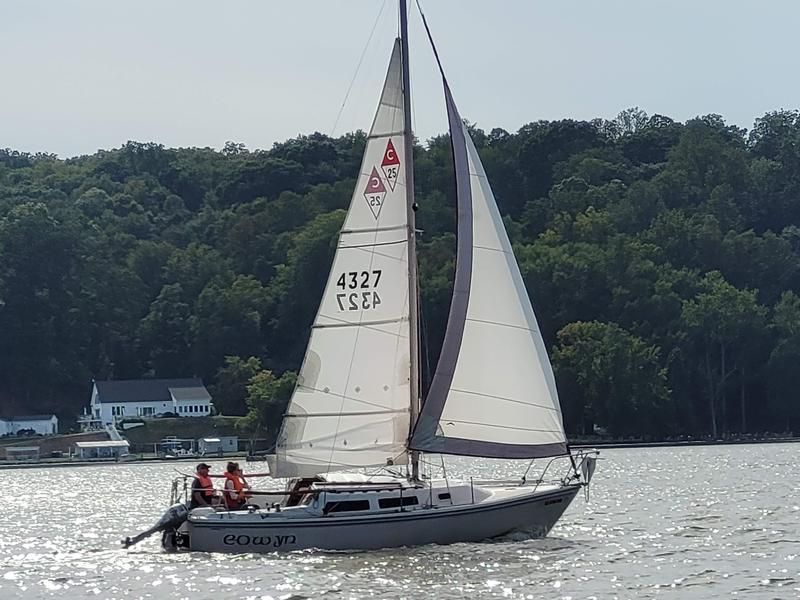
The Catalina 25, with a PHRF rating of around 228 for the standard rig or 222 for the tall rig, is not especially fast for its size. In fact, the swing-keel version, which is noticeably slower upwind than the fin-keel version, probably deserves an even higher time allowance than its been given. The fin keel is generally acknowledged to sail close to its rating, at least once the breeze pipes up to 10 knots or so. The swing keel is not as hydrodynamically sleek, and the keel lifting cable is out in the open where it causes extra drag, intensified if seaweed gets hung up on it.
The boat (especially the keel version) balances relatively well, tracks satisfactorily, and is quite maneuverable if sails are properly trimmed; it can be unforgiving if they are not. Several owners complained to us of a heavy weather helm in a breeze.
Tall Rig
The tall rig is a bit more tender than the standard rig, but definitely adds speed in light air. One just reefs a little earlier to maintain helm balance. But despite its virtues, the tall rig has a drawback mentioned by several owners: Unless you have a sailmaker chop off the bottom 12 in. of the sail, the boom swings too low over the cockpit. This, however, may be the fault of some sailmakers; the consensus is that Catalina-supplied sails were not as well-made or well-shaped as those obtained from other sailmakers.
Propulsion
Under power, the Catalina 25 will make about 5 1/2 knots with a 6-hp. outboard, and you can coax an extra 1/2 to 3/4 knot or so out of the boat with an 8-hp. or 9.9-hp. engine. Theoretical maximum hull speed in ideal conditions is around 6.3 knots.
The outboard is mounted on a fold-up transom bracket mounted off center to accommodate the outboard rudder. Some owners complained that the motor is difficult to raise and lower. Others observed that, in rough seas, when the boat pitches, an ordinary 20-in. shaft outboard prop has a tendency to ventilate, particularly if the auxiliary is used under sail and the boat heels away from the side on which the engine is mounted. The owner consensus is that a 25-in. extra long shaft largely solves that problem.
An inboard diesel engine would also solve the problem, but is not recommended; an owner of a 1986 model equipped with a 10-hp. Universal engine reports his boat is very slow under power, at least with the two-blade prop he’s currently using. A three-blade prop might help, but would also significantly increase drag under sail.
Another disadvantage of the transom-mounted outboard is that its difficult for the helmsman to control. One owner who told us he’d rigged remote engine controls in the cockpit said, “It’s the best thing we’ve done.”
Reefing

The boat needs to be reefed in 15 knots of wind—a jiffy reefing main was standard in later boats, though a roller furler for the jib was not. Above 15 knots, weather helm becomes very heavy if the main is left unreefed; one owner observed that she tends to round up in strong winds, or if heeled more than 15 degrees.
Traveler
A short traveler is integrated into the stern pulpit, and although this works well while cruising, and permits use of a bimini to protect crew from too much sun, mid-boom sheeting and a mid-cockpit traveler work better for single-handed daysailing and racing. Consequently, many owners have added the inboard traveler, some with a snap-on mainsheet block so they can switch back and forth.
Listing
A peculiarity of the design is that the distribution of the boat’s components evidently caused listing, in some boats to starboard, in others to port. For example, in the 1981 dinette model, owners complained that the dinette, engine, fuel tank, galley, and head were all on the port side, causing the boat to list noticeably to port.
Catalina evidently took these complaints to heart, but the results were not totally effective; an owner of a 1982 model complained that batteries, holding tank, and outboard on the starboard side produced a list in that direction.
Owner Comments
Other owner responses to our questionnaire included the following:
- The absence of a bridge deck is a possible safety hazard when sailing offshore in a big following sea.
- Narrow (7-in. wide) sidedecks make going forward somewhat difficult. So do the 22-in. high stanchions when the boat is heeled, impeding passage forward on the high side; shorter stanchions would help, but wouldn’t be as safe.
- The lifelines don’t lead to the top of the bow pulpit, but instead run to the deck at the bow to provide a slot for a deck-sweeping genoa. This can make the foredeck area insecure in adverse weather conditions. Bails on the top of the pulpit and pelican hooks on the lifelines would be an improvement, since it would then be possible to raise the lifelines in heavy weather or when a high-clew jib is being used.
Interior

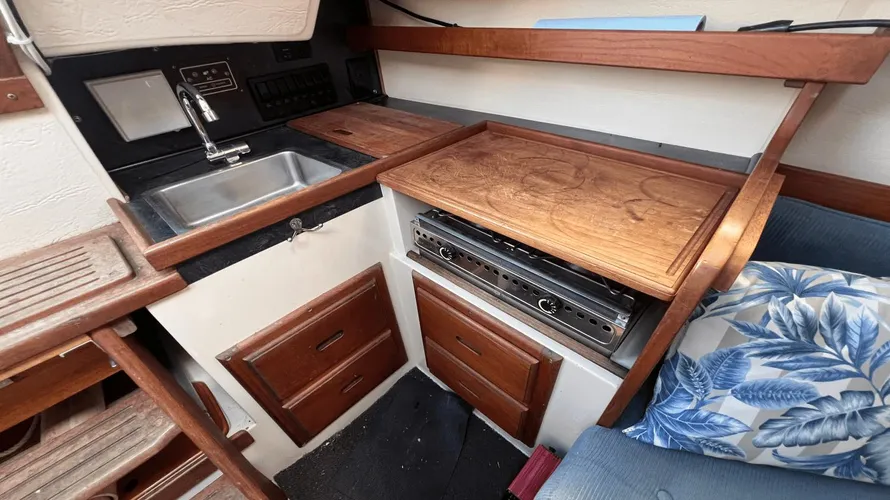
Compared to other boats available in the 1970s an early 1980s, the Catalina 25 is relatively spacious below, though some readers complained that the aft double is really only a single quarter berth and that the port side settee berth is not long enough for an adult. Newer beamier designs, of course, have the advantage of more elbow room below.
At least one owner improved sleeping accommodations by building a plywood platform which fits between the table on the port side and the settee on the starboard. The aft berth cushion, under the cockpit sole, was shortened slightly to fit on this platform. When in place, the platform results in an athwartships berth about 6-ft. 4in. long and 5-ft. 1-in. wide, big enough for a double sleeping bag. When not in use, the plywood platform stows on the aft berth.

Light and ventilation below is very adequate, as long as there’s a breeze from forward. Because the forward hatch slopes down the forward edge of the cabin trunk, when open it becomes a very effective windscoop. Boats with pop-tops have additional ventilation.
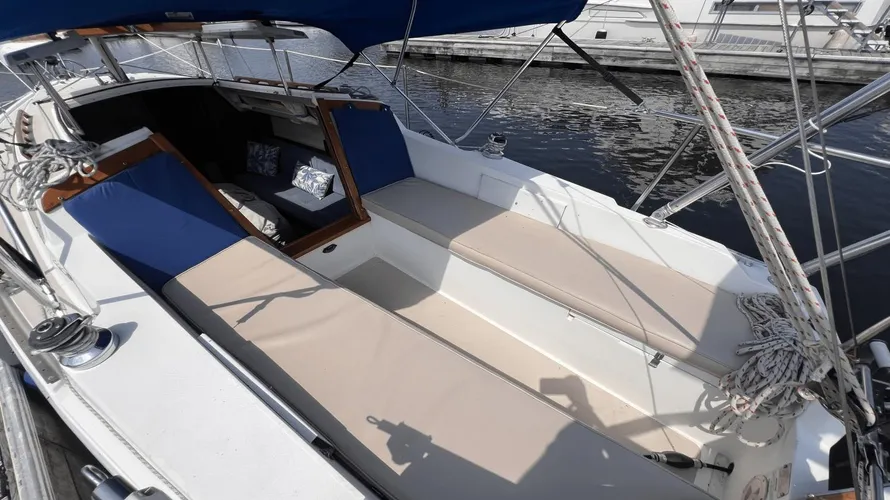
The pop-top was an extra-cost option, and a very popular one. Reader praise of the pop-top is almost universal, with comments from, “Buyer interest is much higher on boats with pop-tops,” to “Contrary to what some folks say, this pop-top does not leak in the rain or spray.” Headroom is 6-ft. 4in. with the pop-top raised.
Until the 1983 model year, when the company redesigned the icebox so it would, as one owner reported, keep block ice for three days, the icebox was severely under-insulated; many owners reported that it would only hold ice for less than a day. Another complaint was that the icebox drains directly overboard, and as a consequence, if the drain is left open when the boat heels, water enters the icebox. One reader killed two birds with one stone: “We keep our trash in the built-in cooler where it is out of sight, and use an Igloo cooler which is bigger and works better.”
Construction

The Catalina 25 has a full fiberglass hull liner, which makes it easier to keep the boat clean but at the same time can make repairs and adding owner-installed custom components more difficult.
Several owners judged that Florida-built Catalina 25 hulls, though adequate in strength, are not as well finished as the California-built boats. And several others commented on gel coat chipping and cracking, voids, pits and crazing, particularly in stressed areas such as at sharp changes of direction in the cockpit, and corners of hatch covers, though these problems didn’t seem to be a function of builder location.
Blistering
Bottom blistering seems to have been a fairly common problem on Catalina 25s when an epoxy bottom coat had not been applied under the antifouling paint to prevent water incursion. Catalina now has a 10-year no-blister warranty, but during the era of the Catalina 25, the company had a five-year warranty with gradually diminishing payments during the period. Judging from reader response to our questionnaire, some owners were not entirely satisfied with that arrangement.
Swing Keel
In the swing-keel version, Catalina used an ordinary galvanized steel trailer winch to hoist the keel, and although there are no doubt some 20-year-old boats that still have the original winch, many owners have had to repair or replace some or all of it, particularly when the boat is sailed in saltwater.
Another problem with early swing keel models involved breaking the pennant. At the lifting point on the trailing edge of the swing-keel there is a tapped hole on a flat area into which screws a stainless steel eye. A swaged fork fits over the eye and pivots on it as the keel swings up or down. The factory fixed the eye in place with Loctite, but over the years the eye could rotate, so that the clevis pin became parallel to the keel instead of perpendicular to it.
Then it would bind, and eventually end up bending and then breaking the wire at the joint of the wire and the swaged fitting. To solve the problem, Catalina came up with a device to keep the eye from rotating, but some older boats may not be retrofitted. Owners and prospective buyers of older boats should examine the swing keel to be sure the eye is solidly fixed in place.
Several owners complained that there is no mechanical lock to stop movement of the swing keel, which even at anchor can move laterally in its trunk, banging, thumping and making it, according to one owner, hard to sleep through the night. Catalina offers a retrofit kit to alleviate the problem, composed of nylon or neoprene washers—but according to some owners, this cure is only partially effective.
The surface of the cast iron swing keel was said by some of the performance-oriented owners to be comparatively rough as it came from the factory. They advise filling and sanding fair and smooth for better sailing speed. We would add that the keel should be checked regularly for corrosion, and an epoxy barrier coat should be maintained on the surface to prevent excessive rusting and deterioration.
Hardware
Deck and cabin hardware, while generally adequate, is considered sub-par by some owners, particularly on the early models. For example, the type of closed-barrel turnbuckles Catalina used are hard to inspect without disassembly, and as a result tend to corrode internally, sometimes freezing or completely failing. Later models have the open-barrel type, which is preferable.
The forward hatch for several model years was attached with self-tapping screws rather than throughbolted, causing the hatch to become loose in some cases. By 1983, bolts had replaced the screws. Other relatively common complaints include rusty screws on deck fittings, broken boom goosenecks, insufficient bow eye backing plates, tillers splitting (on one boat the tiller split twice), and problems with rudders delaminating and splitting along the edge.
Rudder Gudgeons
A particularly common problem noted is that rudder gudgeons and pintles break or come adrift from the transom. The repair involves installing a handhole inspection port on the inside of the transom to gain access to the fastening bolts. One reader said his lower pintle had broken under racing conditions, but that he had cured the problem by adding a third pintle and gudgeon halfway between the top and bottom fittings.
Several other readers reported that their boats had loose gudgeon bolts, stress cracks in the transom at the gudgeon attachment points, and transom leaks. One owner reported the transom cracked below the motor bracket because of lack of reinforcement behind the bracket.
Hull-deck Joint
The hull-deck joint on some models used self-tapping screws rather than through-bolts. Several readers experienced rain and spray leaks along the rail. Portlights also have been a source of leakage problems, as have cockpit scuppers, rudder gudgeons, and various pieces of dealer-installed deck hardware, mostly due, we guess, to inadequate bedding procedures and backup plates.
Trailering
Despite the fact that a bare Catalina 25 weighs approximately 4,150 lb., the boat plus trailer, loaded for a week’s cruise, can easily weigh over 6,000 lb. That means it’s necessary to tow with a big pickup or van equipped with a towing package, and virtually eliminates prospective trailer-sailors who only have access to an ordinary passenger vehicle, no matter how powerful. (An exception: Big cars built before the advent of downsizing and integral frames. For example, one reader says he pulls his 6,000-lb. rig successfully with a 1973 Olds 98).
The Catalina 25’s mast is deck-stepped on a hinge, but several readers complained that no factory method is offered to make mast-raising safer and easier. Still, some owners have devised their own systems, with which they seem to be satisfied. One who made extensive modifications figures it takes him a mere 45 to 60 minutes from the time he pulls into the parking lot at the launching ramp until he’s sailing away-and only a little longer than that to reverse the procedure.
One reader pointed out that with the swing keel model the rudder is deeper than the retracted keel (unless its a folding rudder, which Catalina offered as an option in some model years), which can produce problems at the launching ramp under some conditions. Another owner feels that his fin-keel is as easy to ramp-launch as a swing keel, provided an extra-long trailer tongue extension is used. We think that might be true on some ramps, but not on others.
If you’re shopping for a Catalina 25 already equipped with a trailer, check the GVWR (Gross Vehicle Weight Rating) decal before you buy. It indicates the loaded weight of the trailer in pounds, i.e. the sum of the carrying capacity of the trailer plus the weight of the trailer itself. One reader ordered (from a Florida dealer) and paid for a trailer with a 7,000 lb. capacity rating. What he got was one rated for only 5,000 lb. He was prompted to check the decal because, he says, “The trailer looked skimpy.”
He weighed the combination with the boat stripped and it came to 5,620 lb. “The dealer claimed it was the same trailer they always use for this boat and the dealer passed me off to the Florida plant, who passed me off to the trailer manufacturer, who finally made good after Frank Butler got into the act-after seven months of hassling.”
Conclusion
New or unseasoned sailors making their first or second foray into the boat-buying game may find that the Catalina 25 is an attractive choice. The boat is relatively easy to handle, can be single-handed without too much trouble, and while not fast in the racing sense, is fast enough to satisfy many cruisers. The interior is big enough for two to cruise in relative comfort, while the overall size of the boat is not daunting to most newcomers to the sport.
Other advantages for new sailors are that Catalina, in most cases, does a good job with customer service, and there’s a quarterly 100-page glossy publication for all Catalina owners (from 8-ft. Sabots all the way to Catalina 42s) called Mainsheet which offers support and helps to keep communications open between owners.
Asking prices on used Catalina 25s range from around $3,000 for older (late 1970s) models that probably need some work, to around $17,000 for newish (late 1980s) models fully equipped and in like-new condition, probably with an inboard engine and a trailer included. A price of $7,000 to $8,000 is typical for early to mid-1980s boats, though we noticed a wide range, presumably based on condition and accessories.
Market Scan Contact
1987 Catalina 25 Pop Top SkipperBud's Sturgeon Bay
$17,500 USD 816-565-4840
Sturgeon Bay, WI Boat Trader
1985 Catalina 25 Pop Top Private Seller
$7,000 USD via Boat Trader site
Perth Amboy, NJ Boat Trader
1976 Catalina 25 Sloop Private Seller
$9,900 USD via Boat Trader site
Brooklin, ME Boat Trader
1985 Catalina 25 Port Whitby Marine Centre
$7,214 USD (tax included) 905-367-9021
Cobourg, Ontario Yacht World
Prospective buyers should check for bottom blisters (which can be expensive to repair), evidence of problems around the keel bolts or pivot on the swing keel, rudder connection problems, cracks in turnbuckles or rigging terminals, leaks around windows and hull-deck connection, and other common (and correctable) flaws.
Also check for which of the many extra-cost options have been installed—options which many experienced sailors would say should have been standard: boom vang, genoa winches, pop-top with canvas enclosure (originally two separate options), basic electrical system with running lights and cabin lights, galley equipment, head, lifelines and stanchions, and sails. Check especially the brand of sails—many readers report that they have been dissatisfied with Catalina’s own brand of sails.
Overall, we think the Catalina 25 is not fancy or fast, but is economical, a fair sailer and roomy for its size—a good boat for non-racers who don’t have a big budget and for relatively new sailors who want to get their feet wet in the sport.
This article was first published on 19 March 2016 and has been updated.










Mr Nicholson,
Thank you for the report on the Catalina “25” I’ve Been searching for an older (less expensive) under 30’ single handed sailboat for the past several months and finally today someone posted a Catalina 25’ on buy, sell, or trade in the Destin Florida area. The elder gentleman wanted to restore it but a bad hip has preventing that, so he sold it to me. I started sailing about 20 years ago with a Balboa 27’ with a swing keel (what a life saver). Lost it in the divorce. There are many sand banks and shoals here in Choctawhatchee Bay and a swing keel is what a newbie needs. I don’t think this Catalina has a swing keel, at least I don’t see the crank in the cabin. The ships dimensions in your report help immensely. I have not done an inventory yet on board (they left a lot of stuff) I hoping the main is useable and I have already inspected and cleaned the storm jib, I don’t see a Genoa (Bimini) or any other jib sail hidden away. Anyways, thanks for your report I look forward to getting it under sail.
We’ve had a 1985 Catalina 25 swing keel since 2006. I’ve sailed a lot of different boats over more than fifty years. This boat has been a good investment for fun and reliability. I’ve never reefed in the near fifteen years sailing it on the Monterey Bay. We’ve burried the rails on more than one occasion and while it does weather helm in heavy winds, it’s easily managed and I’ve never been worried about a knockdown.
We’ve had a 1985 Catalina 25 swing keel since 2006. I’ve sailed a lot of different boats over more than fifty years. This boat has been a good investment for fun and reliability. I’ve never reefed in the near fifteen years sailing it on the Monterey Bay. We’ve burried the rails on more than one occasion and while it does weather helm in heavy winds, it’s easily managed and I’ve never been worried about a knockdown.
Have 1985 Catalina 25 swing keel, #K4978. I don’t know if it’s the standard or tall rig. Can I tell from the HIN#?
i am new owner of a 25ft 1981 catalina and i need 1 simple measurement .. height of wing keel from the bottom of keel to the bottom of the boat as i am building a trailer to get it home with..
sorry fin keel
I am looking to buy a fixed keel Catalina 25. The keel seems short ar 4 ft when I would have expected 5 ft for a boat this size. My question is does this make the boat more tender with ballast less lower in the keel. And how does this affect performance say against the swing keel model
Did you get to sail ‘er this summer? We have a 1980 fin keel and as long as your co-captain doesn’t mind 10 to 15 degree heel, you’re not afraid to reef the main in a blow and you’re not sailing in a hurricane, you’ll find that 4 feet of keel is plenty.
Hi Peter,
We’ve had our 1986 C25 SR SK for four years now. Our mooring mates have an 81 TR FK and we oftentimes run them together. While the Tall Rig makes theirs a little tender, proper trim seems to mitigate most puffs. As for our Swing Keel, typically deployed fully, we notice we cannot point as high but routinely we are keeping up around 6kts. I do notice in the SK, with the other owners aboard, that we have gain positive comments for our sails so I guess that is where you have a tough time making scientific comparisons, lots of variables. We have an even less fair comparison, a C25 Capri who has newer nicer sails and a seasoned skipper who wins most regattas and that fin easily allows him to point with a larger sail plan. The more I write, the less I think this will help you; however, for a swing keel, we’re plenty happy from a non-competitive perspective and don’t have envy/regrets when looking on those with fixed.
We have a Catalina 25 from 1983. We are in a humid area. We love the boat!
Our son wants to add an air conditioner of some form to make it more tolerable to sleep on hot nights. I do not want to overwhelm the interior where I sit at the table to prepare meals and do artwork. What suggestions might you have for our situation? Thank you!
Pardon it is an 89 not an 83 Catalina !
I have a 1985 22ft and the cable for the keel broke can this be loaded onto a trailer?
Good, objective review–as a past owner I have a few small quibbles with details such as keels relative to vintages, but that’s trivial. Too bad no mention is made of the active, inviting owners’ association website, catalina-capri-25s.org. Questions (such as the vertical dimension of the fin keel) from new and prospective owners are very welcome, and the expertise of many core participants is substantial. As a past owner, I have found it to be one of the most welcoming and supportive groups of its kind in all of sailing–a major feature of this boat. Catalina Yachts and the third-party supplier of parts and upgrades, Catalina Direct, are also of great assistance.