

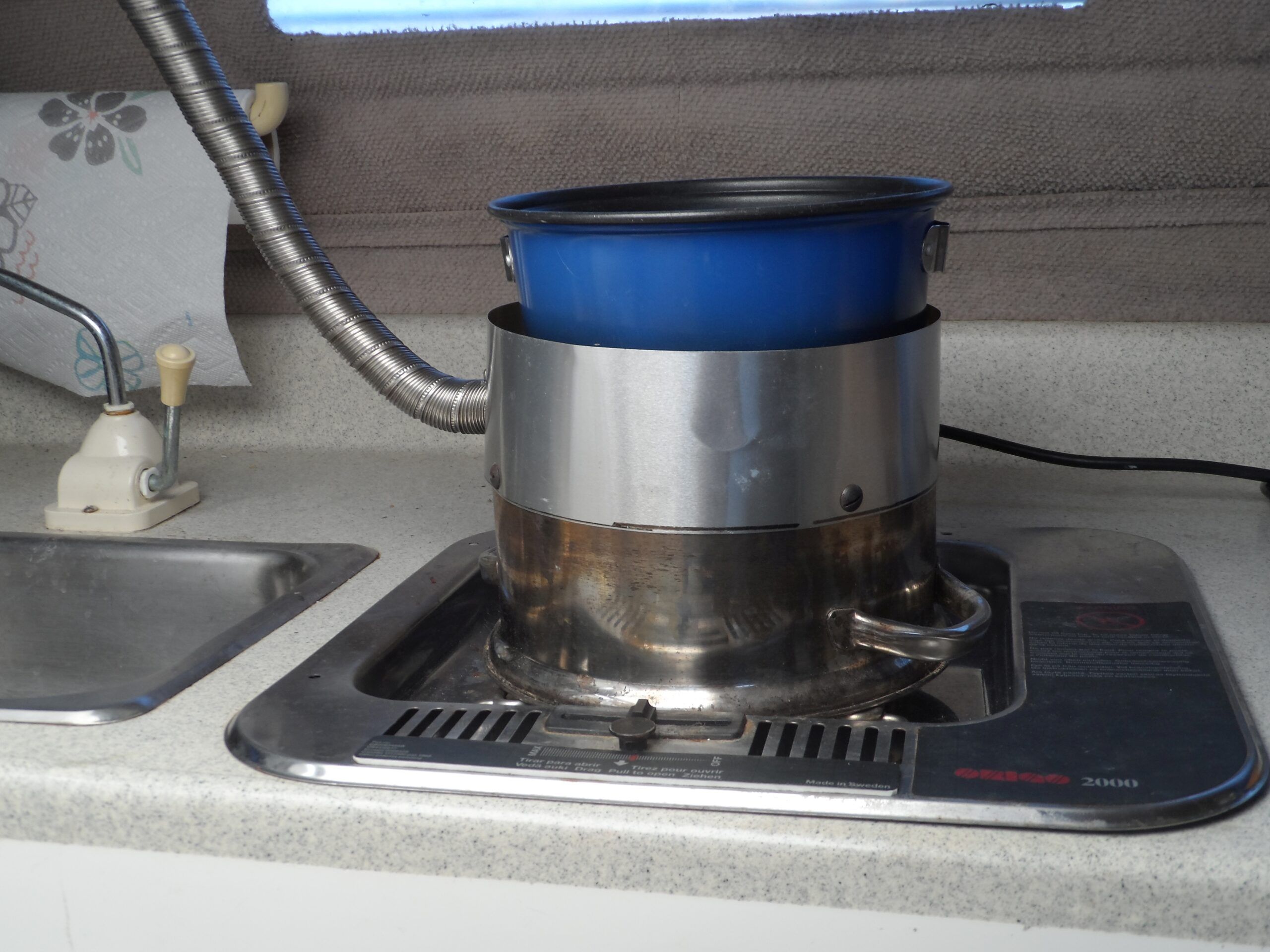
For my small F-24, with no cabin heating and no justification for the complexity of an installed system, this has been one of my best upgrades. I made it entirely from scrap in about an hour. It is based on the idea that most boats already have a heat source with some safety measures in place. All it needs is a heat transfer surface and a smoke stack, and you have a vented heater that is safer than a portable heater that vents combustion gases straight into the cabin.
To continue reading this article or issue you must be a paid member. Sign in

Join Practical Sailor
Get full access to Practical-Sailor.com – more than 4,000 articles – for just $34.
Join today and save 42% off our full price.








Love it! I do really appreciate home (boat?) built solutions to common problems aboard.
I suggest you use Grammarly for free to check and correct your writing. Otherwise, this was a good article.
Does this meet ABYC/NMMA/ISO/CFR/NFPA/etc standards? No it does not. I checked ABYC and there are 5-10 different standards that apply to marine heating and cooking appliances depending on fuel and installation. I like DIY/Rube Goldberg solutions to common problems when they don’t involve electricity and fire or otherwise ignore industry safety standards… As a expert marine litigation witness, I think you are taking on personal risk and putting others at risk by recommending this potentially dangerous hack. There’s good reason that industry safety standards exist. Recommend you make note of them and don’t play with fire on boats!
I appreciate your meticulous nature. I’m glad you posted that, and readers should review your comment.
ABYC is a voluntary standard. Other than installed heaters with sealed air intake, no portable heating device, or using the stove for heat at any time other than while cooking a
meal, meets ABYC standards. I did not describe it as an installed heater. I made no such assertions about complying with ABYC. The article describes a stove accessory. Perhaps that could have been even more clear, so I restate it here. The heater described in the article is a stove accessory, and as such, its use subject to all of the precautions applicable to using a stove, including no operation while unattended or sleeping. It is not a heater per se.
In fact, I did mention installed heaters, and they are best solution for cruising boats that use heat. I had such a system on my cruising cat.
As a stove accessory, the only applicable NFPA standards I am aware of relate to rating of the cook top (I have assumed an industry-rated cook top), and installation of the cook top, including fuel systems (integral in the case of the alcohol stove I described) and the spacing of the cook top from the cabin ceiling, walls, and combustible materials. Obviously, safe, rated stove installation has been assumed and is something the user should review in any case.
The reader is given a list of limitations and precautions, and these are repeated here:
* Do not leave the stove on unattended.
* Do not leave the stove on when sleeping.
* Install a CO monitor/alarm.
* Only for use with installed stove. I could have included that this must be marine-rated and installed in compliance with USCG and NFPA requirements.
Common alternatives to installed systems include running the stove for heat (good chance of CO poisoning), placing a flower pot on a stove burner (same CO hazard, plus the danger of a red-hot pot falling and starting a fire, or exploding from heat stress, which we have seen in testing), using an unvented heater (hazards listed), or using an electric portable heater (I know of quite a few boats burned to ash from heaters flipping over). The Cozy Cabin Heater, common in smaller boats, does not meet ABYC requirements (must have sealed combustion air intake).
These are all things for the reader to consider. I have been active on API and NFPA committees in a former life, and appreciate your concerns. Standards matter.
—
Standards texts are notoriously difficult for non-industry people to access. I was on some of the commitees, and I understand that standards organizations are funded by standard sales. It’s a conundrum for the user.
I found this for stoves in the NFPA for homes.
Household cooking appliances shall have a vertical clearance above the cooking top of not less than 30 inches (760 mm) to combustible material and metal cabinets. A minimum clearance of 24 inches (610 mm) is permitted where one of the following is installed:
1. The underside of the combustible material or metal cabinet above the cooking top is protected with not less than 1/4-inch (6.4 mm) insulating millboard covered with sheet metal not less than 0.0122 inch (0.3 mm) thick.
2. A metal ventilating hood constructed of sheet metal not less than 0.0122 inch (0.3 mm) thick is installed above the cooking top with a clearance of not less than 1/4 inch (6.4 mm) between the hood and the underside of the combustible material or metal cabinet. The hood shall have a width not less than the width of the appliance and shall be centered over the appliance.
3. A listed cooking appliance or microwave oven is installed over a listed cooking appliance and in compliance with the terms of the manufacturer’s installation instructions for the upper appliance.
A boat is not a home. I did not find a heat shield or spacing requirement for boats. Dometic specifies 19.5 inches of vertical clearance and no heat shield is requirment. Grease flare-ups are a serious hazard, particularly on a boat in close quarters. Cooking is not to be taken lightly and a stove must never be operated unattended.
Did you consider making a coaxial exhaust hose? It would provide the benefits of:
– The exhaust pipe should be cool to the touch over its entire length.
– The exhaust would be much cooler as it exits the cabin
– Fresh combustion air would be directed near the combustion source.
– Even better efficiency.
It probably wouldn’t work for your boat, but I had a diesel drip heater mounted directly below a Dorade box. When in use, the lid of the Dorade box was hinged open and a rigid exhaust pipe was inserted through the deck. It made for a very clean installation.
No question there is room for improvement. The goal was very simple stove accessory.
My last heater had a coaxial flue. Preheating the intake air improves efficiency. In the case of a very tight boat it ensures an adequate combustion air supply. The exterior of the pipe is cooler. The exhaust temperature, on the other hand, will be slightly warmer because there is less radiation from the inner exhaust pipe (as the outer pipe reflects much of the IR back) and a lesser temperature difference between the exhaust and outside air (the intake air is quite hot near the stove).
But this also complicates construction and would make the heater bulkier, heavier, and more expensive to construct. My feeling is that if the heater is for more than very occasional use, an installed heater meeting ABYC requirements is the right choice (Andy was right about that).
The Wheems & Plath Yacht Lamp is a very effective, safe and debatably inexpensive heater. That has been my go to for the sailboats I’ve owned. Doesn’t warm up the cabin more than a couple degrees. But, I think, it dries out the air. Regardless, it makes the cabin surprisingly comfy.
Intake for combustion air. Any fuel-burning appliance, vented or not, marine or not, requires an intake for combustion air. ABYC requires that this be sealed to the appliance, to prevent pressure imbalances, but early codes did not.
The standard rule of thumb is 1 square inch per 1,000 BTUs. A single burner is about 5,000-8,000 on high, and my installation included a nearby companionway louver with about 8 square inches of free area (subtracting for the grate). Most often, the companionway was covered with a fitted fleece blanket with a considerable gap around the bottom where it rests on the cockpit floor.
Cooking on a stove (without a sealed exhaust stack) requires about twice this at a high level (heat rises) for exhaust.
Be certain to supply intake air.