
With tropical storms becoming more frequent and less predictable, sailors need to have their lines prepared to resist chafing to keep their boats, and other boats, safely secured. Since chafe is a major cause of dock line, mooring pendant, and anchor rode failure, this is one of the simplest steps you can take to protect your boat.
We’ve often seen unprotected lines in hurricane-prone Florida marinas, yet clearly this is not a supply-chain problem. From fire hose to old canvas, just about any abrasion-resistant material can be used to protect your lines from chafe, but some materials work better than others. Perhaps sailors don’t know how to make their own chafe guards? We’re here to help.
Which Material is Best?
One key finding in our previous chafe protection tests is how impermeable hoses, like garden hose or the reinforced vinyl hose commonly used for boat plumbing, are less desirable than fiber products that allow rain or seawater to reach the rope to dissipate heat.
Intra-fiber chafe and the associated heat buildup have been blamed for many dockline, snubber and anchor line failures, and the risk of this failure increases significantly in older ropes that have lost the factory lubricants that help preserve new ropes. We also look at another major cause of line failure—the loss of elasticity after repeated loads—in “Checking Rope Strength.”
You can find a range of permeable chafe products online or at chandleries, but protecting all the lines on your boat with some of the more expensive products can set you back more than $200, which is a lot to pay for what is essentially sacrificial protection.
Leather Options
Being a team of diehard do-it-yourselfers, we tried our own hand at devising a workable solution to defeating line chafe. After fiddling with canvas, old fire hose, and even messing around with some Kevlar, we settled on leather—an old rigger’s standby. The leather proved to be rugged and remained intact after we put it through the Practical Sailor’s chafe protection test protocol, used in our last comprehensive test of dockline chafe gear.
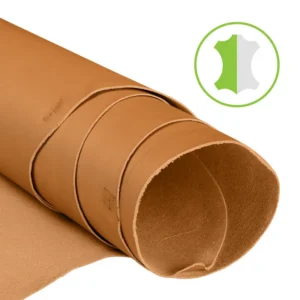
Many online retailers and chandleries sell pre-cut and pre-punched strips, but we found it cheaper to buy our leather by the square foot from an online retailer. Sailmaking supply stores like Sailrite also supply bulk leather at competitive prices. Craft leather is rated by ounces/square foot, with each oz. leather being roughly equal to 1/64-inch, although the thickness is rarely consistent throughout.
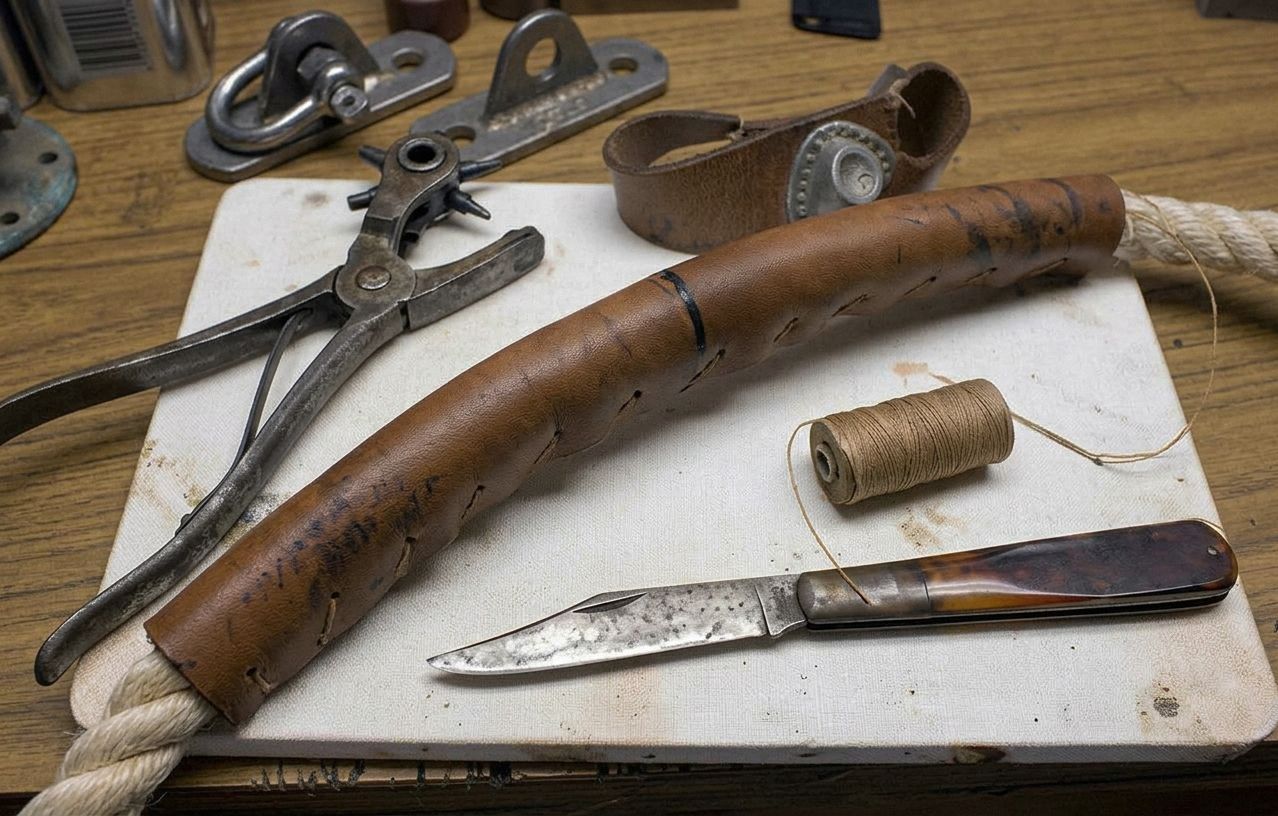
We used cured 6-ounce leather, which was plenty thick and still supple enough to work and pass through our chocks. The fabrication process was kid’s crafting 101, and there was something quite seafaring about the result.
How to DIY Leather Anti-Chafe Line Protectors
Our approach was straight out of the old-salt playbook.
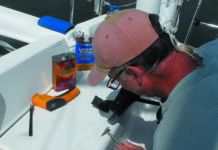
- Using a sharp knife and metal straight edge, we lopped off the size patch we needed.
- Holes were punched opposite each other at 1/2-inch intervals, and for temporary use, we zigzagged small cord the length of the leather.
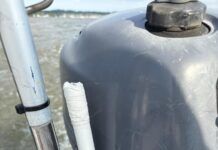
- For a more permanent installation, we hand-stitched the leather in place, tucking locking stitches into the rope at each end.
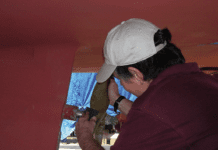
- Holes were made with a pliers-like hole punch, and we fashioned our chafe strips to be long enough to cover the hard points, adding an additional 25 percent to the length to handle stretch and any minor slippage.
Whether laced on for short-term use or stitched more permanently in place, the leather rode smoothly in chocks and prevented the hard edge of an alloy rail from damaging rope fibers. Care needs to be taken to keep the more fragile stitched seam from facing the action and becoming the surface that handles the abrasion. But the same holds true for commercial products that rely on Velcro closures.
Conclusion
At the end of testing, we concluded that if you have the time and enjoy the tradition of crafting a seamanship solution, definitely go find some leather. If you would rather spend the time sailing, purchase an over-the-counter solution recommended from our previous chafe gear testing. But above all, be ready to add anti-chafe gear to your lines when good weather turns bad; a good outcome is all about staying put.
Further Reading
For a more in-depth report on chafe protection and other measures to take to prepare your boat for any storm (not just tropical storms), check out our four-volume e-book “Hurricane Preparedness Guide.”
Covering everything from chafe gear to choosing a hurricane refuge, this report goes into far greater detail than standard guidance offered by various advisory groups and experts. Despite the name, this comprehensive look at gear and tactics to protect boats in harbor is applicable to docking, mooring, and anchoring situations that every cruiser faces, whether or not they cruise in areas impacted by tropical storms.
This article was published on June 9, 2022, and has been updated.