

Ralphs Great Adventures in Laminating
Technical Editor Ralph Naranjo equates spare time with boat projects. His basement shop/test facility has spawned a wide range of boats, boards, and parts for bigger boats. The two latest are test platforms for long-term evaluation of the resins and materials looked at in this round of epoxy evaluation.
Antifouling for Aluminum Boats
When Achim and Erica Ginsberg-Klemmt upgraded to an aluminum sloop, they had to confront one of aluminum’s major pitfalls: copper-based bottom paints don’t like aluminum. After years of good performance from a foreign-made, expensive-to-import inorganic zinc-silicate coating called Inversalu, the couple sought an affordable option distributed in the U.S. Their research led them to a PPG Amercoat product, a hard two-part zinc-silicate paint called Dimetcote 21-5. Practical Sailor’s report covers their prep and painting experience, a look at how zonc-silicate paints works, and Dimetcote’s performance after eight months in Florida waters.
What’s In the Practical Sailor Toolbag?
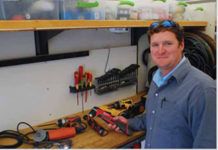
Formerly the manager of a full-service boat yard, Practical Sailor Technical Editor Ralph Naranjo offers a survey of the tools he can’t live without. His toolbag is chocked full, and a peek inside finds saws, trimmers, planers, grinders, belt sanders, multi-tasking power tools, and drivers. His tool inventory—comprising top-of-the-line power tools and tried-and-proven devices, is one that enables him to handle most any boat project. If you’re looking to fill in you’re the gaps in your tool lineup or to stock your workshop, be sure to check out this special report.
Whats In the Practical Sailor Toolbag?
Formerly the manager of a full-service boat yard, Practical Sailor Technical Editor Ralph Naranjo offers a survey of the tools he can’t live without. His toolbag is chocked full, and a peek inside finds saws, trimmers, planers, grinders, belt sanders, multi-tasking power tools, and drivers. His tool inventory—comprising top-of-the-line power tools and tried-and-proven devices, is one that enables him to handle most any boat project. If you’re looking to fill in you’re the gaps in your tool lineup or to stock your workshop, be sure to check out this special report.

Bottom Paint Stripping
Although we’ve tackled our share of varnish with a heat gun and scraper, we’ve never used them to strip bottom paint. The obvious concerns would be marring the gelcoat and the noxious fumes created by heating paint solvents and active ingredients. Our first choice for removing antifouling would be sodablasting (PS, October 2011), but as that’s not an option for you, we’d consider chemical stripping (PS, April 2008 and March 2009), wet-sanding, or vacuum sanding.
A Better Way to Mount Deck Hardware
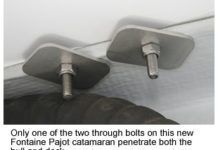
Improperly mounted stanchion and pulpit bases are a major cause of gelcoat cracks in the deck radiating from the attached hardware. The cracks are usually the result of unequally stressed mounting fastenings or inadequate underdeck distribution of hardware loads. Frequently, a boat is received from the builder with local cracks already developed. Once the deck gets dirty enough, these minute cracks start to show up as tiny spider webs slightly darker than the surrounding deck gelcoat While repairing these cracks is a fairly difficult cosmetic fix, the underlying problem - poor mounting - is fairly easy to correct in most cases.
25 Paints Make it Past the 24-month Mark
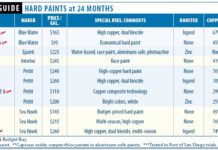
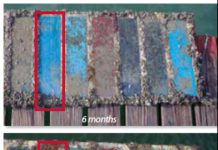
In July 2009, 61 samples of antifouling paints, including several new formulas, went into the water in Sarasota, Fla., for testing. This report and the tables above offer a 24-month update on our findings on the top paints in that field, which we last reported on in April of 2011. For sailors who value longevity over all other factors, that article, along with this report on paints that rated a Fair or better after 24 months, will serve as your best guide to choosing a long-lasting bottom paint.
Semi-Annual Antifouling Paint-Test Checkup
Practical Sailor continues its search for the best antifouling as we test a large field of bottom paints, including products from Pettit, Blue Water, Epaint, Interlux, and Sea Hawk. In this report, we rate the paints' eight-month and two-year performances. Some budget-friendly and eco-firnedly paints were still doing quite well after a season in the drink. When we last checked in on bottom paints in the March 2011 report, the ban on copper in antifouling paints was on the docket in Washington state and California. As the movement to ban copper moves eastward, the bottom paint industry is in flux, with manufacturers reducing the amount of copper in bottom paint and trying new copper-free paints. Bottom paint will probably not decrease in price, or increase in effectiveness, in the next few years.

Rating Paint Panels
The paint samples were applied to 6-foot-by-2-foot fiberglass panels for testing. Testers follow the makers’ instructions for preparation and application. There were 11 samples per test panel. All but four samples had two coats of paint.

Baked-on Prop Coating Still Repelling Barnacles
Last November, we began field trials of Mussel Buster, a baked-on powder coating that relies on its slick, hard coating to prevent barnacles from adhering. After six months, the prop was surprisingly clean. A few small barnacles had appeared, but they wiped away easily with the sweep of a hand.
Latest Logbook

Practical Sailor Logbook – September 2026
In September we tour the Hans Christian 48T — the offshore cruiser many sailors call the holy grail — walk the custom Antigua 60...

Video: If You See This on a Used Sailboat, Walk Away
If you’re searching the used sailboat market, comparing sailboats for sale, or learning how to inspect a sailboat before buying, these are the red...



Latest Sailboat Reviews
Cal 2-27 Used Boat Review
Our story begins in 1970, with the introduction of the Cal 29. Looking for something similar but a bit smaller, the company asked designer Bill Lapworth for a 27-footer, which at first was the Cal 27, a fin keel, spade rudder design with a convertible pop top; another incarnation of this basic hull was the T/2. But the concept of the 29 found its full expression in the Cal 2-27, which began production in 1975 and continued to 1977, after which it was again modified and called simply the Cal 27...again. Production of it ceased in 1986.