



Troubleshooting Marine Battery Issues
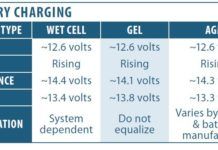
Ive had a bunch of friends troubleshooting battery issues lately. It would be really nice to have a chart that shows the battery voltage at rest and charging voltages for bulk/acceptance/float for lead/acid (flooded cells), gel cells, and AGMs.

Mailport: Smart Plug, More MOB Lights, and More!
The SmartPlug shore-power cord and inlet have been improved since we last tested the system. Upgrades include an enhanced wire-restraint system that uses setscrews and a new mechanical-arm clamp on the connector.

June 2016 Mailport
In response to your Mailport article (May 2016) on re-designing the Value Guide tables to be more friendly to color-vision deficient readers: I am red/green color deficient. Color-blind is a misleading term as most of us are not blind to red or green, just deficient in detecting shades of these colors in certain situations. Be aware that there are other colors to which some people are insensitive; red/green is just the most common.

BOATUS Offers Required Safety Course
The state of Virginia is requiring that all operators of vessels and personal watercraft that have 10 horsepower or more complete a boating safety education course. Compliance is mandatory for operators of all ages, and will be required after July 1.

Sailing Product Updates
Kannad Marine (www.kannadmarine.com), owned by Oriola Limited, has issued a voluntary, global recall of all of its Safelink EPIRBs due to a possible defect that could result in the beacon not operating in emergency situations. The Coast Guard strongly recommends that all owners and users of the Kannad Safelink EPIRBs (manual and automatic models) seek replacement devices as soon as possible and not use the Safelink EPIRB as a primary search-and-rescue beacon.

Pri-D for Diesel Storage?
In your November 2015 article on the best overall gasoline and diesel treatments for storage, you gave recommendations for treating diesel fuel tanks. After reading your article, I am inclined to buy Star Tron Diesel (www.starbrite.com) and add it with the Biobor JF (www.biobor.com) that I already have on hand. But I also have a product made by Power Research Inc. (www.priproducts.com), Pri-D Complete Diesel Treatment, which I got when I had my fuel tanks cleaned at a boatyard. On the Pri-D label, it claims to be a stabilizer, cuts smoke, removes algae and slime, lubricity for ULSD. This was not one of the products PS evaluated. Are you aware of it? Is it any good?

Mailport: May 2016
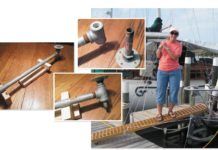
In your February 2016 issue, you had an article about boarding steps. As the freeboard is getting higher and higher on modern boats, there is a need for a practical solution to easily getting on and off the boat. I thought the Edson One-Step (www.edsonmarine.com) that you reviewed was a good solution, so I bought one. Overall, I found it worked pretty well; however, it has a narrow profile that makes the step fairly small. So I came up with my own custom adaptation to that problem (see accompanying photos). Basically, I added a teak step to the Edson frame. It works great. The only real downside is storage.

Seeking Input on Color-blind-friendly Design
Reader Harry Grossman recently wrote Practical Sailor with an interesting question that we had never really considered before. Grossman wrote, I am red-green color blind, as are a fair number of other males. Am I the only one who has difficulty seeing your Value Guide marks when they are placed in the colored background?
Applying Dielectric Grease
Im confused about how to apply dielectric silicone compound or LPS-3 (spray) to electrical connections. These are dielectric substances (i.e., insulators), which would suggest that if you apply either one to the electrical terminals and then assemble the connection, you would increase the resistance, defeating your intentions. So should you just spray or spread it over a terminal block and consider it protected? Or does the compound get squeezed out sufficiently so that a good electrical connection is made?
Mailport: April 2016
The hatch cover project you reported on in the March 2016 review of the Outland Hatch Covers offered a right nifty approach to making your own covers. Could we see more details on the cover backside and buttons? Also, how did you keep the holesaw from dancing around without the center bit to pilot off of?
Latest Logbook

Practical Sailor Logbook – September 2026
In September we tour the Hans Christian 48T — the offshore cruiser many sailors call the holy grail — walk the custom Antigua 60...

Video: The BEST Sailboat You Can Buy for $35,000 – Catalina...
If you’re searching for a mid-30-foot sailboat, affordable cruising sailboat, liveaboard sailboat, first sailboat, or a capable used sailboat for coastal cruising, the Catalina...



Latest Sailboat Reviews
Cal 2-27 Used Boat Review
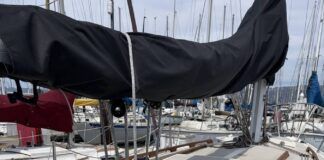
Our story begins in 1970, with the introduction of the Cal 29. Looking for something similar but a bit smaller, the company asked designer Bill Lapworth for a 27-footer, which at first was the Cal 27, a fin keel, spade rudder design with a convertible pop top; another incarnation of this basic hull was the T/2. But the concept of the 29 found its full expression in the Cal 2-27, which began production in 1975 and continued to 1977, after which it was again modified and called simply the Cal 27...again. Production of it ceased in 1986.