


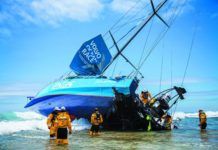
NOAA Charts Coming to an End
The National Oceanic and Atmospheric Administration is seeking public comment on ending production of traditional paper nautical charts. The transition to Electronic Chart Display and Information System (ECDIS) set for 2025 is already underway, but this does not mean the end of backup paper charts, and hopefully not the end of the navigational skills associated with traditional pilotage. Even if you do not intend to make a public comment (see link at bottom), here are…
Lessons from a Death at Sea
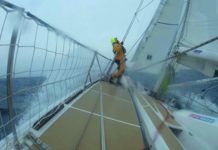
On November 18, 2017, Simon Speirs was washed off the bow of Clipper 70 CV30 during a southern ocean leg of the Clipper Around the World Race. He was attached to the boat with a 2-meter tether, which initially held him but failed within a few minutes. He was recovered 32 minutes later, but he could not be resuscitated.
Tragic Accident Highlights Safety Gear Shortcomings
The United Kingdoms Marine Accident Investigation Branchs report on the death of Simon Speirs highlighted several factors that contributed to Speirs death, as well as the many elements required of successful MOB rescue. The full report, documenting in great detail the events leading up to Speirs going overboard, and the eventual recovery of his body should be required reading for any offshore sailor. You can find it online at: https://bit.ly/36lzh8H

Clipper Ventures Cites Inaccuracies in Report
The following is an excerpt from the statement that Clipper Ventures released in response to UKs Marine Accident Investigation Branchs report on the death of sailor Simon Speirs. The full response can be found online at: https://bit.ly/36cpUb3
A Dangerous Way to Learn
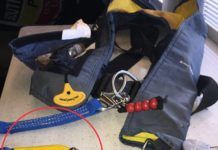
We recently talked about the tremendous forces at work when a person goes overboard (see PS December 2018, Leg Straps Put the Load on Fanny). Monterey Bay sailor Jack Davies, 63, who is lucky to be alive, felt those forces firsthand. Davies set out in his Ericson 35 Ean na Mara for a winter sail from Monterey Harbor to Point Pinos about three miles away and back. On the return leg, with sunset closing in, he…

Superlight Helmet Suits Sailors
Primarily known for mountaineering and industrial climbing gear, sailors know Kong for the robust Tango tether clip used on most safety tethers (See Safety Tethers Under Scrutiny, PS March, 2018). In addition to climbing gear, Kong also makes anchor swivels, mooring hooks, and snap shackles. Here, in an update to our July 2019 report, we look at their new helmet.
Fire Escape Hoods for Boats
In case of fire, obviously there are times when quick retreat is the only plan. If gasoline, propane, or even a can of WD-40 is likely to become involved, you need to go. Fiberglass ignites fast, so only incipient fires are worth fighting. Of course, if you are sailing and aware, this is the only sort of fire you should face. Thus, assuming the engine is diesel and the propane is shut off at the tank, which is also some distance away, you have a few minutes.

Mailport: DSD; PFD Testing; Water Purification; Rewiring; Air Conditioning at Anchor
Like Tom Taylor and Joseph DiMatteo (see Mailport PS August 2019), Ive stopped using inflatable PFDs and instead wear inherently buoyant foam versions. I found that ones designed for dinghy sailing are often very comfortable and have convenient pockets for knives, whistles, flashlights, and even handheld VHFs (I keep one with GPS and DSC on myself, especially when single-handing).

Tips to Preventing a Crew Overboard Incident
Some simple steps can reduce the risk of a crew overboard incident.
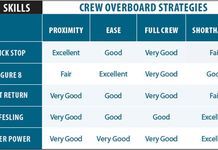
Revisiting Recovery Techniques for MOB
Ocean sailing in a modern race boat or multihull with a high horsepower rig makes double-digit boat speed attainable and complicates a MOB rescue. Our research suggests that no single MOB tactic works for all occasions.
Video: Beneteau 361 – Full Review
Should you buy an older Beneteau sailboat? In this Practical Sailor boat review and yacht tour, we examine the Beneteau Oceanis 361 to see...



Latest Sailboat Reviews
Jeanneau Sun Odyssey 42 DS Used Boat Review
This boat is dangerous for one simple reason—it looks like the answer. It’s big enough, pretty enough, modern enough, and suddenly, somehow, almost affordable...