



Wooden Anchor Chocks
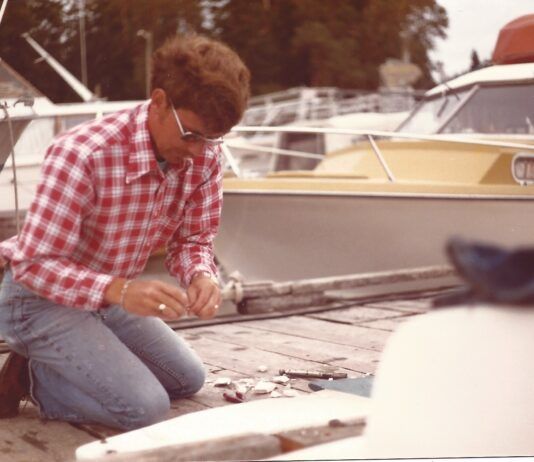
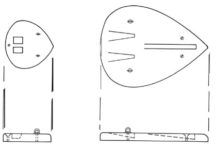
Conventional commercially available anchor chocks, though convenient, can be nasty metal toe stubbers and not particularly attractive. In contrast, wooden chocks are easy to make, handsome, and relatively snag- and toe-proof.
West Marine Updates Recalled Tether
West Marine has released a new, improved version of the safety tethers it voluntarily recalled last summer. As we reported in the August 2010 issue, West Marine recalled its model 9553512 (single) and 9553504 (double) safety tethers—which featured Kong hooks on the boat end and snap shackles on the user end—over concerns about the durability of the split ring connecting the snap shackle’s release pin and the lanyard.
Design For: Building Your Own Handrails
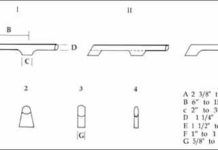
One of the most used and easily made items of safety gear on boats is the handrail. Rare is the boat which shouldn't have handrails along the major portion of either side of the cabin top, and also down the centerline of the deck. Belowdecks, handrails are also important for safety. They are usually mounted on the cabin overhead, parallel to and on either side of the boat's centerline. To simplify mounting, the most desirable position is under the rails on deck. That way a single set of bolts can serve to fasten both rails.

How To Help Your Boat Survive A Major Storm
Hurricane Gloria was a most impolite lady. She barreled up the Atlantic coast, scaring the heck out of people from Florida to Massachusetts. Despite the fact that the storm didn’t live up to its billing, hundreds of boats in New York, Connecticut, Rhode Island, and Massachusetts were destroyed or severely damaged. In some cases, the boats were lost through no fault of the owner. No amount of preparation will save your boat if another boat drags down on it in the middle of a hurricane. In other cases, however, lack of proper preparation was a major cause of a damaged boat. There’s no excuse for that type of loss.
A Close Look at 2 New MOB Alarms
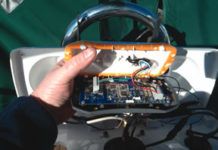
There are several different man-overboard alerting systems that represent different approaches to the challenges of an MOB event. Testers reported on the long-term testing of the MobiLert 7200, tested BriarTek’s ORCAdsc, and evaluated the upgraded Mobilert. Both of the new man-overboard alarm systems are designed to alert crew when any crew member goes overboard. The ORCAdsc is a water-activated, wearable MOB beacon that sends out an alarm via a VHF radio's DSC function. Any boat in the vicinity of the MOB that has a DSC-capable VHF radio will receive an alert that there is a man overboard. The wearable Mobilert beacons activate an alarm when the radio signal between the beacon and its base station is interrupted, typically because the beacon is either in the water or out-of-range. For cruisers who spend most of their time in regions with well-established search-and-rescue support, we still recommend a third-generation 406-Mhz personal locator beacon (PLB) such as the ACR ResQFix.
More New MOB Alarms
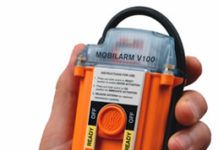
Still awaiting FCC approval, the 4.2-ounce SafeLink R10 from Kannad Marine (www.kannadmarine.com) has a 2-watt transmitter that operates on the VHF frequencies used by AIS (Automatic Identification System). Equipped with a built-in GPS receiver, it sends a structured alert message, GPS position data, and a special identity code to AIS receivers within about four miles. The position data is updated every 60 seconds. (The first alert, 10 seconds after immersion, contains no GPS data.) Battery life is 24 hours, with a storage life of seven years. The beacon must be manually activated, but it can also be professionally installed to activate when an inflatable life jacket inflates. Retail price is set at $349.
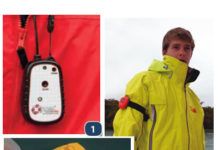
How an MOB Beacon is Worn Can Impact its Performance
Any device designed as a man overboard alarm must have a bulletproof means of attaching the device to a person’s body or apparel. When you hit the water from 15 feet, the force of impact alone can rip a ring from your finger. Some units will only work when submerged, requiring careful thought into how and where the pendant will be worn.
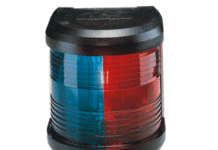
Aqua Signal Recalls Series 40 Bi-color Nav Lights
Aqua Signal Corp. (www.aquasignal.info) recently recalled a small number of its popular Series 40 bi-color navigation lights. The recalled lights, manufactured between November 2010 and February 2011, were made with the colored lenses reversed—with the red lens on the starboard side and the green lens on the port side.
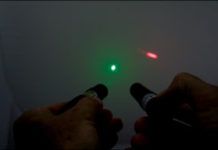
PS Tests New Green Rescue Laser
Practical Sailor tested a prototype of Greatland Laser's Green Rescue Laser a few years ago, and we took the opportunity to check out a production model for this report on the visual distress signals. The Green Rescue Laser flare looks like a mini-Maglite with anodized aluminum bodies, measuring less than 5 inches long and 7/8 inches in diameter, and weighing 3.3 ounces. In tests, the green laser's exceptionally brilliant light proved to be visible from greater distances than red laser flares, flashlights, and strobe lights; its signaling capability lasts hours rather than the minutes of pyrotechnic flares; and its green light is easier to spot against a cityscape than a white flashlight. Waterproof to 80 feet, the Rescue Laser is compact and can be reused, doesn’t expire, and can be carried through airport security. While it would be a good addition to a ditch bag or foul-weather gear, it's not a replacement for aerial flares, in our opinion, and its $250 price tag is a hard pill to swallow.

Safety Tips From the Pros
Every two years, some 150 offshore sailboats line up in Newport, RI, to race roughly 650 miles to Bermuda, a semi-tropical island in the western Atlantic, almost due east of Charleston, SC. While this is a relatively short ocean passage, it is not always an easy one. Boats have met serious gale conditions and dodged hurricanes during past editions of this race.
How Long Do Sails Last?
How long do sails actually last? Sailmakers often say cruising sails last around 10–15 years, but what happens when you discover a sail that’s...



Latest Sailboat Review

Jeanneau 55 Boat Review
This recent sailboat from Jeanneau may as well be a spaceship. They’ve taken all the time-honored designs of a monohull aft cockpit and turned...