

Adding Some Zing To Anchor Testing
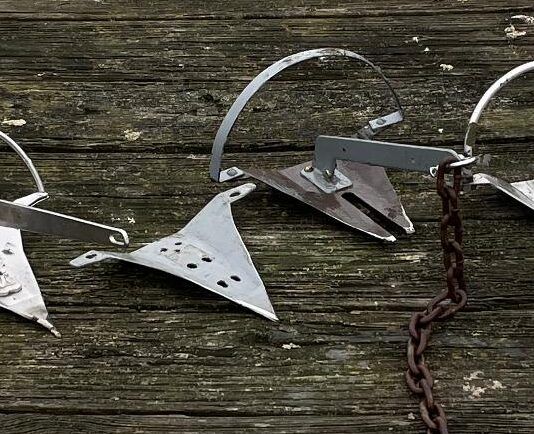
Quantifying anchor loads is tricky business, and our article on the topic, beginning on page 24, gives some insight into the trouble a tester faces when trying to compare the performance of various types of anchors. Apart from the obvious questions about the bottom type and the scope amount to be used for evaluating, testers need to sort out more subtle details, such as how the anchor should be set, how the load should be applied, and what the pull direction should be.
West Marine Issues Rocna Spec Notice
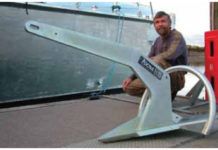
In the wake of questions about the tensile strength of steel used in the shafts of Rocna anchors, West Marine has issued “product specification notices” to customers who have purchased Rocna anchors since 2010 and recently posted the notice on its website (www.westmarine.com). West Marine is one of world’s largest distributors of the Rocna, a plow-style anchor sold in 34 different countries. The Rocna (www.rocna.com) earned a Recommended rating in our 2008 tests of heavyweight anchors, finishing behind the Manson Ray and the Manson Supreme (November 2008).

Where Credit is Due: September 2011
Letters to Practical Sailor, September 2011. This month's letters cover subjects such as: Johnson Pumps, Raymarine, Edson and More!
Anchor Chain Advice
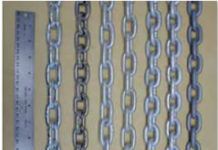
I sail an Areodyne 38 in New England, primarily on weekends and a two-week annual cruise. I use 25 feet of 5/8-inch chain with 200 feet of oversized braided rode and a 35-pound Bruce anchor. In 12 years of cruising this boat, the setup has dragged only once, yet I’m still unable to relax at anchor. I’m considering going to all-chain. Also, because my boat is pretty light with a fin keel and bulb, the rode wraps around the bulb when the current is stronger than the wind, requiring diving to free the mess. This is manageable in July, not so fun in October. Can you recommend a type, size, and length of chain given my criteria? My boat weighs in at 10,000 pounds, and I am the windlass.
Chafe Protection for Dock Lines
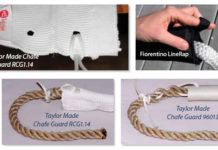
The best anti-chafe material to rely on in a storm is the one that resists abrasion, doesn’t cause heat build-up in the line, and can be easily installed—even if the line already has been deployed. Practical Sailor tested five commercially made products marketed as chafe protection for lines on boats: the Davis Secure, from marine accessories maker Davis Instruments; LineRap from Para-Anchor manufacturer Fiorentino; Chafe-Pro from the North Carolina-based Fjord Inc; and two sets of Chafe Guards by Taylor Made. Products ranged from single-skin webbing designs to tough Dacron double-layer designs, and the chafe gear’s attachment, or locking, methods were an integral part of the ratings. (The products don't work if they don't stay in place.) Chafe gear was put through a series of abrasion tests and was rated on price, ease of use, and performance.
Clear the Decks: Anchor Wells and Bow Rollers
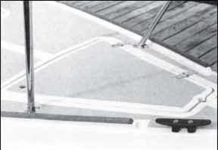
Ever since some ancient mariner broke a toe tripping over the killick stowed in the bow of his curragh, sailors have sought to solve the mysteries of ground tackle stowage. The solutions have been endless, and as a rule compromises. A significant portion of the interior volume of a 19th century warship was given over to the storage of anchor rode. Even aboard modern boats, the search for the proper stowage of several anchors and chain, plus hundreds of feet of sometimes slimy nylon anchor line, is one that occupies both designers and boat owners. Two "modern inventions" — the anchor well, and the bow roller — have greatly eased many of the problems of ground tackle stowage. But even these developments vary greatly in quality and design, some creating more problems than they solve.
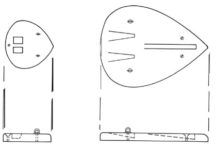
Wooden Anchor Chocks
Conventional commercially available anchor chocks, though convenient, can be nasty metal toe stubbers and not particularly attractive. In contrast, wooden chocks are easy to make, handsome, and relatively snag- and toe-proof.
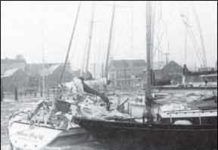
How To Help Your Boat Survive A Major Storm
Hurricane Gloria was a most impolite lady. She barreled up the Atlantic coast, scaring the heck out of people from Florida to Massachusetts. Despite the fact that the storm didn’t live up to its billing, hundreds of boats in New York, Connecticut, Rhode Island, and Massachusetts were destroyed or severely damaged. In some cases, the boats were lost through no fault of the owner. No amount of preparation will save your boat if another boat drags down on it in the middle of a hurricane. In other cases, however, lack of proper preparation was a major cause of a damaged boat. There’s no excuse for that type of loss.
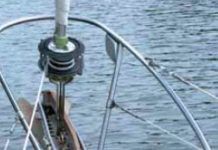
Sealing Anchor Chain Spill Pipes
Anchor lockers are a convenience to coastal cruisers but no friend to offshore sailors. Passagemakers often forgo a deck-clearing locker for a belowdecks anchor-chain well. An angled spill pipe leads the anchor chain from the deck to the well, which often is under the forepeak and behind a watertight bulkhead. The setup not only eliminates the flooded-bow worries inherent with an on-deck locker, but it also moves the chain and anchors’ weight lower and further aft, where it should be to avoid hobby-horsing.
Sailboat Design Conference Part II
Take a cursory glance at a new 35-footer and you might easily conclude that, except for cosmetic changes, the boat is essentially unchanged from those that made their debut in 1995. But that is not the case. In contemporary designs, modifications to deck layouts, the design of creature comforts, and boathandling systems, all reflect the market's desire for easy use, as evinced by below-deck sheeting systems (X Yachts), electrically controlled stern platforms (C&C), and removable traveler systems (Etap), for instance.
Latest Logbook

Practical Sailor Logbook – September 2026
In September we tour the Hans Christian 48T — the offshore cruiser many sailors call the holy grail — walk the custom Antigua 60...

Video: The BEST Sailboat You Can Buy for $35,000 – Catalina...
If you’re searching for a mid-30-foot sailboat, affordable cruising sailboat, liveaboard sailboat, first sailboat, or a capable used sailboat for coastal cruising, the Catalina...



Latest Sailboat Reviews
Learning by Doing on a $5,000 Catalina 30 Mk II
When Davis’s mother started talking about wanting to do something “big” for retirement, Davis and Gloria half-jokingly threw out an idea that seemed suitably...