


Choosing Ground Tackle for Cruising
Choosing an anchor best suited to your cruising style must take into account the area you are cruising, the type of boat you will be sailing, and the demands you will make on your gear. Purchasing an anchor and its chain and rode can be an expensive proposition.

Mailport: January 2011
Letters to Practical Sailor, January 2011. This month's letters cover subjects such as: Sailing non-profits, wind gens, pressure cookers, wood finish and mildew remover.
Broken Barnacle
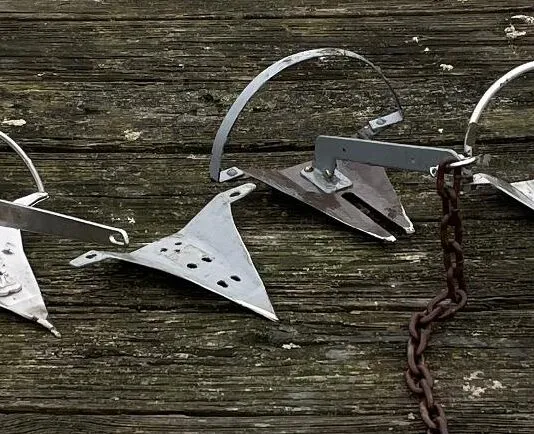
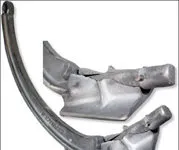
The editors at Practical Sailor get a few reports of broken anchors each year. Typically, these are failed fluke welds on Danforth-style designs or bent shanks on plough-types. The experience of Ted Goodwin, whose 43-pound cast aluminum Barnacle anchor catastrophically broke on the Bahama Bank earlier this year, is fortunately quite rare. …
SpeedsealLife Puts a New Spin on Keeping Cool
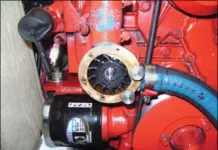
Picture this: You fire up the iron jenny in preparation to exit a crowded anchorage. As the anchor slides onto the bow roller, the engine overtemp alarm shrieks a noisy reminder that youve skipped item number 2 on your pre-departure checklist-open the engine cooling water seacock. Your water-pump impeller typically would be toast at this point, but youve got an ace up your sleeve, SpeedsealLife. So you simply duck down below, open the seacock, verify the engine temp is good, and then continue on your way. At your destination, you check the impeller, verify that its fine, and life is good.
Mailport: August 2010
Letters from the August 2010 issue of Practical Sailor. Subjects include: Shore anchoring, feathering props, earth-friendly cleaning products, staying hydrated and dink repairs.
PS Advisor: Mooring System Failure
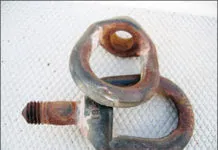
My wife and I leave our boat moored in Bahia Coyote, Sea of Cortez, BCS Mexico. Our mooring is a system of anchors and chain that has worked well for us since 1987. Last year, I hired some friends to dive it. They replaced the chains and reported that everything else was in good shape. Days later, a neighbor noticed the boat drifting and rescued her. The cause: a swivel had failed. The swivel was in good shape, but the nut holding the halves together unscrewed. I don’t use jaw/eye swivels because cotter pin-related failures are too common, and I don’t use Chinese swivels because the U.S.-made ones are more reliable. Have you heard of this happening?

Whats a Deluxe Pickup Stick?
Overheard aboard a bareboat charter at the Bitter End on Tortola, British Virgin Islands, at sunset circa 1978: "I wish George would hurry up and whack all those big orange balls out of the way, so we can anchor." There are still many places where snagging a mooring requires someone who knows the business end of a boat hook, but in most of New Englands municipal harbors, the ubiquitous mast buoy has made the chore infinitely easier. These "pickup sticks" are now standard in the region (much to the chagrin of area divorce lawyers). If you are tasked with maintaining your own mooring-and you don't yet have a good pickup stick-we can recommend a replacement: a "deluxe" mooring buoy from Island Mooring Supplies. Now, before the idea of a deluxe pickup stick starts you choking with laughter, please bear with us.
Ground Tackle
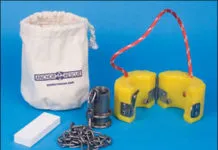
As Practical Sailor prepares for a new round of anchor tests, weve been on the hunt for new anchors, as well as new accessories. One of the most interesting devices to come our way is the Anchor Rescue developed by Richard Provonchee, a sailor and principal in Boxer Marine Inc., based in Cushing, Maine. The most common complaint about anchors is their lack of holding, but an anchor that refuses to budge-can also have serious consequences. The Anchor Rescue uses an innovative two-part system to free fouled anchors. The typical antidote to fouling is to attach a buoyed line to the anchor crown so that it can be hauled backward out of its snag. Most anchors have an eye at the crown for attaching a buoyed retrieval line. (Danforth-style anchors are an exception).
Mooring Anchors for Sensitive Seabeds
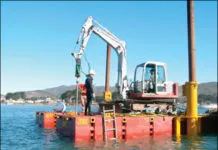
Mooring anchors fall into two general categories: those that rely on sheer weight and mass to provide holding and the embedment types that penetrate the sea floor. There are also some hybrids that rely mostly on their weight, but also embed themselves in the sea floor over time. BoatUS projects and municipal tests on Sarasota Bay, Fla., support helical screws as the best option when it comes to choosing mooring tackle, particularly in sensitive areas. Practical Sailors evaluation of mooring anchor types includes the Helix screw, Manta Ray, Dor-Mor, Mushroom, and concrete blocks.
PS Advisor: Sea Anchor Sizing
While most sea anchor manufacturers may use similar formulas for determining the right size sea anchor for a boat, other factors must be considered, including the weight of the material used in the anchor and a boat’s windage. Ultimately, what matters is that the anchor can displace enough water mass for your size boat. It’s a good idea to select a sea anchor, and then use that maker’s criteria to determine what size you need for your boat. If you have questions or concerns, contact the manufacturer for clarification. According to Don Whilldin, president of Para-Tech (maker of the Sea Anchor), the company figures Sea Anchor sizing based on a boat’s length, displacement, and type. If the result is on the line between two sizes, Para-Tech recommends going with the larger size.
Latest Logbook

Practical Sailor Logbook – September 2026
In September we tour the Hans Christian 48T — the offshore cruiser many sailors call the holy grail — walk the custom Antigua 60...

Video: The BEST Sailboat You Can Buy for $35,000 – Catalina...
If you’re searching for a mid-30-foot sailboat, affordable cruising sailboat, liveaboard sailboat, first sailboat, or a capable used sailboat for coastal cruising, the Catalina...



Latest Sailboat Reviews
Learning by Doing on a $5,000 Catalina 30 Mk II
When Davis’s mother started talking about wanting to do something “big” for retirement, Davis and Gloria half-jokingly threw out an idea that seemed suitably...