
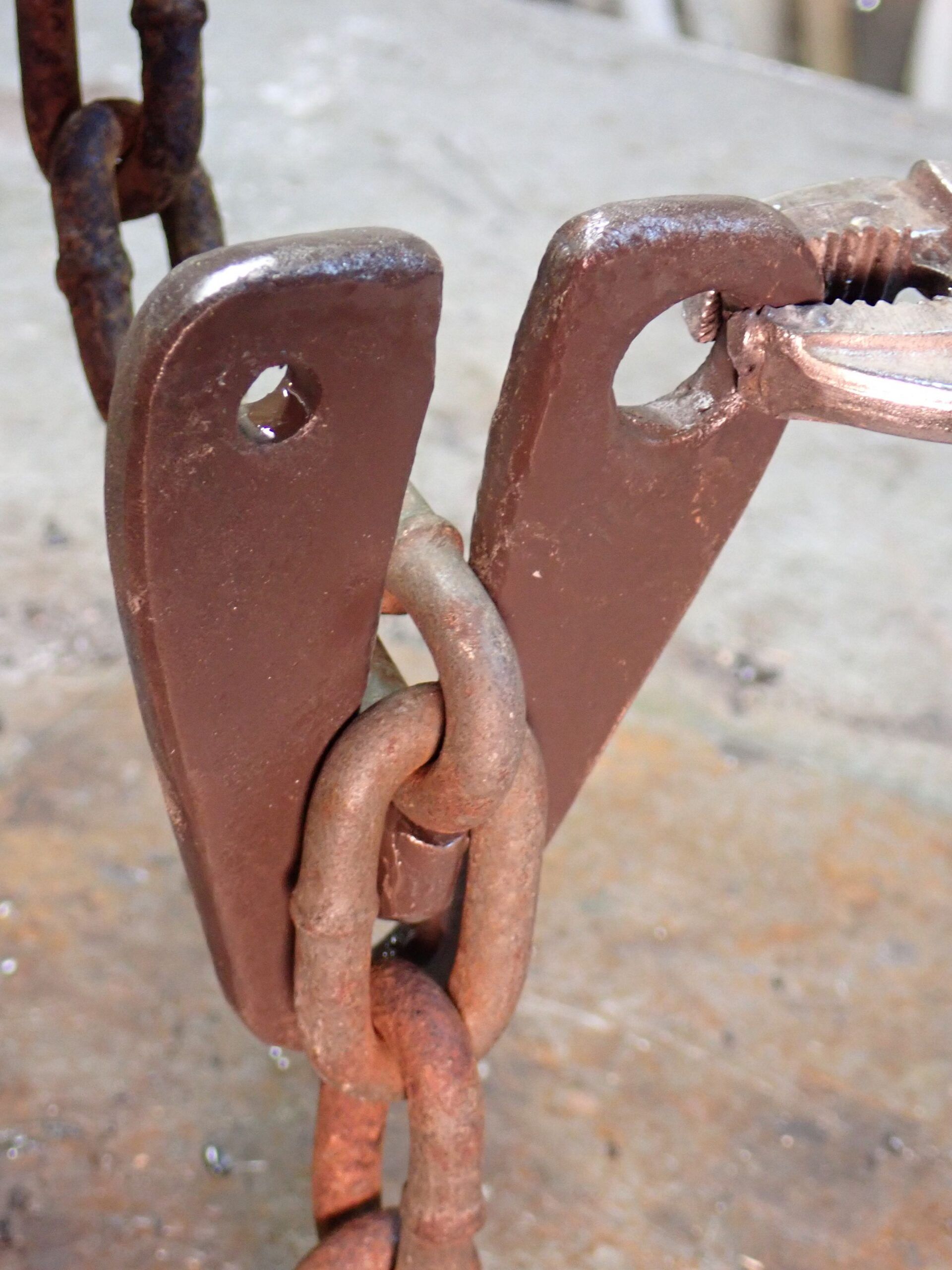
In the midst of discussing bridles, snubbers, and rigging multiple anchors, ten years ago we introduced the idea of an improved bridle plate—see “Adjustable Bridle and Chain Hook.” Now we have another improvement to offer. It requires welding—and galvanizing would be nice. While this is not simple for the average tinkerer, we’re hoping some enterprising manufacturer picks it up. More than a few Practical Sailor ideas have been adopted by manufacturers, either as corrections of sometimes dangerous design defects, improvements on existing products, or even new products. Hopefully this will be the latter.
Limitations of Chain Hooks and Plates
You can, of course, attach a snubber to a chain rode with a rolling hitch, a Dyneema soft shackle, or a Prusik hitch. We often do. They are simple and run smoothly over the bow roller. The rolling hitch will creep on chain under high load unless backed up, based on PS testing and cruiser experiences. There is a hypothetical risk of cutting the snubber on a rocky bottom, however. You can use a common chain hook, but it will weaken the chain 20 percent and can fall off.
In theory, the weight of a lazy loop of chain hanging on it will keep it in place, but if the snubber twists or if the hook rests on the bottom, it can come off. In fact, we’ve tested all manner of labyrinthine hooks, and if they rested on the bottom (a common occurrence when catamarans anchor in shallow water, and because of the bridle length) for a few hours in light winds, often as not they came off, leaving the boat hanging directly from the rode.
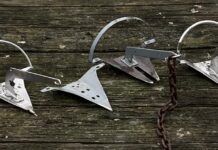
The Sea Dog Chain Gripper Plate is the wrong shape, with a slot that is too short, causing it to invert and drop the chain, and leaves no space for a locking plate. It is too thin and there have been reports of bending. In 2009 I built my own, made of thicker steel, with a longer slot and a locking plate. It never failed us.
Bolsters Restore Chain Strength
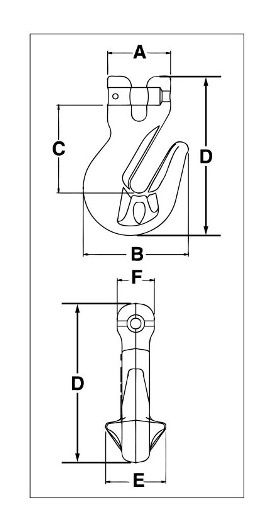
But there is still the matter of weakening the chain. Where the chain hangs over the edge of the slot, the side pressure weakens the chain by 20 percent. This is common knowledge, and riggers re-rate the chain 20 percent when using a common chain hook. To solve this, rigging companies created the cradle hook, by adding small bolsters to support the captured link (see illustration above). This is simple enough.
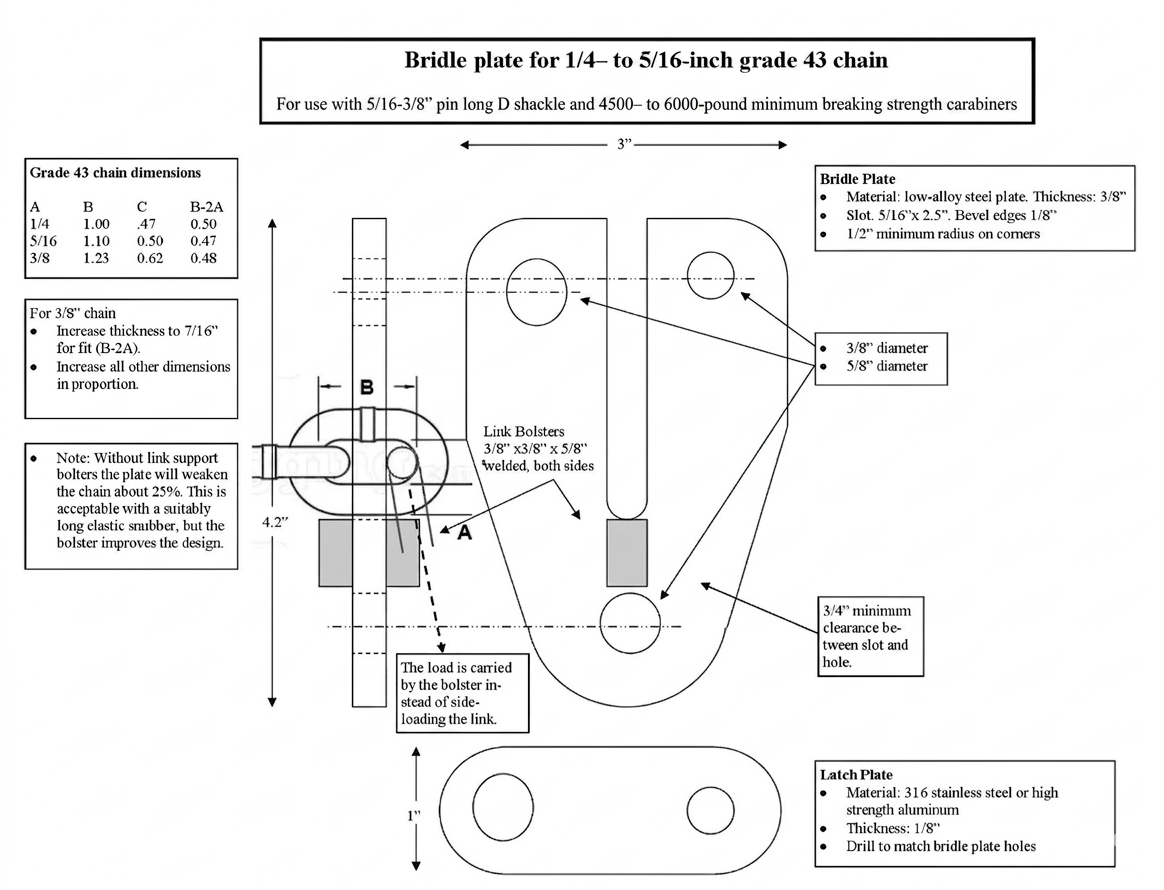
We upgraded our DIY bridle plate with small bolsters at the bottom of the slot to support the captured link. The bolsters must be wide enough to support the link, but narrow enough and short enough to fit inside the next link. The result? The chain is no longer loaded over an edge and strength is restored to 100 percent.
Corrosion Protection and Maintenance
We never got around to galvanizing this well-used plate. It did rust, so every other year we would wire brush it, applied a phosphate conversion coating similar to Parkerizing, and paint it—corrosion still took a toll.
Worth Building—or Manufacturing
Like a splice versus a knot, a pair of tiny bolsters prevents weakening of the chain by 20 percent where it hangs over the edge. If you like fabricating stuff, we hope you will give it a go. Perhaps some enterprising business will add it to their product line.