

Heavy Weather Sailing Gear
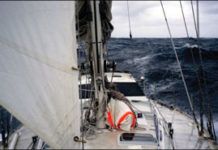
From sea anchors, drogues, and trysails to forereaching and heaving to, tactics and gear for surviving a storm at sea vary greatly. During a high-latitude circumnavigation, Evans Starzinger and Beth Leonard, aboard their 47-foot Van de Stadt sloop, had several opportunities to test heavy-weather sailing tactics. The couples main storm gear was a Galerider sea drogue, made by sailmakers Hathaway, Reiser and Raymond, is a webbing bowl with a wire hoop. Deploying the drogue involved a bridle of strong nylon lines connected to the Galerider rode via an oversized galvanized swivel. Starzinger and Leonard used the Galerider when running before the wind in gale-force conditions. The drogue helped slow the boat, kept it from surfing down the face of a wave, and provided directional stability, which allowed their autopilot to maintain control. Drogues and other storm-survival gear and tactics are particularly necessary for short-handed crews and boats that tend to surf in heavy weather. Other storm gear for sailboats that Practical Sailor looked at included the Jordan Series drogue and the Seabrake drogue.
Mailport: 01/09
In the December 2007 Practical Sailor Advisor, you requested feedback on Ultimate Sole, a product for coating cabin soles. Two years ago, I added a -inch teak-holly veneer plywood covering to my sole and used Ultimate Sole as the finish. I first put on a sealer and then two coats of Ultimate Sole. It went on very easily and performed better than I expected. It is a hard, glossy finish that truly does offer nonskid properties. You look at the finish and think you will slide all over the place, but you don't! It is a wonderful product, and I wouldnt use anything else.
Practical Sailors Heavyweight Anchors Test 2008
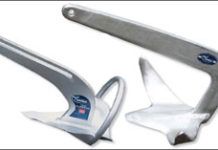
In a followup to the November 2008 shoreside testing of three large cruising anchors, this field report offers a glimpse of how the Manson Supreme, Manson Ray, and Rocna anchors perform in the real world. The test products, two roll-bar anchors (Rocna and Supreme) and one Bruce-style anchor (the Ray), are all acceptable as main cruising anchors. They are all good, but with distinctive strengths and weaknesses, so we tried them out, anchoring in dense kelp, soft mud, and hard rock bottoms, as well as in anchorages where short scope was required.
Practical Sailor Names 13 Products Best Gear of the Year
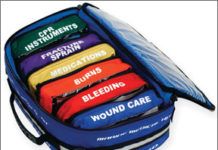
Practical Sailor’s annual wrap-up of the year’s best sailing equipment looks at our favorite top-rated products from November 2007 to November 2008, including the Facnor furler for light-air sails, Scad Solo external holding-tank sensor, Pelican Recoil LED flashlight, and Adventure Medical’s first-aid kit for coastal cruisers. In the boat maintenance category, Interlux’s Micron 66 bottom paint and Spray Nine’s waterline stain remover garnered Editors’ Choice picks. Foulie sets (jacket and bibs) by Gill and Helly Hansen were tapped as Practical Sailor Editor’s Choice in apparel, and a host of marine electronics made the list, including the Icom CommandMic III remote mic and Garmin GPSMap 545s 5-inch chartplotter sounder. Jeppesen was recognized for its top-notch electronic chart updating services. Other top gear picks were the Acco proof coil mooring chain and the Achilles HB315-LX fixed-transom inflatable dinghy.
Product Test: Heavyweight Cruising Anchors for Challenging Anchorages
One of a cruising anchors most important traits is its ability to set easily (and reset after a wind shift) in the widest possible variety of bottoms. For those who can carry extra large anchors, holding power, the normal parameter measured by anchor tests, is not as important as setting performance. Once set, an oversized anchor should easily have sufficient holding power. With that in mind, this comparison focuses not on ultimate holding power but the ability of the anchors to set quickly-even in difficult bottoms and with short scope-and to stay set when conditions change. Practical Sailor tested the rollbar-style Manson Supreme and the Rocna as well as the Bruce-inspired Manson Ray claw anchor. Testers looked at each anchors design and measurements, as well as its setting and veering performance on a frozen-sand beach covered with large rocks and on a sand/ mud beach. Practical Sailor encourages readers to weigh these results along with those of previous tests on more typical bottoms before selecting a primary anchor.
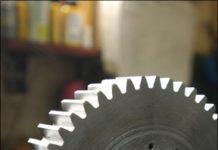
Alarming Trend Shows Minimal-duty Windlasses Becoming More Common on Cruising Sailboats
Although the day sailor or marina hopper may not need heavy-duty ground tackle or heavy-duty windlasses, it is alarming to see lightweight windlasses appearing more often on boats deemed long-range cruisers. It pays to confirm that your boat’s windlass was selected for ruggedness and reliability. Practical Sailor Technical Editor Ralph Naranjo examines what goes into the making of a windlass at Ideal Windlass in Rhode Island. Naranjo outlines windlass choices and examines windlass design, materials used to make the devices, and windlass repair. Windlass distributors and manufacturers spotlighted in the article include Ideal Windlass, IMTRA, Lewmar, and Maxwell.
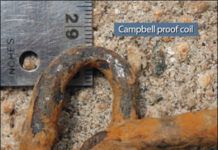
Nearing the End of Our Chain – Mooring Chains Tested
Practical Sailor dropped seven different lengths of 5/16 mooring chain in Long Island Sound 2 1/2 years ago. We reported on the initial inspection and the one-year inspection. After a quick look at the chains at the two-year mark, we left them in the drink for another six months and then pulled them. During the test, all chains had the upper parts exposed to air twice a day and were subjected to constant wear from waves and tidal changes. When we retrieved the chains for the final time, we found the greatest loss of material just below the halfway points in the 5-foot lengths. Chains we tested were Acco, Campbell, Chinese, and Suncor. Chains tested were galvanized, zinc-plated, and stainless steel.
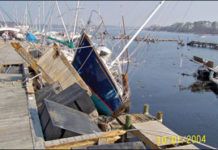
Gear for Battening Down Ahead of Storms
Practical Sailor offers an overview of products designed to help secure a boat for a major storm or hurricane. Well ahead of storm season, each boat owner should devise a hurricane preparation plan and should inspect the marina, dock, mooring, or hurricane hole where he intends to ride out the storm. One of the most important aspects of storm readiness is being sure you have the right gear and ground tackle to handle the loads of high winds and rising seas. In this overview, Practical Sailor takes a look at line choice and chafe gear for storm mooring. More line is obviously better, but more of what type and size? Editors discuss Fiorentinos RodeRap and LineRap, Davis Secure Chafe Guard, and the Chafe Guard from Taylor Made. We also consider docking aids including snubbers such as Shockles, Bungy Shock, and Synergy Marines braided poly dock lines; shock absorbers; and tidal-surge protectors including Tideminders, TideSlide, and the Slide-Moor.
Three New Anchors Throw Their Weight Into the Practical Sailor Anchor Chronicles
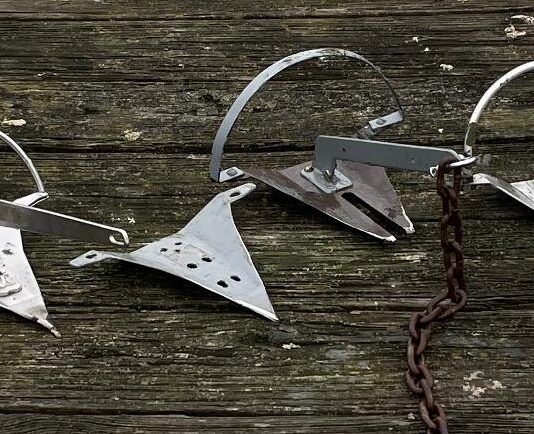
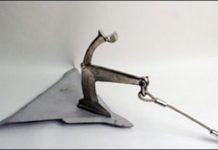
Practical Sailor adds three anchors to our test lineup: the Quickline Ultra and two updated versions of the XYZ Extreme anchor, the original of which we reviewed in the April 2006 issue. The three anchors were attached to rode and tested in shallow, muddy water along the Florida coastline. The anchors were rated for how well they set and how well they fared under load. Sustained holding power was recorded for all three anchors. Price, weight, warranty, and stowability were also considered in the final ratings. The shiny stainless-steel anchors were easy on the eye, but weighing the pros and cons of stainless anchors versus galvanized anchors left testers more inclined to purchase a galvanized anchor. Galvanized steel is more likely to show corrosion and so has a good warning system for metal failure.
Anchoring Rights Revisited
I don't know David Dumas, the owner of a lovely Kadey Krogen trawler named Kinship, but I like his style. Fighting against draconian anchoring restrictions on Marco Island, Fla., Dumas recently had his day in court, and the world is a saner place because of it. Dumas, his pro bono lawyer Donald Day, and local boating activists deserve credit for their perseverance. Thanks is also due to the National Marine Manufacturing Association (www.nmma.org), the Seven Seas Cruising Association (www.ssca.org), and members of BoatU.S. (www.boatus.org) whose lobbying efforts last year resulted in a new Florida law that clarifies anchoring rights in the state. Dumas anchored his boat in Marco Islands Smokehouse Bay last January with the intention of toppling a Marco Island ordinance that restricted boats from anchoring within 300 feet of a seawall for more than 12 hours. Similar ordinances, with equally shaky legal footing, are in place in many communities across the nation.
Latest Logbook

Practical Sailor Logbook – September 2026
In September we tour the Hans Christian 48T — the offshore cruiser many sailors call the holy grail — walk the custom Antigua 60...
Video: RIB vs Inflatable Catamaran Dinghy
For decades, the standard cruising setup has been something like a 10-foot RIB with a 15-horsepower outboard, but lightweight cat dinghies are challenging that...
Latest Sailboat Reviews
Learning by Doing on a $5,000 Catalina 30 Mk II
When Davis’s mother started talking about wanting to do something “big” for retirement, Davis and Gloria half-jokingly threw out an idea that seemed suitably...