

Bottomless Lockers Be Gone
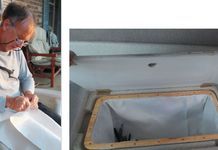
Storage is a challenge on small boats, and my new-to-me Corsair Marine F-24 trimaran was particularly Spartan this regard. The skinny hulls provided minimum volume and the race-focused designer intentionally omitted proper lockers. A performance-oriented boat such as this must be kept light if she is to sail to her potential. But even day sailers and racers attract a certain amount of necessary clutter, sure as honey attracts flies. Something had to be done, and yet, as a new owner its tough to know what will best suit your needs and what the boat needs. Its even harder to cut the first hole. This project was 100 percent non-invasive.

New Goyer Guard vs. Firehose
One of the quickest ways to lose your floating investment is to chafe through a dock line or mooring pendant, sending your boat smashing into the neighboring slip or a rock jetty. It has been a while since we tested chafe gear (see PS October 2012), so when a new product came across our radar, we jumped on the chance to test it.
Controlling Motion: Two Case Studies
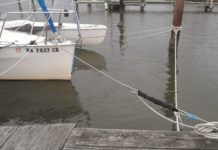
Securing a small boat between pilings in a wrong-sized slip is a common challenge. The dock line angles from the dolphins (outlying pilings) are too narrow for a beam wind, allowing the boat to dance around, increasing forces, chafe, and even making it difficult to stand in the cockpit. During a recent winter near-gale we measured dockline forces on several smaller boats that reached four times higher than the static wind load. If the recommended size dockline was used, the rope would be operating beyond its working load limit in real storms and could fail. Increasing the line diameter would result in more jerking and chafe.
Make Your Own Over-the-Boom Riding Sail
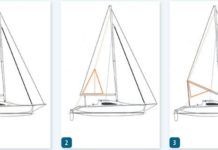
Delighted with the performance of the over-the-boom riding sail, we decided to make our own.
Mailport: anchoring etiquette, stern-tied boats, and wind generators
I really appreciated the article Anchoring in Crowded Harbors (see Practical Sailor, June 2019). The difficult and critical part is always estimating distances, and the guides you gave (two-to-three mast heights, using fractions of a nautical mile, etc.) can be difficult to do accurately in a crowded harbor with the sun setting, with some of that information available only at the helm, and multiple boats moving to anchor. As a bow hunter, I am…
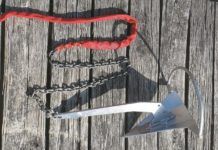
Collapsible Anchor Prototype Tested
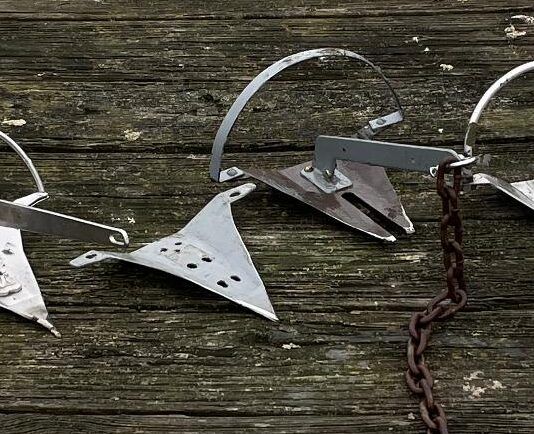
A big rollbar-style anchor on a bow roller is now synonymous with cruising. They are efficient in many types of bottoms and reliably rotate or reset when the wind and tide change. Unfortunately, they are shaped awkward and are difficult to stow anywhere other than a bow roller. Lacking this, many smaller boats, both sail and power, are forced to store the anchor in either a shallow bow locker, a snag-prone railing bracket, or in a lazarette.
Anchoring Legal Responsibility
We often get questions about anchoring rights. While it is commonly understood that the first boat arriving in an anchorage has privileges, many see this as a matter of etiquette, but it is also a legal issue. The below citations are from the case Juniata 124 F. 861 US Admiralty Court, E.D. Virginia, 1903. Other rulings we reviewed generally agree.]
Selecting the Right Anchor Size
Over the years Practical Sailor has conducted dozens of anchor tests, and like many publications, weve repeated the common guidance that cruising sailors should buy an anchor that is at least one size larger than what the maker recommends for your size vessel.

What Chain Connector Will Fit My Gypsy?
Regarding your recent article on joining chain segments, Ive been coastal cruising from Canada to Panama since 1983, and continuously since 2005. I have wondered about using a single 5/16-inch shackle, which will connect two lengths of 3/8-inch, G-43 chain. The Crosby top of the line 5/16-inch will go around the gypsy pretty well. I tried it, but I am reluctant to use it. Any thoughts?
Mailport: Tourniquets at Sea
Add a tourniquet to your first aid kit and know how to use correctly - it is less likely to accidentally loosen or inflict additional tissue damage.For further training, I would refer you to the American Red Cross, they have a Basic and Advanced First Aid certification, and along with the American Heart Association offer classes in cardiopulmonary resuscitation, and the use of automated external defibrillators (AEDs).
Latest Logbook

Practical Sailor Logbook – September 2026
In September we tour the Hans Christian 48T — the offshore cruiser many sailors call the holy grail — walk the custom Antigua 60...
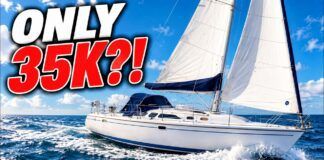
Video: The BEST Sailboat You Can Buy for $35,000 – Catalina...
If you’re searching for a mid-30-foot sailboat, affordable cruising sailboat, liveaboard sailboat, first sailboat, or a capable used sailboat for coastal cruising, the Catalina...


Latest Sailboat Reviews
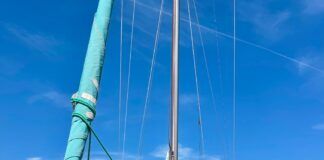
Learning by Doing on a $5,000 Catalina 30 Mk II
When Davis’s mother started talking about wanting to do something “big” for retirement, Davis and Gloria half-jokingly threw out an idea that seemed suitably...