

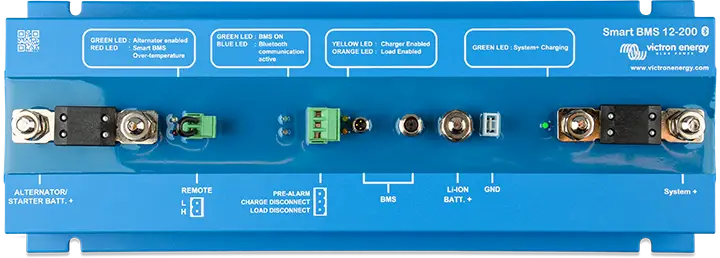
If you are contemplating installing or operating an LFP installation, you will need to become familiar with Battery Management Systems (BMSs), as they will have effective control over your new system. Especially inconvenient are BMS shutdown events, which happen when the LFP is disconnected due to the BMS detecting a condition that it considers to be potentially damaging to the LFP. To avoid these, and potentially recover from such events, it is necessary that you invest some time in understanding how your BMS operates.
To continue reading this article or issue you must be a paid member. Sign in

Join Practical Sailor
Get full access to Practical-Sailor.com – more than 4,000 articles – for just $34.
Join today and save 42% off our full price.













small error
might run 10 C to 15 C (50 F to 59 F) hotter … I think you’re trying to say a temperature differential of 10C to 15C, 18f to 27f may be enough to trigger a temperature related shutdown.
“The greatest single risk to an LFP is a thermal runaway event,”
Everything i’ve read indicates that thermal runaway in not a concern with LiFePO4 (LFP) batteries.
Temperature monitoring is important to prevent damage to a LFP due to use outside of the approved temperature range.
Excellent article. Thank you.
My Victron 12/200 BMS shut down when revving my engine to leave the marina twice this year. It took a minute to recover then repeated the shutdown/restart at least once. I could not replicate this behavior by revving the engine at the dock. A review of stored data from my Smart Shunt did not show any voltage spikes over 14.2 volts at the start battery. I’m still scratching my head.
Brad, is your alternator feeding a lead acid start bank, with any charging current to the LFP house bank first passing through a DC-DC Converter (in which case this shouldn’t be possible)? If it’s not shutting down because of excess voltage, the likely candidate is too great a charge current but this still shouldn’t be possible with a properly designed system. Is there any chance your installer omitted to remove an ACR? Or do you have an unconventional configuration? The one other possibility is that you have all the right equipment, installed correctly, but itvis sized incorrectly. As an example, a 100A alternator, feeding a 100A DC-DC converter, but the maximum charge current capacity of the LFP is 50A. At tickover, your 100A alternator might only deliver 10A but when it gets to higher RPM, it is delivering more than 50A and tripping the BMS.
I was asked a question in a previous article about the low temperature cut off when charging, and whether this also shut down discharge. My presumption had been that it had to shut down both charge and discharge (and shut down the entire BMS) but I have since learnt that some BMS have two separate actions, distinguishing between low temperature charge and discharge. Of course, it can only measure net flow (eg if your discharge load exceeds the charge current, it wouid see that as a discharge, not a charge event). However, the main point is that if the temperature drops to a point where charging is not allowed, it should not down everything, allowing charge to resume when the ambient temperature rises.
If the LFP shutdowns due to a low voltage event (e.g. nearly fully discharged) can a portable battery charger (like ones used on lead acid batteries when they go dead and you need to start your electric start outboard) be used to wake up the LFP? Having one of those on the Sailing Uma boat might have provided a quick and easy solution.
I believe the answer depends on whether it includes what is called a ‘live feed’. Most chargers will read zero battery volts as a disconnected battery and not proceed to charge. Chargers with an LFP setting are unique in that, they interpret zero volts as a shut down BMS and provide a small wake up current (more often a pulse than a continuous current). The question is whether a small portable device, such as you are describing, would have such a live feed capability but it seems unlikely to me. There is one other approach that might work (if the only other option is to sail thousands of miles to a port), and that is to directly connect a solar panel (18V in good sunlight with no controller) to the LFP. Never tried it myself but one manufacturer suggested it (and another was strongly against it).
Maybe the portable charger I mentioned could be connected to the LFP terminals and used to start the outboard, then the internal alternator in the outboard would produce the necessary current to the LFP to wake it up?
Running an alternator into a no load is ill-advised, as it can blow the rectifier. However, that presupposes that you don’t have a lead acid start battery (to take the alternator output). Our recommendation has always been to retain lead acid on the start side and LFP on the house side. – there are multiple reasons for favoring that configuration. If you have that set up, waking up the BMS is very simply achieved by briefly connecting the lead acid start battery.
Stephen,
Why do I see such short shrift paid to what I consider the best way to maximize the benefits of LFP, namely twin alternators charging from a single engine directly into an LFP bank to minimize daily engine run time?
You use an AGM starter battery, kept charged by a DC to DC converter off the LFP bank, that is wired exclusively to your DC “critical loads” main panel.
Any LFP shut downs seamlessly do not impact the vessel’s basic operation.
The LFP bank is relegated to exclusively servicing the AC main panel “luxury loads” such as induction and microwave cooking, air conditioning, etc.
See any downsides to this?
Thanks,
Eddie Lare
I didn’t quite follow whether you were suggesting one dedicated alternator for the start bank and one dedicated alternator for the house bank or if both are in parallel, charging the LFP bank. Either way, charging an LFP off an alternator is not recommended, for multiple reasons. Firstly, alternator regulators are designed for lead acid service (much higher resistance) – although that issue can be resolved by fitting an external regulator. Secondly, regulator diodes are vulnerable to failure if exposed to an open load (such as can occur with a BMS trip). Thirdly, given the shape of a LFP’s SOC/OCV curve at the upper end, a near fully charged LFP acts similar to a no load condition and charging can become unstable. For these and other reasons, most manufacturers and third party agencies recommend alternators are only used to charge lead acid batteries. Also, i couldn’t quite see what benefit you presume from such a configuration – DC converters are inexpensive and 96-98% efficient so why try to avoid charging your LFP that way? Also, shoujd add that if your goal has been fast charging, you can achieve that through the more conventional configuration although we generally do not recommend pursuing fast charging, as it can significantly reduce LFP life expectancy.
Stephan,
Are you familiar with Victron NG batteries and charging technology?
Best, Eddie