

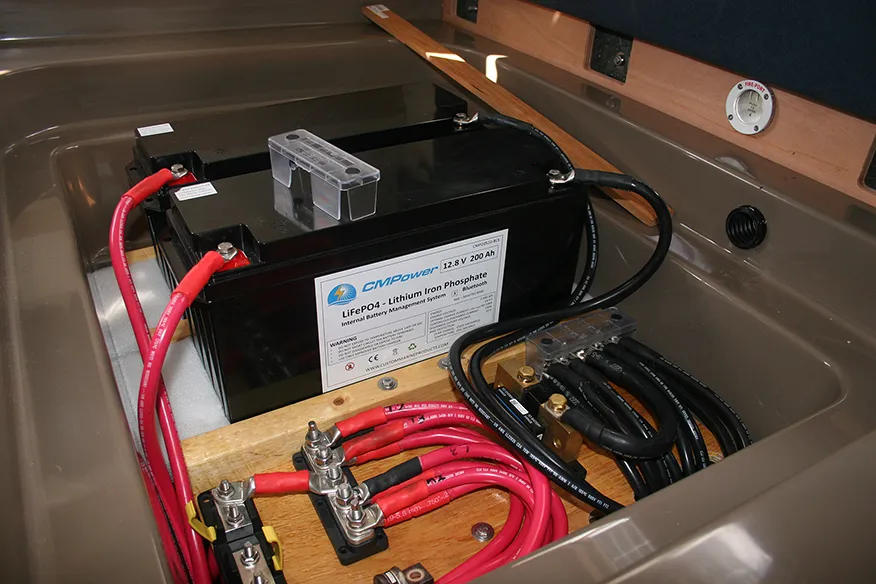
Before we consider the safety issues of lithium-ion batteries, we should remember that lead acid batteries are not without risk. Apart from the obvious risk of a sulfuric acid spill or exposure, there are other concerns. Under heavy charge or discharge they can give off heat and gases which can be corrosive, explosive, and poisonous in high enough quantities.
A viewer of a recent Practical Sailor video commented that a hydrogen sulfide discharge from his lead acid battery nearly killed him (his words), while under charge overnight. It was a quality charger, on shore power, but it seemingly delivered an excessive charge (possibly because of a battery fault). Thankfully, the smell woke him and alerted him to the issue.
There are also some rare stories of high-capacity alternators overheating lead-acid batteries and discharging hot acid onto operators. Moreover, in the event of a cell dropping internally, lead acid batteries can draw high currents (as this essentially represents an internal short), which can also lead to heat and degradation in the battery.












the initial portion of the article uses non-LFP incidents as an attention getting/scare device. This is misinformation & not useful Practical Sailor” level information. The first and most basic warning any such article should be “Use only LFP – other chemistries are currently inappropriate”
as Jack Webb said “just the Facts Ma’am” (and I believe he added ‘and no distracting scary stories about other crimes’)
I do agree with Geoffry and I don’t think we need even another week to make a conclusion. I have an electric motor with 24 Eve cell LiFePo4 batteries on a 28,000 lb 41′ ketch. 16 of the cells are for the 48v motor and 8 are for a 24v house battery bank. I have “gone through”/destroyed another 10 through my trials and errors over the last three years after installing the system. Dropped a couple cells in the drink and then retrieved them at low tide. Dropped a few more off a work bench. Probably more importantly, drew down the engine battery bank well below its stated limits and killed a few more cells in the engine bank. The worst that has happened is they might leak a little (which isn’t ideal) and the ones that go below 2.0 volts can get so blown up (expand) that they are difficult to remove from the batter bank enclosure I built. I have since reconfigured the enclosure for easier removal if it happens again. I basically, because of my own experience, skimmed through the lithium battery horror stories because it’s not based on LiFePo4 batteries. I am careful with charging phones, and other devices that have regular lithium batteries because I have no interest in experiencing a lithium fire.
Sorry about that. Hit send by mistake. Although I have seen LiFePo4 batteries being shot and nothing happens I will not go so far as to say the are “bullet proof”. But – any fears I had of what they could do if they were mishandled have been put aside due to my own accidental tests of, “I wonder what would happen if I dropped, or overcharged, or overused, or undercharged one of them?” I know what happens and it isn’t much. My biggest problem, now, is finding a place that can recycle them and not charge me what it cost to buy one.
You make a good point. I gather that manufacturers have been lobbying hard, for LiFePO4 to be segregated (in the legal & regulatory framework such a UN, airlines, ABYC, ABS etc) from the other types of Lithium-ion battery but the response, currently is ‘no way’. At this time the various agencies are considering new regulations, not relaxing anything for LiFePO4. My ten year prediction was that, ultimately, LiFePO4 will get it’s own set of regulations (separate from Lithium-ion), recognizing its safety but I gather that the political will (and/or the studies) is not there, to contemplate such a move today. As a result, we currently live in a world where LiFePO4 is viewed as more hazardous than a flooded lead acid battery, which makes no sense. The reality, of course, is that any sort of lithium related incident is magnified by the media, where as any form of lead acid incident is likely to go unreported.
Familiarity breeds contempt as the saying goes. I think that is sometimes an issue with lead-acid batteries. We are so used to them we no longer think of them as hazardous. LiFePO4 is a new and relatively unknown tech, so people tend to look at the safety record more closely and skeptically. As a retired nurse, one of the most serious accidents I dealt with involved someone working in a battery centre who had a lead-acid battery he was working on explode, spraying him with boiling acid. Fortunately, there was an emergency shower on hand so he was immediately doused with many gallons of water. Without that, he would certainly have lost his sight. Lead-acid batteries are also hazardous, just in different ways. My view is that the most dangerous systems on the boat are not the batteries but the propane system, which can blow the boat into matchwood, and the can of gas for the dinghy.
Having experienced the catastrophic failure of a Lifeline AGM battery in the 90’s with significant aerosolized acid discharge, I believe no battery technology is completely immune from serious failure.
My current LFP batteries, with a very good external management system, don’t keep me up at night.
I can’t find a single confirmed case of an LFP battery chemistry causing a fire in a sailboat or RV.
Articles like this just perpetuate an exaggeration of a perceived but unlikely risk.
I have been asking around as to whether anyone knows of an LFP fire on a boat. The only thing I can find is an incident (some refer to it as an explosion) on a canal boat (“narrow boat”) in the UK, last year. As there was no fatalities, there is no public enquiry or report, however (just an insurance inspection report, which is not public). Nonetheless, there is keen on-line interest in knowing what occured, with speculation ranging from it was not a TR incident (maybe a propane incident) to others suggesting mismatched 48V LFP’s were in parallel, triggering some form of overload condition. It seems to be confirmed that they were Victron LFP’s on the vessel and it was an electric propulsion system. If anyone knows anything more, please comment below.