

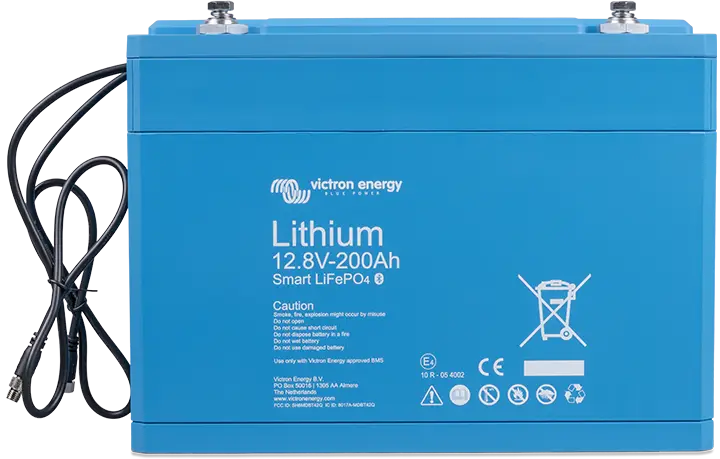
Marketing literature does a good job of promoting the primary advantages of lithium iron phosphate batteries (LFP or LiFePo4), such as life expectancy, weight, usable capacity etc. What is generally under-appreciated, however, is the many other features of LFPs, especially as they differ from lead acid batteries. This article therefore seeks to address that deficiency, by summarizing eight key differences between LFP and lead acid batteries.
To continue reading this article or issue you must be a paid member. Sign in

Join Practical Sailor
Get full access to Practical-Sailor.com – more than 4,000 articles – for just $34.
Join today and save 42% off our full price.













Thank you. This was over my head, but helpful to understand some of what is involved.
Having just done a “practice installation” of LiFePo batteries from LiTime on our old Roadtrek camper van, I find your article of great value. On the Roadtrek we now have 3 separate batteries/banks to supply engine starting via a lead acid starting battery, a small lead acid to start the onboard generator, and a auxiliary (RV nomenclature) house bank of two LiFePO’s in parallel. We depend on the typical RV battery isolator to separate the three, with a DC-DC charger to both adjust the voltage and limit the current for the house bank. I haven’t seen the use of battery isolation in the marine world, can you comment?
I am not familiar with an RV isolator and would really need to see a circuit diagram and description to properly comment. The key thing to check out, however, is that the isolator does not defeat the purpose of the DC to DC converter.
When both house & start batteries were lead acid, boats used to include a device called an automatic combiner (which combined the two in parallel, when a charging voltage was detected and isolated them at lower voltages, thereby allowing the alternator to charge the house bank but ensuring that house loads did not discharge the start battery). That is maybe what you are talking about. If so, this should be removed, upon converting the house bank to LiFePO4, as the two battery types have different charging needs and should not be charged in parallel.
Ok, but if you separate the LFP from the lead acid, does that mean your battery switch is now a liability in the system? That the “Both” setting ought not be used for starting the engine? And if the LFP shouldn’t be used for starting, does that leave you without a back up battery for starting the engine? Sigh…..
No, not exactly. I left my combiner in for two reasons. Firstly (presuming you are away from shore power), if your BMS switches off your LFP due to a discharged battery, you need to provide a voltage to ‘wake’ it up, which the solar controller may not be able to deliver, even if receiving good solar radiance. Engaging the manual combiner allows the solar controller to ‘see’ the higher voltage, and a few minutes of that should be sufficient to wake up the solar controller and for that to begin charging the house bank. The second reason is the more crucial – if your BMS switches off your LFP (for any reason) and it’s a crucial moment (say trying to navigate through a narrow passage at night), by switching the combiner to combine, you can energize your electronics and get your way through safely. The point being that repeated parallel connection is to be avoided but there are times when circumstances justify a parallel connection, for brief or emergency circumstances.
However, combining the two for reasons of engine starting on a flat lead acid start battery is more complex. Size for size, LFP’s have a much lower discharge rate than lead acid, which is why they are generally not used for engine starting (especially for diesels, that have a higher compression and are typically bigger). However, it depends on your individual set up. Say that your starter pulls 100 amps and the lead acid battery still has sufficient charge to deliver half of that (50 amps), in which case the question is whether the LFP can handle the other 50 amps. Excessive draw is a safety issue and the most likely scenario is that the BMS senses that excessive current and switches off the LFP, which means that you still don’t have a running engine and you also have a dead house side. The question then becomes waking up the BMS (although hopefully it wakes up on its own, after you stop trying to start the engine). Something LFP advocates generally forget to mention, therefore, is that whereas with an all lead acid boat, the two systems could prop each other in times of stress, that is generally not the case once you have converted, so you need to be comfortable that your lead acid side is capable of serving its loads, without support, which may mean a new lead acid start battery. Even with a good lead acid battery, the question is how to keep it well charged, if you are away from shore power? Some boaters have come across some very odd approaches to that question (such as a separate, dedicated solar array) but by far the best solution I have come across is a reversible DC to DC converter, which tops up the start battery (from, say,solar) even if that is connected to the house side.
Ok, so does isolating the two battery banks (LFP and starting battery) mean your battery switch is now a liability in the system? There’s no use for the “Both” setting? And does that leave you without a backup to the starting battery. Of course, if you have a large enough LFP bank (say 300ah), is the 300 amp max draw enough to start the engine? Things get complicated in a hurry, if you think about it.
I just put in 4 x 100 ah of LFP to replace my old Firefly house bank. The start battery is still a 100 ah AGM. 3 of my 5 solar controllers and my WS100 regulator would need replacing if I want to charge directly to the LFP. I’m not interested in throttling back charging with a DC-DC charger.
The solution has been a Battery Bank Manager that utilizes the charge limitation provided by the lead but allows all the available current to flow through to the LFP.
With 1000 watts of solar we are doing all of our cooking with an induction cooktop and running the watermaker.
There was a discussion about that device, in the comments section of the recent Practical Sailor YouTube video.
My personal experience with the Bank Manager is that it is extremely accurate in its charging profile. More appropriate charging than the Victron Smart Solar that I have.
Out of curiosity, how did you manage the issue of short circuit currents in your set up? If the description (in the comments section of the video) is accurate, an algorithm in the device decides when to connect the two in parallel and when to disconnect. While in parallel, however, a short circuit fault on the lead acid side could discharge the LFP side also. How did you design for that?
I am much better at english than electrical system design (my helpful edit – “A lead acid battery comprising six cells…”), but I am trying to research and learn. I was convinced by what I believe is a reputable firm that the BALMAR MC-618 would be a safe external regulator to use with LFP if/when I upgrade from AGM. They even provide a settings guide based on the brand of LFP. Your article suggests this regulator needs to be modified. What am I missing? Thak you for a very informative article!
Thank-you for the grammar correction! What is fast becoming the industry standard (not just boats but vehicles too) is to retain lead acid on the start side and to only convert the house side over to LFP, with the two systems bridged by a DC to DC converter. With that set up, you can use a standard alternator regulator, as it is only charging the lead acid start battery, which is what it was designed to do. Yes, in the pioneering days of LFP adoption, some early adopters explored also converting the start battery over to LFP but there are several reasons why this is not a good idea, and an aftermarket external regulator only really resolves one of those issues. This was explored in an earlier set of articles.
Better at grammar, not spelling!
Thanks for the article. It cleared up many of my questions.
What are your recommendations for supporting an inverter. A 2000 watt (VA) inverter will deliver about 20 amps of 120 volt AC, but draw about 200 amps off a 12 volt battery. 2K watt inverters often include a 100 amp shore power charger.
Will a 200 amp-hour lithium battery limited to 1C output support a 2000 watt inverter?
Will the 100 amp shore power charger in the inverter fry when charging a lithium bank, assuming that the system has 100 amps of DC-DC converter/charger?
My first reaction is what sort of load do you have that requires 20 amps at 110V? Are you thinking of occasional use of an induction hob or something like AC, that runs for hours at a time? The reason for asking is that the inverter will only pull from the DC side what it needs eg if you were only using your inverter to serve (say) an occasional 800W power tool, you wouid likely be pulling only something like 80 amps off the LFP., and for brief periods only.
You didn’t mention whether you have the LFP and inverter / charger yet, or if you are simply exploring this solution. Either way, the LFP manufacturer should be able to tell you whether that model of battery can take 1c of discharge and 0.5c of charge. If they say that it can, all that really means, in practice, is that the BMS should not trip out at that level – that doesn’t necessarily make it a good idea. Charging and discharging an LFP at its maximum rating is a bit like continually racing a car engine to its maximum RPM. The brochure may say that you can do it, but you are potentially reducing the LFP’s life expectancy by some margin. So, assuming that you really need a 200 amp discharge capability, and you have not yet purchased one, my recommendation would be a much bigger battery.