


We spend a lot of time talking about PFDs, man overboard procedures, jacklines and tethers. But those are all safety measures intended to help when the primary old-school directive has failed. One hand for the ship, one hand for yourself. It’s far better not to fall off or fall down. None of the back-up safety measures, including PFDs, beacons and tethers are certain. Boaters can hit cold water face first (if you trip, head first is most common) and gasp underwater, downing in seconds in spite of wearing a PFD. You could drag in the water and become injured or drown, or simply fail to be recovered in time, either because they couldn’t find you or they couldn’t get you back on the boat. Perhaps you can handle the boat in all conditions but can your partner, if you fall off? Or perhaps you slipped and hit your head on a bench or fell down the companionway. Your first and primary belay is always your hands and your feet.
If a construction worker falls off the roof of a tall building the recovery plan involves black clothes and flowers. If their tether catches them, injuries are still common, as they slam into the building or the harness breaks bones. Suspension trauma from restricted blood flow is common (construction harnesses pinch femoral arteries—OSHA recommends rescue be accomplished within 3-6 minutes). When adventuring into the mountains, even with full climbing gear, ropes and belays, my climbing partner would still occasionally remind me that “this would be a good time not to fall.” Mountaineering is more like ocean sailing and less like gym climbing or dinghy sailing in the harbor, in that it can’t be made safe with equipment. Rescue may not be available for days. Your first belay will always be not falling. This is instinctive to experienced sailors and climbers; good movement skills and a plan keep them safe. Situational awareness is a must.
Planning to Stay Aboard
Singlehanders don’t focus a lot on POB procedures or even jacklines—although tethers are common when working at a fixed point for personal safety. Instead, they plan each action and they move carefully. They prepare the boat. As a 45-year climber, the edge of a cliff or roof does not scare me, but I move a certain way and I evaluate the conditions:
- What sort of work needs to be done?
- Is there moss or gravel near the edge? What is the slope?
- In industry I will ask myself, will I be working with tools that could make me slip, like pushing a scraper or straining on a wrench that could slip?
- How will I move there safely and how will I secure myself once there and while working?
Bottom Line. Effort spent not falling is much more effective than effort spent on tethers, PFDs, and POB drills. Those are what happens when staying on board fails, and they often involve injury even when they do work.
Personal Experience with Falling Off
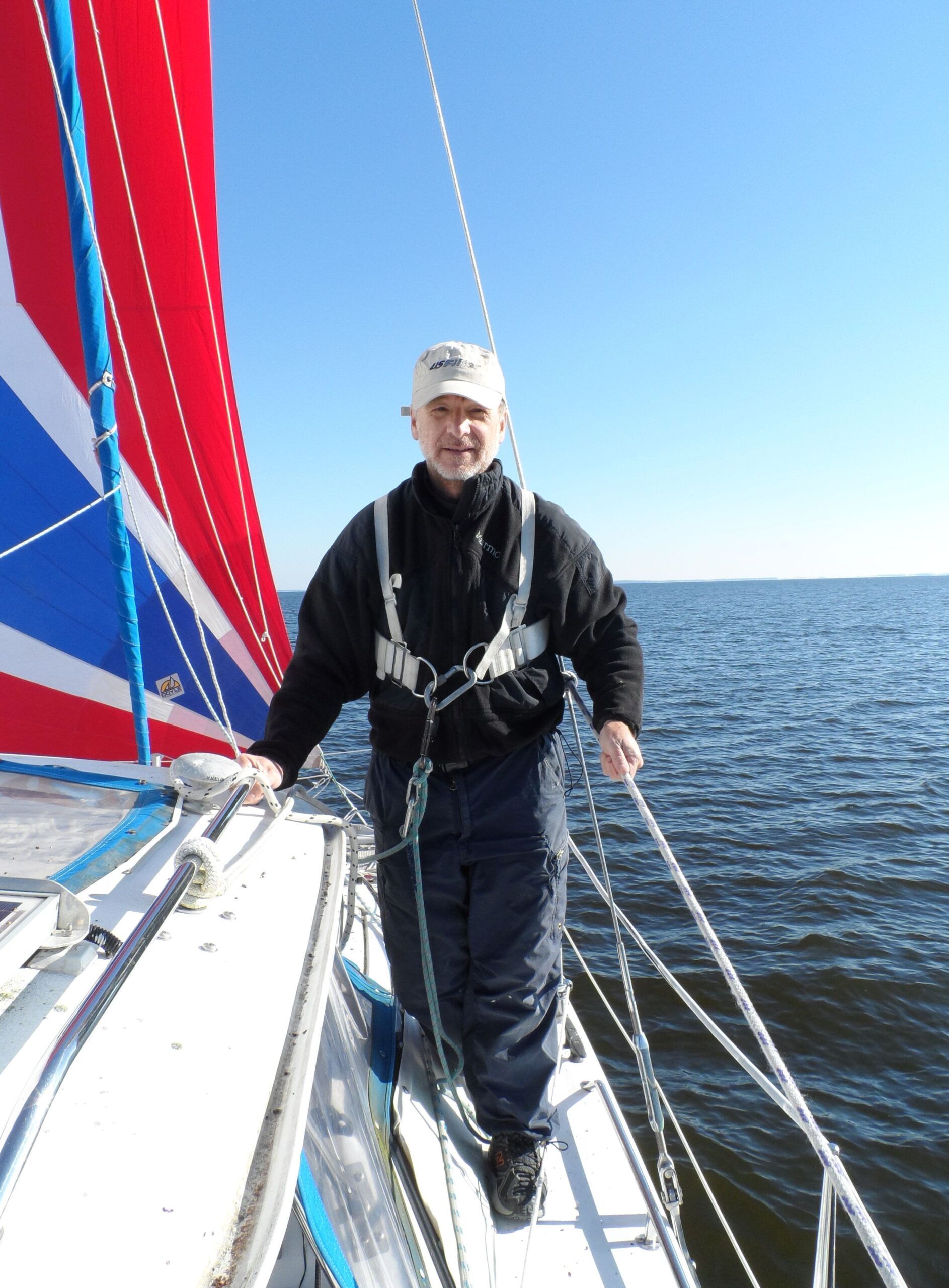
I’ve fallen in a few times, none of them serious:
- Performance beach cat. The trap line snapped (first boat with worn-out gear) but I kept hold of the mainsheet and climbed back aboard. The boat rounded up enough to prevent capsizing. We don’t count pitchpoling performance boats inshore in a breeze. Farther from shore, where help may be unavailable, is different, and you sail more conservatively.
- Stepping off dock onto boat with batteries. A dock board snapped. I used the last of my momentum to swing the battery onto the dock and went for the harmless swim. Make sure you won’t hit anything on the way in.
- Docking disturbance. The boat stopped suddenly when coming into dock (stern line snagged on something) and I was standing on the bow with nothing to grab. I could have caught myself, I suppose, but it was warm, I was in board shorts, and water is soft.
But never while sailing. Saying I take no risks wouldn’t be truthful. I don’t always wear a tether or a PFD. I’ll go forward when the bow is playing submarine. I also suspect decades of sailing and rock climbing have taught me a good bit about movement and holding on.
Cataloging How People Fall
I surveyed racers and cruisers, and the ways they fall off are very different. Racers fall off fighting with head sails, dropping spinnakers, and generally running around on deck. Cruisers fall of getting in and out of dinghies, fighting with davit tackles or dinghies tied to the foredeck while underway. Both groups are vulnerable during surprise or rough tacks and jibes, and can be washed from the cockpit or deck in survival storms.
Multihull
I surveyed a group of Corsair trimaran owners including both racers and cruisers. The majority were racers and all of their POBs were either while racing or pushing hard. Spinnaker handling mistakes accounted for about a third of the mishaps, but coming and going from the wing nets (trampolines connecting the main hull to the outriggers) accounted for over half. The common thread in all cases was focusing on the sailing rather than safe movement.
Monohull
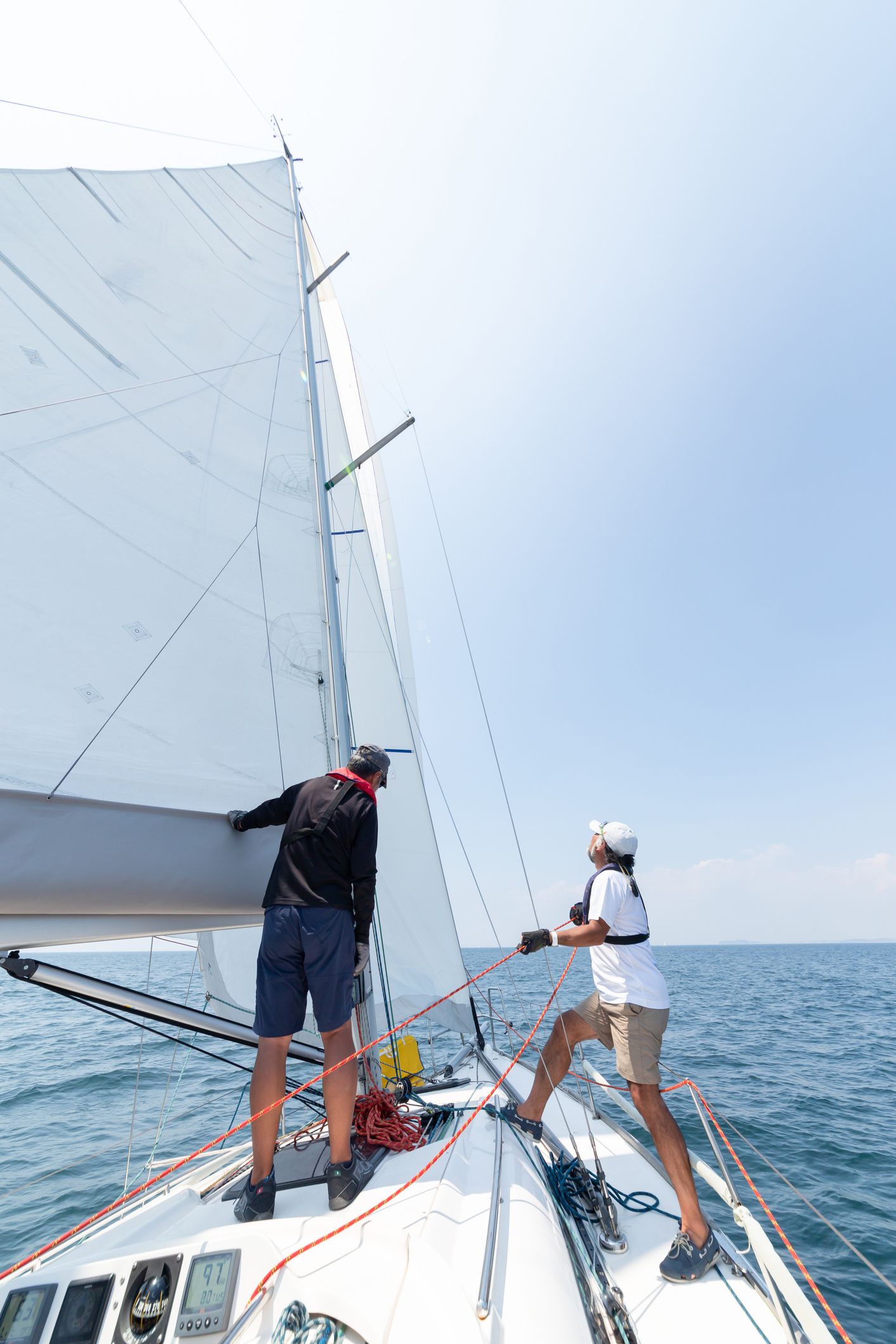
I interviewed a cross section of mono-hull racers and cruisers. Messing with stubborn headsails is a constant risk for racers both non-furling headsails and spinnakers. Severe heeling is another common factor; racers carry maximum sail, and in fresh conditions knockdowns both upwind and downwind are not uncommon. People in the cockpit can slide under lifelines, and those standing and grinding can go over. A boat that is yawing downwind is vulnerable to accidental jibes and racers don’t set preventers. Cruisers also put themselves at risk.
Plan for the Unexpected
What these share is that they are not when people are moving along and holding on, they are when people are working at a fixed point, preoccupied by what they are doing. In “Rethinking MOB Prevention,” we examined improving railing, jackline and hard point coverage in those areas. But the primary solutions should be mindfulness and ergonomics—how you move. Have a grip before you stand up, and have a plan for each subsequent hold. Will they effectively brace you against the expected heel, wave impact, or lurch? Could you approach from a different direction or take a different path?
Walking straight where you are headed works in your living room, but not on deck. Consider both hand holds and foot placement, which may be the more important of the two; your feet carry your weight. Getting your sea legs doesn’t just mean recovering from mal de mare. It means keeping your feet under you and anticipating where they should be. From rock climbers, even when passing the most severe overhang, success depends more on the feet than the hands.
What Can We do to Reduce the Risk?
Dock Safety
Every year people drown right next to their boats. Sometimes it’s ice, but often just dew and perhaps not being used to the boat, having been away from it for a while. In cold water they can drown almost instantly from the gasp reflex (see “Beware of the Gasp Reflex”), and unless the boat has a pull-down boarding ladder or a dock ladder is right there (many marinas do not have adequate dock ladders), the odds are poor.
Have a means of pulling the boat tight to the dock for boarding less secure passengers, in bad weather, and loading supplies.
Toe Rails
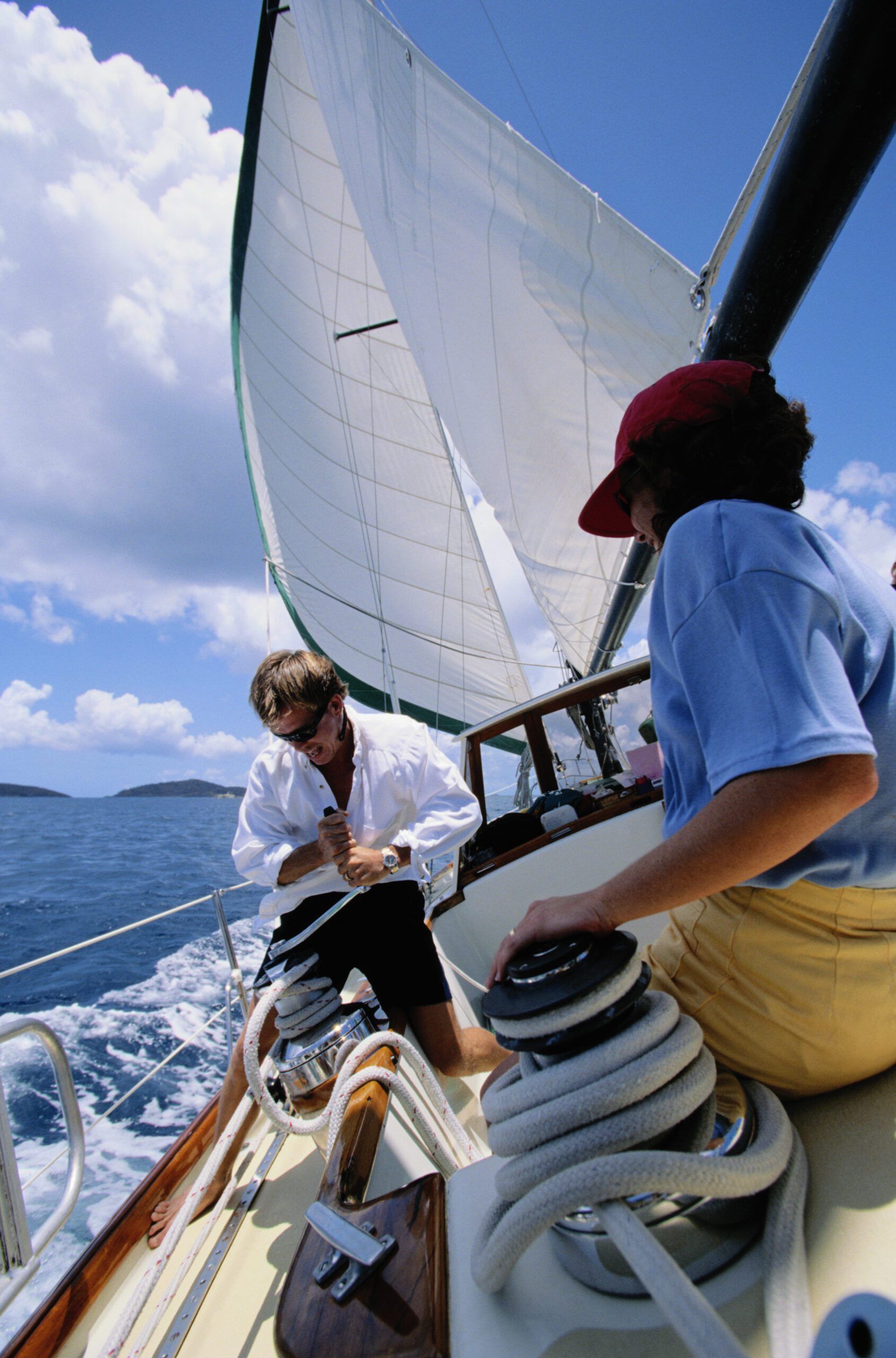
World Sailing says they are mandatory forward of the mast, but we recommend at least until the cockpit, and all around is better. The only reason not to have them aft is discomfort for rail meat, which is a racer-only reason.
Lines in Covered Galleries
This creates a clean deck and reduces tripping risk, but there is less to grab onto. Evaluate a deck in terms of what it will feel when well heeled, bucking, and wet with spray.
Leading All Halyards, Reefing Lines, and Control lines to the Cockpit
We have mixed feelings on this. On one hand it reduces trips forward, but if you think you will never have to go forward at sea you are deluding yourself. There will be more friction. And then there is the tangle of lines in the cockpit. Our PDQ catamaran had two winches at the mast, and many functions were managed from there. As a result, there were only eight lines in the cockpit. Our F-24, on the other hand, leads all controls to the cockpit, resulting in 21 tails. A huge difference in spaghetti. We know of several sailors that were washed out of the cockpit while coiling up tails.
Practice Leaving the Cockpit
Leave the cockpit frequently while sailing, preferably every day when conditions are safe and you have crew. There is no other way to be prepared for when it’s not safe. You will learn all of the handholds, the motion of the boat, and to stay comfortable moving about the deck. Pilots and climbers that don’t fly or climb frequently become rusty and unsafe. Use the opportunity to inspect gear and enjoy the view.
When You Move, Have a Plan
Locate the good holds and consider where they are in relation to your balance and the motion of the boat. Which direction will a wave throw you? This is obvious going forward, but in lumpy conditions it also applies in the cockpit and even below decks.
Watch Crew Members Move on Deck
Some move well and have situational awareness, others are stiff and fearful or careless. How do they react to a bump? Don’t ask an awkward person to go forward in fresh conditions. It’s not fair or safe. How comfortable are you on deck? The job should fit the person.
Practice Using Tethers in Both Fair and Moderate Weather
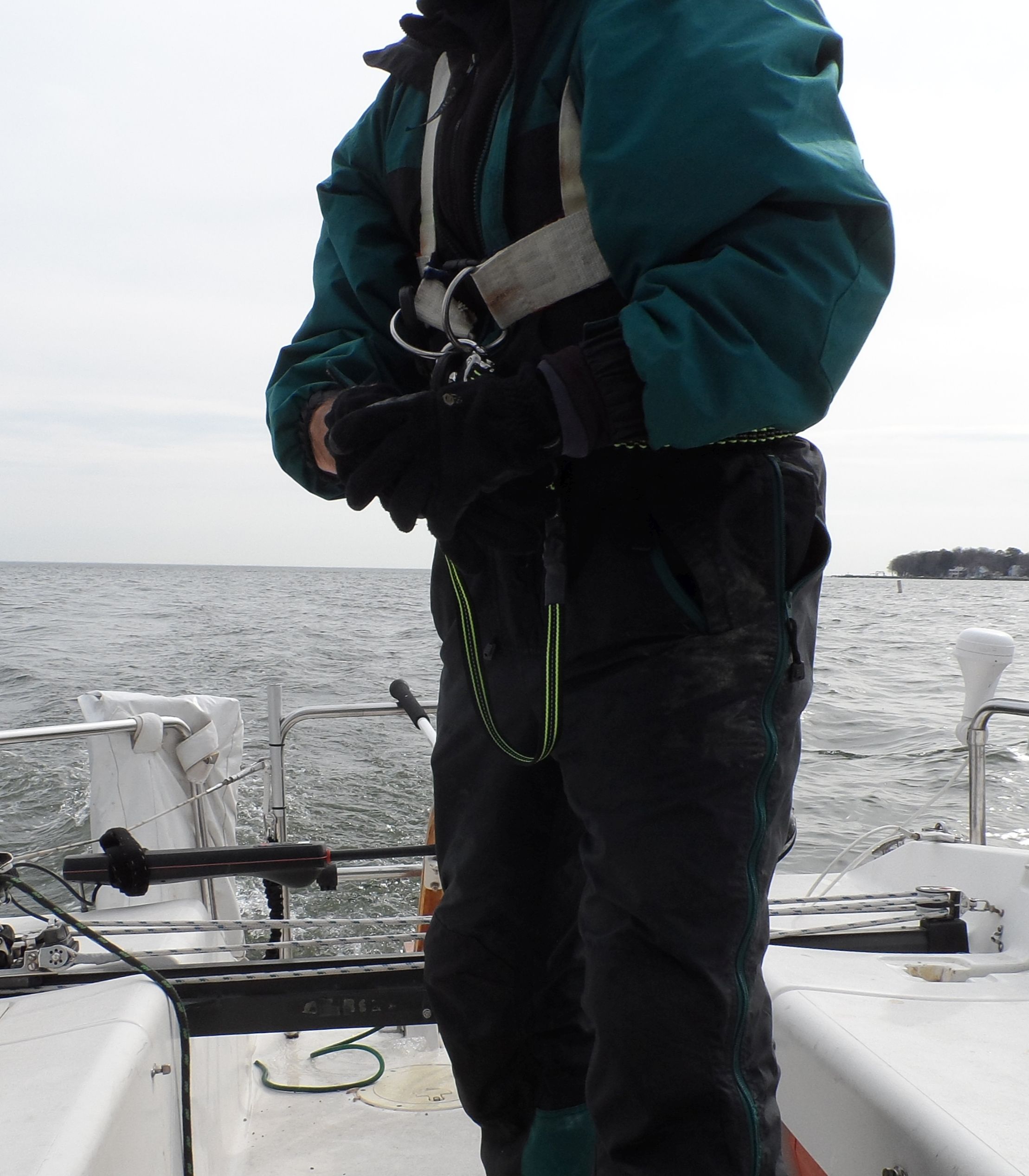
We didn’t intend for this article to be about jacklines and tethers, but if you have them, practice with them in fair and moderate weather to work out the kinks until their use is second nature. As a long time climber, the gear came naturally to me, but for most sailors it is something new with a learning curve. Reef. Change sails. If anything snags or can catch on a sheet during a tack, fix it. Learn how to navigate to every location with minimal ducking and unclipping. If the tether is in the way you are doing it wrong or it is rigged wrong. Fix it while the weather is nice and the sun is up.
Jacklines
Can you go over the rail anywhere if clipped short? Move the jackline as needed. There may be a place where a jackline cannot keep you on board. Have good holds for both hands and focus on what you are doing. Provide short clip points at all work stations, including the mast and helm. More sailors fall off when they are working at a fixed point, focused on what they are doing, than moving on deck and holding on.
Tether Comfort
Leave the tether on while you sail, even if not clipped. Does it bother you? Hint: Wrap the long tether behind your back when not in active use. Don’t clip the spare tether to your harness when not in use; that negates the quick release (or even one-clip release) function—clip it to the main clip or the other tether.
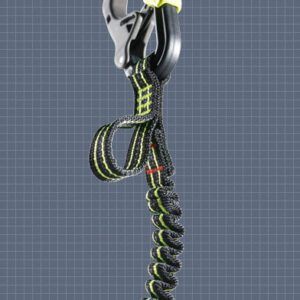
Many love folding pad eyes for clipping points. We don’t. They take two hands to clip, which is kind of useless in rough weather. They may be unavoidable in some traffic areas, but we prefer fixed padeyes and U-bolts. Climbing bolt hangers are another good option, as they can often be mounted under an existing bolt, if the bolt is large enough (3/8-inch) and well backed (it should be, if the hardware required that size bolt). Often the bolt can be upsized for this purpose by redrilling larger.
Harness Fit
It must be high and tight under arms. Loose at the bottom of the rib cage is not going to hold. Leg loops—great, but ONLY if you are really going to wear them all the time. Most of you probably won’t. Otherwise, focus on fit. But combination PFDs don’t fit that way. A perfect case of marketing versus actual function. We want an all-in–one solution, but without leg loops, sorry, false advertising. We’ve yet to find one we could not easily slip right out of. If you find yourself being recovered by the harness, keep your elbows down. It is your only hope.
Stay Low
Don’t walk when you should scoot. Crawling can work, I suppose, but it’s hard on the knees and unstable for me. I’d rather crouch low until it is time to sit and scoot. You can’t fall over the lifelines when you’re sitting! This will also reinforce why good toe rails are important. Are your foul weather gear bottoms slick when wet? Consider that when buying; it’s more important than color. Slick is also annoying in the cockpit.
Handholds
Wood gives a nice grip, but if you heave with both hands could it break or come off? ISO, ADA, and World Sailing require 250 pound breaking strength, for good reasons. Will they be used as clipping points for tethers? Then the requirement is 5,000 pounds; the tether is a lot stronger than your grip and there will be an impact load.
Polished stainless, on the other hand, is slick when wet, even just sweat. Either texture the railings or wrap them with cord, like the helm. Lifelines and low handholds work best if you pull up on them, pressing your feet down into the deck when the boat drops out from under you. It will also be easier on the stanchion bases.
Lifelines
Inspect them religiously. People do lean against them, no matter what you say, and if they fail they are POB. Dyneema can chafe and stainless corrodes. Rings and cotter pins can go missing and gate clips can be stiff and not latch properly.
High Lifelines. Some boats can benefit from higher lifelines, rigged from shrouds and arches. My PDQ had a narrow passage beside the cabin that was protected by a chest high lifeline. See “Raising the Bar on Lifelines,” July 2016.
Other Gear
Good shoes help. Not all gym shoes or sandals are equal, and some stick like glue when dry and slide as though greased when wet. Let’s skip the barefoot debate. Bare feet are fine in the cabin and perhaps even the cockpit in fair weather. Sure, sailors of old wore bare feet around the horn, but not on fiberglass decks and I’m guessing they broke a few toes. Sneakers with thin soles are good, and actual deck shoes are better.
Gloves. Wear gloves when going forward in wet or rough weather. They will give you a much stronger, safer grip on shrouds and stainless lifelines, without the pain of steel cutting into your flesh if you slip. You won’t let go when it hurts.
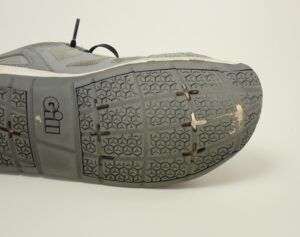
A common complaint about deck shoes is that they become slick long before they are worn out. When Practical Sailor investigated this in 2022, learning from manufacturers that this was completely expected, and their only real recommendations were to wear them off the boat on concrete walkways enough to wear off the oxidized surface rubber, and to replace them every few years. We tried rejuvenating some marginal shoes with solvents and cleaners, but in the end, the best and only real solution was to sand them down until you reached good rubber—see “Resurrecting Slippery Boat Shoes.” After a long career with Sperry Harbor Masters, we switched to Gill Race Trainers. They are lighter and less supportive, although with prescription orthotics they suited my flat feet just fine. In fact, the thinner sole improves grip and makes them considerably less vulnerable to ropes rolling underfoot; the sole conforms around the rope, maintaining contact with the deck. The sole is perforated with broad X-shaped penetrations to aid drainage (they really work), and at 3.6 years one sole developed a small tear. We injected Locktite PL S40 (much like Sika 291 or 3M 4200) through the hole, pressed them together overnight, and four months later the repair seems permanent. The mating shoe is showing no signs of tearing, so we’re thinking that perhaps we probably snagged the drainage slot on something, most likely a dock nail. The uppers are showing only very slight wear, nothing unusual for the age and similar to Harbor Masters at the same age. The real surprise is that the grip still tests at 100 percent of new on a variety of surfaces, both wet and dry. No decline in performance. They’re still comfortable, so we’re going to keep wearing them until they die. Sperry’s would be getting slick and due for a sanding at this age. It could just be the batch, but the rubber seems a little better for the use. The drainage slots and thin sole mean this will never be a durable walking shoe, suitable for hiking the hills; deckshoes are lightweight by design but suitable for the purpose. We also have a Gill Race dry backpack that has been our regular boat bag for five years, and is showing no wear or sign of stiffening. We’ve been getting long wear out of our Gill Pro sailing gloves. It seems Gill uses durable materials.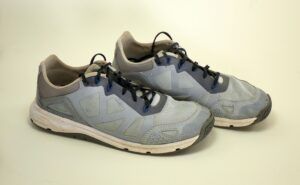
The Update
Fixing the Worn Sole
Summary
Reduce Tripping Hazards
Multihulls can run lines under the trampolines. A new boat trend is to run control lines in galleries under the deck. Of course, they require cleaning, birds can nest there (not guessing—had to open the gallery to dig the twigs out) and there is less to grab if you slide on deck. Just sayin’.
Boarding Ladders
ABYC and ISO require that every boat have a ladder than can be pulled down by a swimmer without assistance and that has at least two full steps in the water (24 inches submerged). If you do not have such a ladder, fit one. We haven’t heard an excuse that would make a difference if a serious accident could have been mitigated by having one. Falls from docks, dinghies, and just off the deck are common. Sure, there may be other people onboard, but they may not hear the swimmer in time.
Drinking
I surveyed a group of cruising sailors, and more than half of the incidents involved someone drunk as a lord. Not just tipsy but unstable. Contributing circumstances include boarding dinghies, landing on a beach, relieving themselves over the side, walking off docks, and just plain falling off. Don’t be an idiot. Any drink will dull reflexes and blur judgment, so exercise additional care with even one drink. No we don’t keep a dry boat, but we do keep our wits.
Peeing Overboard
Let’s look past the legality of discharges or the situational inappropriateness of such behavior. If you have a head, use it, and I strongly suggest sitting down unless you are the one doing the cleaning. For solo sailors that don’t want to disappear into the head for 5 minutes, or if the head is winterized, the smart answer is a bottle. Label it brightly to identify its purpose; a skull and cross bones works. Urban legend has it that this is a common cause of POBs, but in fact we could not find any documentation. But why risk it?
Non-Skid on Deck Hatches
Sure, you shouldn’t step on them, but often they are in traffic paths and around the mast. When wet they’re like ice, particularly barefoot. Translucent non-skid tape is minimally invasive, at least for those likely to be stepped on if someone loses their balance. Evaluate this with the boat heeled well over.
Foot Braces in the Cockpit
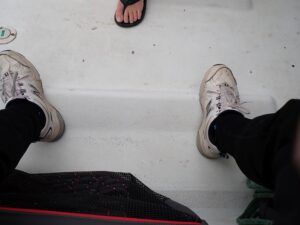
A narrow cockpit is best in many ways. A foot can brace on the lee seat edge. But they’re cramped, so what is the solution? Braces on the floor are helpful, but you will trip on them unless brightly painted and thoughtfully places. Are they high enough if the boat is heeled, not just to keep you place, but to pull on a line or the tiller? Hinge-up versions are good.
Summary
Not falling off is key. One of my greatest fears is simply tripping over my own feet and falling out of the back of the cockpit like an idiot. I’m not too worried about falling off when I’m paying attention, not in the worst of conditions with the bow playing submarine. I’ll be tethered in tight and planning every move. Sometimes I’ll lean on the tether as a third point of support while working on something with both hands. But though I have tested and written much about jacklines, tethers, and lifelines, and not once in 40 years of sailing have I ever been actually saved by one of these engineered systems. I pay attention. I move from hold to hold. Not falling off comes down to situational awareness, movement skills, and planning.







I “drive” a old 36′ ketch with solid bulwarks, fore and aft. I installed 30 lifeline stanchions and I rig my jacklines in a continuous loop from main to mizzen, and practice 100% tie off. Incidentally, many years ago, while coming in to St. Catherine’s Sound, Georgia, I was seriously pooped and, a life jacket, laying in the cockpit, floated out with the receding wave.
I was taught to believe every point beyond the rail is a 10,000-foot drop.
Curiously, as a climber, that does not have to mean fear, only constant vigilance.
Footwear! Old fashioned deck shoes are too loose on your foot and can slip off partially or completely. Sneaker style like Sperry Harbormasters or the Gills are crucial in my opinion.
Center of gravity – I always keep in mind my personal center of gravity. If I were to lose my balance, which way will I fall? So I try to keep my center of gravity towards the center line of the boat. That explanation seems to help guests on the boat…
Re. classic foot-slide-out deck shoes I agree completely. Sperry Harbormaster and Gill Race Trainers are two of my favorites. Stan Smiths (below) are also great and under mentioned by sailors. They’ve been making them for 60 years! I almost added them to the last shoe review. Well here it is: a Best Buy and Best Choice.
Re. Center of gravity, as a climber I am always thinking of hand and footholds not in terms of how they are where I am now, but in terms of holds that will improve as I make my next move. Same on the boat; I’m constantly thinking, at least subconsciously, if the boat lurches a certain way, how can I flow into my next position, like a gibbon brachiating through the trees. It’s not so much where I am now, but the holds that will safely get me where I need to be.
Great article…will take your advice!
Footwear. My favorite are Adidas Stan Smith court shoes. Snug and secure fit, and the little round dots with water ways between at two heights create great traction. Much better than traditional deck shoes.
Years ago, on the first boat that I was a professional captain, the wise owner pointed out that the boat was made of fiberglass and was pee proof. His rule was if you are on watch alone and need to pee, just pee in the cockpit. “It washes off and we have an unlimited supply of salt water.” The same is true of vomit.
For the guys, a urinal bottle marked with a scull and crossed bones is smart for when the deck is not constantly wet and you can’t leave watch for a few minutes.