To provide the best experiences, we use technologies like cookies to store and/or access device information. Consenting to these technologies will allow us to process data such as browsing behavior or unique IDs on this site. Not consenting or withdrawing consent, may adversely affect certain features and functions.
The technical storage or access is strictly necessary for the legitimate purpose of enabling the use of a specific service explicitly requested by the subscriber or user, or for the sole purpose of carrying out the transmission of a communication over an electronic communications network.
The technical storage or access is necessary for the legitimate purpose of storing preferences that are not requested by the subscriber or user.
The technical storage or access that is used exclusively for statistical purposes.
The technical storage or access that is used exclusively for anonymous statistical purposes. Without a subpoena, voluntary compliance on the part of your Internet Service Provider, or additional records from a third party, information stored or retrieved for this purpose alone cannot usually be used to identify you.
The technical storage or access is required to create user profiles to send advertising, or to track the user on a website or across several websites for similar marketing purposes.












Doug, Thank you for this comprehensive article.
Big project very well done and well described!
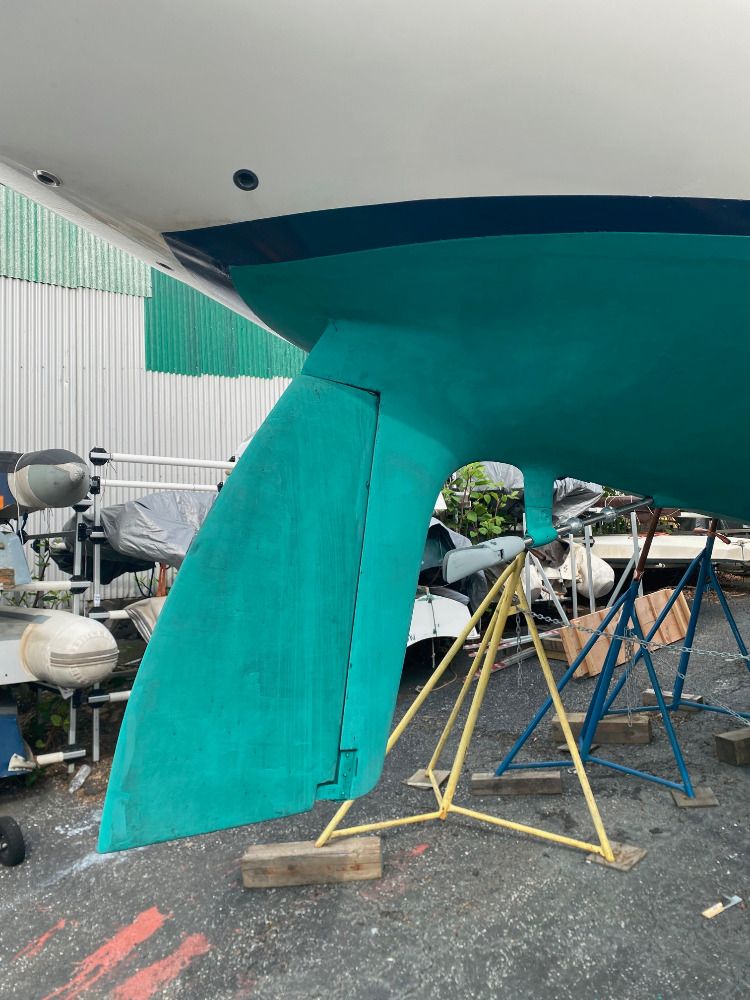
I am at the tail end (I hope) of my rudder rehab on my 1969 Pearson P35. Initial goal to replace the decades old stuffing box and the exhaust hose and single hose clamps with a real Buck Algonquin assembly… I found the bronze stuffing box merged with the bronze shaft (rotating inside the hose). Even MAPP gas heating and very large pipe wrench, with the emergency tiller tied off to hold the shaft steady, only yielded 15 degrees rotation, so had to very carefully cut it off (avoid damaging the shaft).
When I dropped the rudder, I found the Delrin top bearing at the cockpit floor level, no mid-shaft bushing, and the socket bearing in the bottom shoe. – the rudder shaft floated in the stub-tube and the wear marks on the shaft showed it wearing on the rear/starboard side. I’ve added a bronze bearing with a slightly press-fit UHMWPE sheeve bushing as a mid-bearing. The trick has been to get that mid bushing lined up so the shaft is concentric top to bottom.
Your article very closely describes my adventure, including a LOT of fairing because the rudder was not symmetrical around the shaft. Luckily, no rot in the trailing edge of the full keel nor in the rudder. – other than that, and resculpting the aperture to accommodate a three-blade feathering Variprop , I could almost plug my photos and drawings into your article and repost.
Fair winds and flat water!
David Lidrbauch
s/v Terrapin
Thanks so much for sharing your experience and your validation of these lessons learned. I tried to make my advice applicable to most any boat, so it was nice to read your “could almost plug my photos and drawings into your article and repost” comment. I, too, replaced my shaft seal (a.k.a. stuffing box) while I was at it. That’s why you see fresh barrier coating around the shaft as well as the skeg in one photo. I wanted to make sure any leaks that might have shown up could only be due to the seal. Fortunately everything worked.
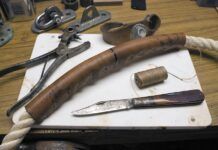
From the photos, your original bushings appear to have been made from Micarta, a material made up from thermoplastic resin impregnated cloth. It is reddish, and was in common use when your boat would have been built. It is good stuff and still available.
Yes, it does seem fiberous, which would fit the “impregnated cloth” description. Thanks for sharing!