

Stopping Deck Hatch Leaks
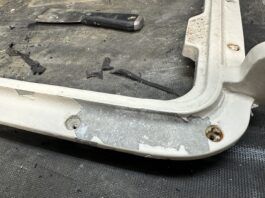
When I searched the internet for advice on repairing a small leak between the lens and sealant on a 20-year-old Lewmar Ocean 60 hatch, on my 1996 Valiant 42, I was dismayed by the dearth of information. Even the Lewmar site does not provide a schematic of the hatch or a service manual. You can purchase a new gasket but that is not what is leaking. There is no mention of the sealant. Hatchmasters quoted a repair cost 1/2 the price of a new replacement with a greater than four-week turnaround. I would still have to remove and replace the hatch. I will wing it, but thinking that if it came to that, I would definitely not want to replace it with a hatch I could not readily service myself. In my subsequent search I found a reference to a PS July 1, 1994 comparison of Offshore Deck Hatches. I was then dismayed to find that the PS archives stop at year 2000. Fortunately, after some rummaging I found the print version. It was still relevant and useful. In fact as far as I can tell, it is the most recent hatch comparison out there.
The DIY Sail Repair Kit
If youre going to sail youll be doing some stitching. No two ways about it. Dont jump into the $100 do-everything kit. Start with a modest kit, adding tools and materials only as your skills grow and projects require them. You already have most of what you need in your other supply lockers or tool boxes. Study a good book on sail and canvas repair, concoct a few small projects for practice.
Removing 3M 5200
Our recent test of caulk removers, (PS Tests Caulk Removers, Practical Sailor, January 2017), focused primarily on silicone caulk remover because these caulks can leave a residue that makes it impossible for anything to bond. After that test, we got a call from reps at Debond who explained that their product, although effective with silicone, is formulated to break the bond between to break the bond between 3M 5200 and a smooth gel coat surface. This is a common challenge for sailors who must disassemble through-hulls, remove chainplates, or repair structural components. So we went back to the lab to find the best antidote to 5200, and we present the results of our tests here.
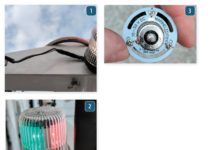
Converting an Anchor Light to an LED Tricolor Light
The cost of masthead tricolor navigation lights, a safety improvement many sailors add to their boats, involves expense beyond the fixture itself such as a switch on the DC panel, additional wire to snake from the panel to the masthead, through-deck fitting, and labor.

2017 Top Sailing Gear
Each year, just prior to the fall boat show season, Practical Sailor editors consult with our testers to come up with a select list of Gear of the Year from the previous 12 months of testing. For most of the 2016-2017 testing season we focused on essential everyday products that owners of boats of all sizes-with a few exceptions-rely on. While our testers appreciate new technology, they recognize that a safe passage often depends on the reliability of the weakest link, and that weakest link is often a seemingly minor component that gets little attention. In short, our Editors Choice list is not the sexiest product roundup, but if youre serious about keeping your electrical connections corrosion free, making professional repairs on a blue-collar budget, maintaining a safe speed in a steep following sea, or looking for a way to manage a big genoa without upgrading to an electric winch, youll appreciate it.

Fixing Tears in Sunbrella Boat Canvas
Sooner or later, chafe, UV rays, and sharp edges take their toll on our canvas. A misplaced screw or simple friction will eat holes in a dodger. A seam gives up, a boom rubs through the fabric, and a few snaps come loose.
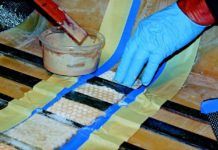
Esoteric Fibers Call for Epoxy
Theres little debate over the adhesive quality and toughness of epoxy resin-just look at where its being used. We hear about its presence in crucial structures such as aircraft wings, race car bodies and high-end custom racing yachts. But it takes a little familiarity with engineering lingo to help us understand why epoxy trumps its ester relatives.
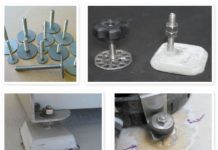
Glue-on Fasteners
Although through-bolts may be the gold standard for strength and security, sometimes drilling a hole isn't practical, or exposes foam or balsa core to water intrusion. Mounting a sump-pump to the side of the hull, attaching electrical components when the other side is either inaccessible or exposed, mounting an air conditioner on the bridge deck of a catamaran, or adding solar panels to a hard top are just a few examples of situations where a surface mounting is needed.
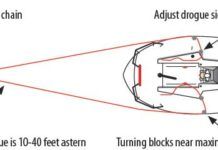
Ideal Drogue setup will require experiments
For maximum maneuverability, the control lines-one port, one starboard-should attach at the widest part of the boat. This maximizes leverage and places the effort close to the center pivot point. On a catamaran, closer to the transom works because of the wide beam, but for monohulls, attaching near the pivot point at the keel will be more responsive. For maximum responsiveness, the drogue should be as close to the transom as practical-this results in more responsive steering and minimal drag. We found the best compromise to be around 65-80 percent of the way aft, where there is still enough beam, but less risk of the control lines fouling.
What’s the Best Anode Material?
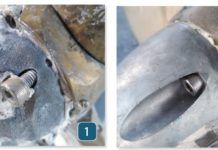
Every fall, as the hauled-out boats are sardined into boatyards, a walking tour reveals the casualties from the underwater war. Saildrives are deeply pitted and shedding paint. Bottom paint is burned near seacocks. Folding props no longer fold. Most often, these losses are blamed on the zinc anodes-or lack of them.

Morgan 382 – The $30K Boat Nobody Talks About
The Morgan 382 might be one of the most overlooked cruising sailboats ever built. Designed by legendary naval architect Ted Brewer and produced between...


Latest Sailboat Review
Caliber 33 Used Boat Review
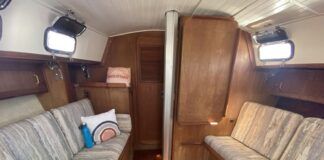
The Caliber is a peculiar blend of tradition and innovation, of security and performance, of practicality and pizzazz. All of the owners we heard from were "satisfied." One called the 33 his favorite boat over six decades of sailing.