



Download the Full October 2018 Issue PDF
- Gear of the Year
- Non-destructive testing
- Testing Welds
- Fall Prevention
- Get Me Home Tool Kit
- Wrap That Handhold

Weather & Navigation Seminars Set for October 2018
On October 9-10, hell be conducting a 2-day introduction to celestial navigation. The course covers introduction to the basic skills required for celestial navigation. Topics include introduction to taking a sun sights with a sextant, reading time and arc, using sight reduction tables (Publication 229), reducing sights by calculator, and identifying celestial bodies.
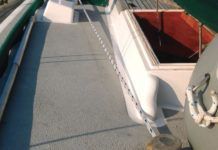
Non-Skid Paints and Adhesive-backed Mats
Over the years, Practical Sailor has conducted dozens of test comparing painted-on non-skid exterior coatings. Weve also compared the heavy-duty textured mats, including faux teak and cork, that are applied with adhesive. Three long-term tests of these coatings and mat products are still ongoing.
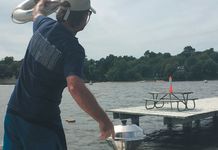
Ropes for Throwing
We all know the drill. A new arrival pulls toward an unfamiliar marina or fuel dock with a breeze blowing, and they can't quite get in. An inexperienced crew is rapidly dispatched to the bow and instructed to throw a line to a helper on the dock. They grab a coil of line, heave it . . . and it lands in a tangle in the water, scarcely halfway to the dock. Confusion erupts and the boat kisses a piling or nearby boat. If and when the line is successfully thrown, its a wet tangled mess aimed at your head.

Perfecting the Toss Requires Some Practice
Passing a line to a helper on shore is as basic a part of seamanship as tying a bowline. Youve probably seen an old salt seaman cast a line 40 feet as casually as passing the pepper, but more often youve seen the line launched with a huge arm swing, only to tangle and fall short of the mark. A few simple tips, all assuming you are right handed and you are throwing -inch line.
Horseshoe and Ring Buoy Mounts for PFDs
The December, 1993, issue contained an in-the-water test and evaluation of 16 different Type IV life preservers (cushions, horseshoes and ring buoys). Besides their throwability, flotation and the ease with which a person in the water can get to and utilize them, an important consideration was said to be how quickly these Coast Guard-required "throwables" can be detached from the boat and made available to the man overboard. …
In Search of Stability
Good stability for a racing sailor may be the ability to carry a #1genoa upwind in 20 knots of breeze. Stability for the cruising sailor involves a different and more serious set of questions. What happens when a boat is knocked down so far that it doesn't come back up? What if it comes back up, but is full of water and is at risk of sinking? From what degree of capsize should a boat be able to right itself?
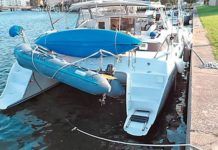
Fenders and Lines for Seawalls
To the lubber, tying-up to a bulkhead seems like the simplest of all docking situations. Perhaps with floating docks this is true. You just throw in a few fenders and tie a few lines. Simple. But in the world of tidal bulkheads with pilings or rough concrete facings, it is often a hammer and anvil situation, with the wind and waves hammer incessantly as the anvil moves up and down with the tide, causing fenders to slip out of position.
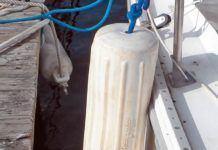
Dodging a Bullet When Caught on Bulkhead
The following is aimed primarily at boats that are unable to leave an alongside dock or bulkhead before wind and seas become dangerous. Any fetch beyond 200 yards is dangerous, and there may be nothing you can do to protect the boat. However, if you are in a protected marina, well up a creek, and the storm is moderate, these actions can help. Just remember that low breakwaters will be overtopped, wooden breakwaters fall apart, other boats will come loose, and there will be lumber in the water from broken docks.
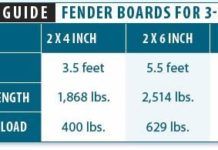
Make Your Own Rugged Fender Boards
We described a simple home-built version several years ago (Practical Sailor, December 2011); here we present a few simple upgrades on the same basic design, allowing for simpler deployment, better fender retention, and more stable positioning. Pressure treated lumber provides inexpensive durability.

Video: Beneteau 361 – Full Review
Should you buy an older Beneteau sailboat? In this Practical Sailor boat review and yacht tour, we examine the Beneteau Oceanis 361 to see...



Latest Sailboat Reviews
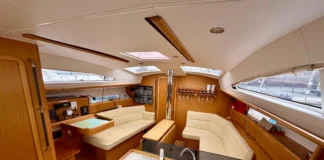
Jeanneau Sun Odyssey 42 DS Used Boat Review
This boat is dangerous for one simple reason—it looks like the answer. It’s big enough, pretty enough, modern enough, and suddenly, somehow, almost affordable...