



Disposing of Expired Flares
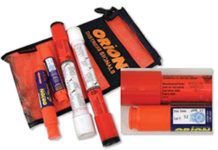
It’s a good idea to keep expired flares on hand to use as backups (on board or in a vehicle), but be sure to store them in a clearly labeled container separate from your current flares. If you find yourself with an overstock of old—or unwanted—hand flares, however, you must dispose of them properly. Unfortunately there’s no set agency that deals with expired flare disposal or recycling. Because state and federal laws pertaining to flare disposal and transportation vary, there’s no single disposal policy.

Lessons from the Mackinac
On Oct. 31, U.S. Sailing released independent reports on three highly publicized sailing accidents that happened this year. Practical Sailor has been closely following the WingNuts capsize, in which the captain, Mark Morley, and Suzanne Bickel died of head injuries and drowning, while still tethered to the boat, and six crew were saved by fellow racers. Practical Sailor Technical Editor Ralph Naranjo served on the U.S. Sailing panel; his focus was on the weather and the boat design features that led to the accident.
Tropical Storm Do’s and Don’ts
As Hurricane Irene headed for the Eastern seaboard in August 2011, Practical Sailor Technical Editor Ralph Naranjo set his storm-preparedness plan into action. He secured his Ericson 41 in an estuary just off Chesapeake Bay and hunkered down to ride out the approaching hurricane aboard his sloop. This first-hand account offers a close look at what worked for him—ground tackle, chafe gear, the locale selected, tactics during the storm—and what didn't.
Hope for Best, Plan for Worst
When tropical weather threatens, being prepared for the wind, waves, surge, and flooding pays off. How you prepare for a storm depends on where your boat is in relation to the storm and whether you choose to keep it at a dock, on a mooring, or anchored in sheltered waters or a hurricane hole. Irene may have lacked super-storm status, but her sizable diameter and the angle with which she approached the Northeast coastline caused considerable impact from Beaufort, N.C., to Bangor, Maine. Sailors hiding from the storm faced a range of impacts. The most common was tropical-force winds with gusts to about 60 knots.
Tropical Storm Do’s and Don’ts
As Hurricane Irene headed for the Eastern seaboard in August 2011, Practical Sailor Technical Editor Ralph Naranjo set his storm-preparedness plan into action. He secured his Ericson 41 in an estuary just off Chesapeake Bay and hunkered down to ride out the approaching hurricane aboard his sloop. This first-hand account offers a close look at what worked for him—ground tackle, chafe gear, the locale selected, tactics during the storm—and what didn't.

The Cruise of Mascot
Ninety-nine years ago last month, Henry M. Plummer, his adult son, Henry Jr., and a cat named Scotty set out from Massachusetts, bound for South Florida in a 24-foot catboat. Mascots waterline was 23 feet; the beam was 10 feet; and draft was 3 feet, 6 inches. The Marshall 22 reviewed in this months issue offers a pretty good example of Mascots traits. Mascot was engineless. In calms, father and son pushed it with a 15-foot dory equipped with a 3-horsepower engine. Accommodations were rough. They shot or caught most of their meat.
Dinghy Launchers: Wheels for the Dinghy
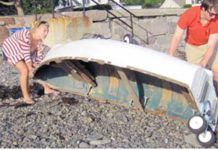
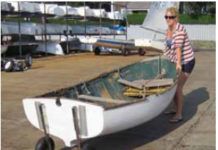
Getting your dinghy to the dock, across a beach, or down a boat ramp can be a real back-breaker, unless you have some mechanical advantage. Several manufacturers offer wheeled devices to keep you out of the chiropractor’s office. We tested seven of them—one dolly and six sets of launching wheels: Davis Instruments’ Wheel-a-Weigh Boat Dolly, two sizes of Davis' Wheel-a-Weigh launch wheels, the Garelick Eez-In, Newport Vessels Launching Wheels, Defender Industries Launching Wheels, and Danard Marine Launching Wheels. Selecting the appropriate launching wheels depends on the size and weight of your dinghy or small boat and where you intend to use it. Practical Sailor tested the products on concrete, a soft-sand beach, and a rocky shore, and we found that not all wheels can handle uneven terrain.
Dinghy Roller Test Drive
We tested each product for overall quality of construction, ease of installation, and ease of use. Each model was tested on three different surfaces that are common dinghy-transporting areas: an inclined, concrete boat launch ramp with cracks in the pavement wide enough to push some dinghy dollies off course; a sandy beach, where the sand ranged from nearly flat and hard at water’s edge to more than 4 inches deep and soft above the high-tide mark; and a rocky shoreline, with some irregular stones that measured up to a foot in diameter. Each set of dinghy wheels was attached to the transom of a 9-foot, 130-pound rowing skiff. To avoid drilling a bunch of holes in our own $1,200 dinghy, we picked up a haggard—but appropriately sized—$75 garage-sale skiff for these tests.

The No Discharge Zone Illusion
Long Island Sound, the belt of water stretching 110 miles from Hell Gate in New York City to the Race at the Sounds eastern end, is a fitting emblem of the water-quality woes future generations will face. Today, as Tom Andersen, author of This Fine Piece of Water: An Environmental History of Long Island Sound, describes, the Sound is at the brink of an ecological crisis, a term so frequently applied today that weve become numb to it.

PS’s Safety Tether Test Results Reignite Concerns
The safety tether is the sailor’s leash—a short stretch of webbing or rope that keeps a sailor from going overboard. Its purpose is complicated by the fact that it must be capable of two opposing functions: It must offer a secure means of attachment to the boat, and, when the need arises, provide a quick means of release. The recent Chicago-Mackinac Race tragedy and similar accidents, recent product recalls, and findings in Practical Sailor’s latest round of tether testing also bolster the argument that sailors—and manufacturers—need to pay more attention to the safety tethers on the market today. For this test, we evaluated three different West Marine tethers and found that despite improved engineering, they still fall short of perfection.

Morgan 382 – The $30K Boat Nobody Talks About
The Morgan 382 might be one of the most overlooked cruising sailboats ever built. Designed by legendary naval architect Ted Brewer and produced between...



Latest Sailboat Review

Jeanneau 55 Boat Review
This recent sailboat from Jeanneau may as well be a spaceship. They’ve taken all the time-honored designs of a monohull aft cockpit and turned...