

Summer Sailing Gear
Summers warm breezes and lazy weekends have arrived, so PS testers have put together a lineup of cool toys and tools for the dog days. Tower Adventurer Inflatable Standup Paddleboard: Inflatable SUPs are sprouting up everywhere on the Internet; many boards are identical, made by different brands at the same factories in China. Quality varies. Generally, boards 6 inches or thicker offer better stiffness and stability, making them easier to ride.

Mailport: June 2013
How thick is too thick for the buildup of old layers of bottom paint? This question arises because I have just finished painting the bottom of my boat. Even though I diligently sought out potential flaking spots with my knife, while rolling on the paint (Pettit Ultima Eco), I would frequently get a mess caused by the paint flaking off. I have only owned this boat for three years, so I really do not know how many layers there are.
Anchor Tests: Bending More Shanks
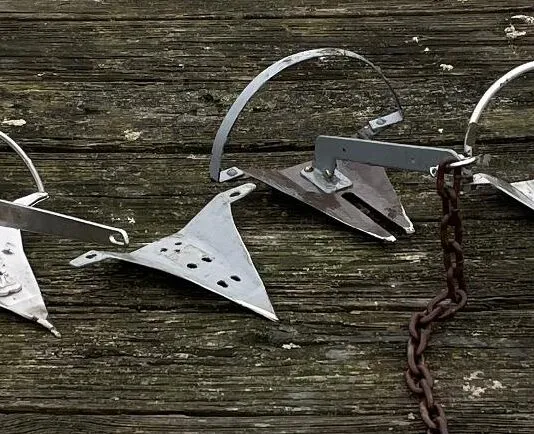
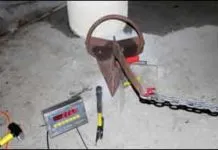
In the first part of this series on anchor-shank strength, we examined how the shanks of anchors that supposedly met the most stringent industry standards could bend under loads that a typical cruising sailboat could encounter. With this installment, we wanted to demonstrate how that might happen in a fact-finding field test. Based on our previous findings, we concentrated our study on a specific group of anchors and specific type of load. The anchors are regarded as super high holding power (SHHP) anchors, and the load was a sudden, snatch (or dynamic) load applied at a 90-degree angle to the direction each anchor was set.
Bends and Breaks: Anchor Shank Strength
As more and more anchor-makers source their materials and move their fabricating offshore, Practical Sailor has been fielding an increasing number of questions about anchor quality. Is the tensile-strength steel used to fabricate anchors consistent with the application? Is anyone actually measuring shank strength? And how much does it matter? At the heart of this discussion is shank strength. There seems little point in having a high holding-capacity anchor, if the shank isn't strong enough to cope with projected loads.

A Second Look at Anchor Tests
Anchor testing at Practical Sailor has always been a controversial enterprise, sure to fire up someone. As one reader commented in response our most recent anchor report (PS, March 2013): Anchors are a whole lot like religion. No matter what the tests show, each of us has a favorite that well defend to the death! This month, our report on anchor-shank strength approaches the topic from a different angle. Rather than singling out specific anchors for holding power or design, we take a closer look at the way anchors are evaluated and promoted.
The Hassles of Hockles
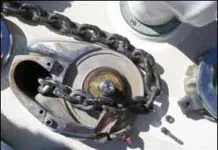
Taking the advice of a PS review, I installed a Lewmar V2 windlass on my boat in 2008. I went with the installers recommendation of 100 feet of galvanized chain and 100 feet of eight-part braid, connected with a rope-to-chain splice, and I have a Delta 35 anchor. I found that a chain hockle (a twist in the chain that jams the windlass) will terribly mangle the vertical windlass. I have just completed my second mangling and ordered replacement parts-but these parts will not save me from the next mangling. The Lewmar distributor told me to install a chain swivel, but PS has warned about this (PS Advisor, May 2010). Is an all-chain rode a dumb idea? Is there some solution?
Anchor Resetting Tests
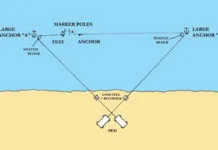
Practical Sailor has carried out dozens of anchor tests over the years. This month, we set out to compare anchor performance when the boat position changes under the forces of wind or tide, a shift that often causes the anchor to move and reset itself. The test compares 12 anchors, including some newer fixed-shank anchors-such as the Rocna and the Manson Supreme-and some concave fluke designs similar to the Spade, one of the strongest performers past tests. The test field included: the CQR, Spade, Ultra, Super SARCA and SARCA Excel, Manson Supreme, Rocna, Kobra, and the Lewmar Claw.

Attack of the Zebra Mussel
For 20-plus years, I have removed my mooring buoy from the water at the end of the sailing season on Lake Champlain. This year, however, I was surprised to find that my mooring chain was totally covered by zebra mussels. The 3/8-inch chain was about 3 inches thick with mussels when I hauled it up! Do the zebra mussels affect the chain strength or its life expectancy?

Life Rafts, Pride, and Prejudice
My cruising life often seems like a string of disasters narrowly averted-storms, reefs, mechanical failures, bad enchiladas-but the most frightening near miss (apropos of this months special report on life-raft inspections) was the one I never knew about.
The Custom Winter Cover
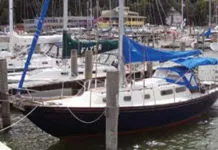
We now have a boat-an Allied Seabreeze 35 sloop, hull number 23, from 1965-and overall, its a well-kept and sea-kindly boat. Winter is coming, and a winter cover seems in order. The conduit-frame-and-tarp that you published (www.practical-sailor.com/marine/do_it_yourself_winter_frame-10593-1.html) is an option, but a fitted canvas (Sunbrella or better) cover is another, which will perhaps pay for itself in about three seasons. What is your view on this?
Latest Logbook

Practical Sailor Logbook – September 2026
In September we tour the Hans Christian 48T — the offshore cruiser many sailors call the holy grail — walk the custom Antigua 60...

Video: The BEST Sailboat You Can Buy for $35,000 – Catalina...
If you’re searching for a mid-30-foot sailboat, affordable cruising sailboat, liveaboard sailboat, first sailboat, or a capable used sailboat for coastal cruising, the Catalina...


Latest Sailboat Reviews
Learning by Doing on a $5,000 Catalina 30 Mk II
When Davis’s mother started talking about wanting to do something “big” for retirement, Davis and Gloria half-jokingly threw out an idea that seemed suitably...