

Inflatable Boat Fenders Test
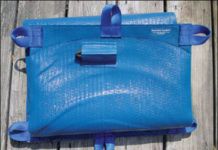
When youre tight on storage space but still want to be prepared to protect your hull when docked in a blow, consider inflatable fenders. They often offer the same protection as conventional fenders without the storage headaches. Practical Sailor inflatable boat bumpers from three manufacturers: StowAway Boat Fenders from DACA Innovations; Aere fenders from Pratek; and Easystow Fenders from Seoladair. All were subject to abrasion tests and compression test. Long-term testing is under way to determine resistance to UV, chemical, and biological deterioration. Stay tuned to see which of these docking aids is the toughest inflatable fender.
Gear for Battening Down Ahead of Storms
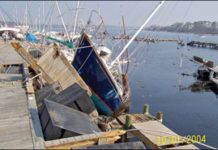
Practical Sailor offers an overview of products designed to help secure a boat for a major storm or hurricane. Well ahead of storm season, each boat owner should devise a hurricane preparation plan and should inspect the marina, dock, mooring, or hurricane hole where he intends to ride out the storm. One of the most important aspects of storm readiness is being sure you have the right gear and ground tackle to handle the loads of high winds and rising seas. In this overview, Practical Sailor takes a look at line choice and chafe gear for storm mooring. More line is obviously better, but more of what type and size? Editors discuss Fiorentinos RodeRap and LineRap, Davis Secure Chafe Guard, and the Chafe Guard from Taylor Made. We also consider docking aids including snubbers such as Shockles, Bungy Shock, and Synergy Marines braided poly dock lines; shock absorbers; and tidal-surge protectors including Tideminders, TideSlide, and the Slide-Moor.
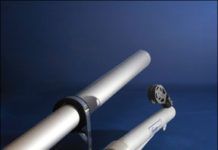
Extending the Bow: Are Add-on Sprit Kits Worth It?
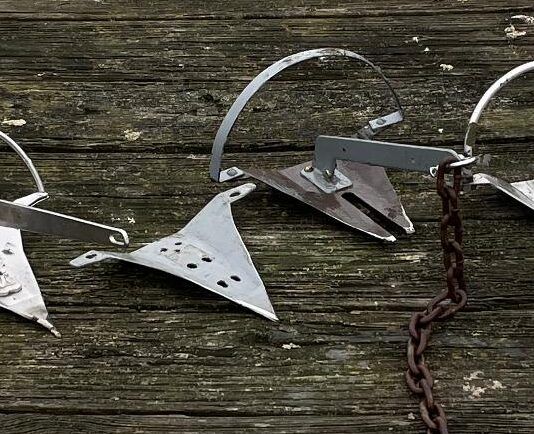
Easy-to-handle, lightweight sails continue to gain in popularity with performance-oriented cruisers. Setting a large, light-air sail a couple of feet ahead of the boats stem improves performance and sail-handling characteristics but presents challenges and risks. Practical Sailor reviews four aftermarket bowsprit kits and examines whether adding a spar to the front of your boat is safe, effective, and worth the added cost and effort. Aftermarket sprit kits by Forespar (Banana Sprit), Forte, Selden and Sparcraft are reviewed.
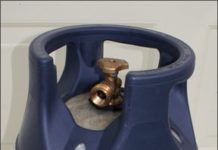
Composite Gas Tank
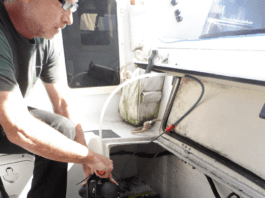
Having had our propane supply run bone-dry at the worst possible time, we were drawn to the translucent composite liquid propane gas (LPG) tanks, which recently gained the approval of the U.S. Department of Transportation (DOT). The new tanks do not corrode and allow the user to see remaining fuel. We found two types: Ragasco one-piece blow-molded tanks made in Norway, and two-piece molded tanks (with a seam joining the top and bottom) made by Lite Cylinder Co. in Franklin, Tenn. We obtained a 9-kilogram Ragasco tank from distributor Trident Marine (www.tridentmarine.com) for testing and noted that its dimensions (12.5 inches in diameter by 18 inches high) differed slightly from that of its 20-pound aluminum or steel equivalent. The tank may not fit in some propane lockers. The dimensions for the composite tank are actually smaller, but it is broader at the top and bottom.

Singlehanded Sailors Notebook
First contested in 1978, the Singlehanded TransPac (SHTP) offshore race crosses 2,120 miles of Pacific Ocean from San Francisco Bay to Hanalei Bay, Kauai. Though the singlehanded race has been dubbed a bug light for weirdos, world-class navigators and sailors often throw their lot in with the pack. Longtime singlehanded racer and cruiser Skip Allan took time out from his TransPac preparations to outline the equipment he keeps onboard Wildflower, his 27.5-foot Thomas Wylie-designed sloop/cutter. From his Sail-O-Mat windvane to boom vangs to tiller pilots, Allan discusses a range of gear helpful to all singlehanded sailors and small boat sailors. He outlines his sail inventory and storm tactics, along with his approach to provisioning and eating at sea. A second installment of the Singlehanded Sailors Notebook will take a look at onboard electronics and safety gear for the solo sailor.
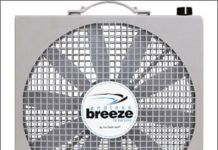
Windy Ways: Practical Sailor Whips Up 12-Volt Cabin Fan Test
Getting air flow inside a sailboats cabin can be critical to everyones comfort onboard. Practical Sailor tested 11 different 12-volt fans from seven Caframo, Fan-Tastic Vent, Hella, HotWire, MarinePro, SeaBowld, and West Marine. We measured current draw and wind and noise output, and considered price. All of those we tested run on 12-volt DC power and are sized to accommodate the small spaces of a sailboats cabin. Your choice of fan will be determined by your intended use, the space you have available, and your budget. Although its pricey, Caframos Kona was among our Recommended picks. Also recommend were the Hella Turbo, the Port Fan from HotWire, the Fan-Tastic Vent Endless Breeze, and the Caframo Sirocco. The Sea Bowld oscillating fan is rated the Practical Sailor Budget Buy. The top performers in this test will move on to Round 2, where we will test their durability.
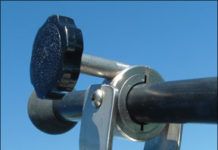
A New Tiller Tool
After some experimenting with design and materials, the Steer-iT was born. The Steer-iT looks like a tillerpilot without the motor. In fact, it connects to the boat (stainless steel pin slipping into bronze socket) and tiller (socket snapping onto a male pin on tiller) using the same size fittings as standard tillerpilots. The key element is the tensioner, a steel donut with an adjustment knob threaded across a slit at the top. The donut pivots vertically on a yoke, and since the yoke also rotates horizontally in its female socket, it functions as a universal joint. The steering arm is a slippery, UV-resistant acetal plastic rod that slides through the yoke. One of three holes can be used to fit the rod over the male pin on the tiller. A twist of the knob on the tensioner adjusts the amount of friction that keeps the tiller in place. We found it easy to dial in enough friction so that the skipper can still make minor course corrections without loosening the knob.
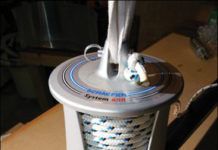
New Twist on Furlers: New Generation of Roller-Furling Systems For Light-Air-Sails Skip the Fixed...
Roller furling has pushed headsail piston-hanking headsails to the brink of extinction. But it also results in a significant loss in light-air efficiency. Meanwhile, genoas, drifters and reachers have become orphans without a stay on which to hank. A new generation of light-air roller-furling sails aims to resolve these issues. They require no fixed stay and, on a properly equipped boat, they can be set, furled, doused, and dropped with relative ease. Practical Sailor reviews seven roller-furling systems for light-air sails, including models from Bamar, CDI, Colligo, Facnor, Harken, Karver and Schaefer.
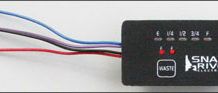
Marine Holding-Tank Sensors: How do you Know When the Black Water Level is at...
Knowing how full your holding tank is can mean more than simple peace-of-mind. Whether setting out for a Sunday sail or taking off for a week-long cruise, no one wants to discover an empty water tank or full black water tank, after you¹ve already cast off the dock lines. Practical Sailor tested five external tank sensors with displays: Raritan Tank Monitor, Scad Solo Profile Tank Monitor, SensaTank Marine 100, Snake River Acu-Gage Smart Mini, and Snake River Acu-Gage Three-Tank. We compared the accuracy of all five gauges, along with ease of installation, display dimensions, tech support, and price.
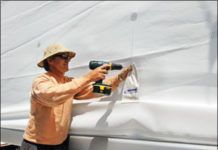
Taming the Main: Sail-Handling Systems for Bigger Mainsails
More often than not, boat buyers these days are looking for bigger boats with mainsails to match—and the larger the mainsail, the bigger the chore of flaking it. That’s where sail-flaking aids like lazy jacks, cover/lazy jack combos, and the innovative Dutchman systems come into play in the battle to tame the main. Practical Sailor’s close comparison of these options provides valuable insight into what is the best sail-flaking device for you and your boat. Find out what you need to take the gymnastics out of mainsail- handling. Mainsails up to about 250 to 300 square feet are easy enough to handle that flaking aids are optional rather than essential. However, if you have a boat with a 300- to 500-square-foot mainsail, take a look at what PS testers have to say about the Dutchman, lazy jacks (E-Z Jax, Harken jacks, etc.) and StackPack-type of systems (Mack Sails, Schaefer, and Doyle Sails, etc.).
Latest Logbook

Practical Sailor Logbook – September 2026
In September we tour the Hans Christian 48T — the offshore cruiser many sailors call the holy grail — walk the custom Antigua 60...

Video: The BEST Sailboat You Can Buy for $35,000 – Catalina...
If you’re searching for a mid-30-foot sailboat, affordable cruising sailboat, liveaboard sailboat, first sailboat, or a capable used sailboat for coastal cruising, the Catalina...



Latest Sailboat Reviews

Learning by Doing on a $5,000 Catalina 30 Mk II
When Davis’s mother started talking about wanting to do something “big” for retirement, Davis and Gloria half-jokingly threw out an idea that seemed suitably...